2026 Green Power Leadership Award Winners
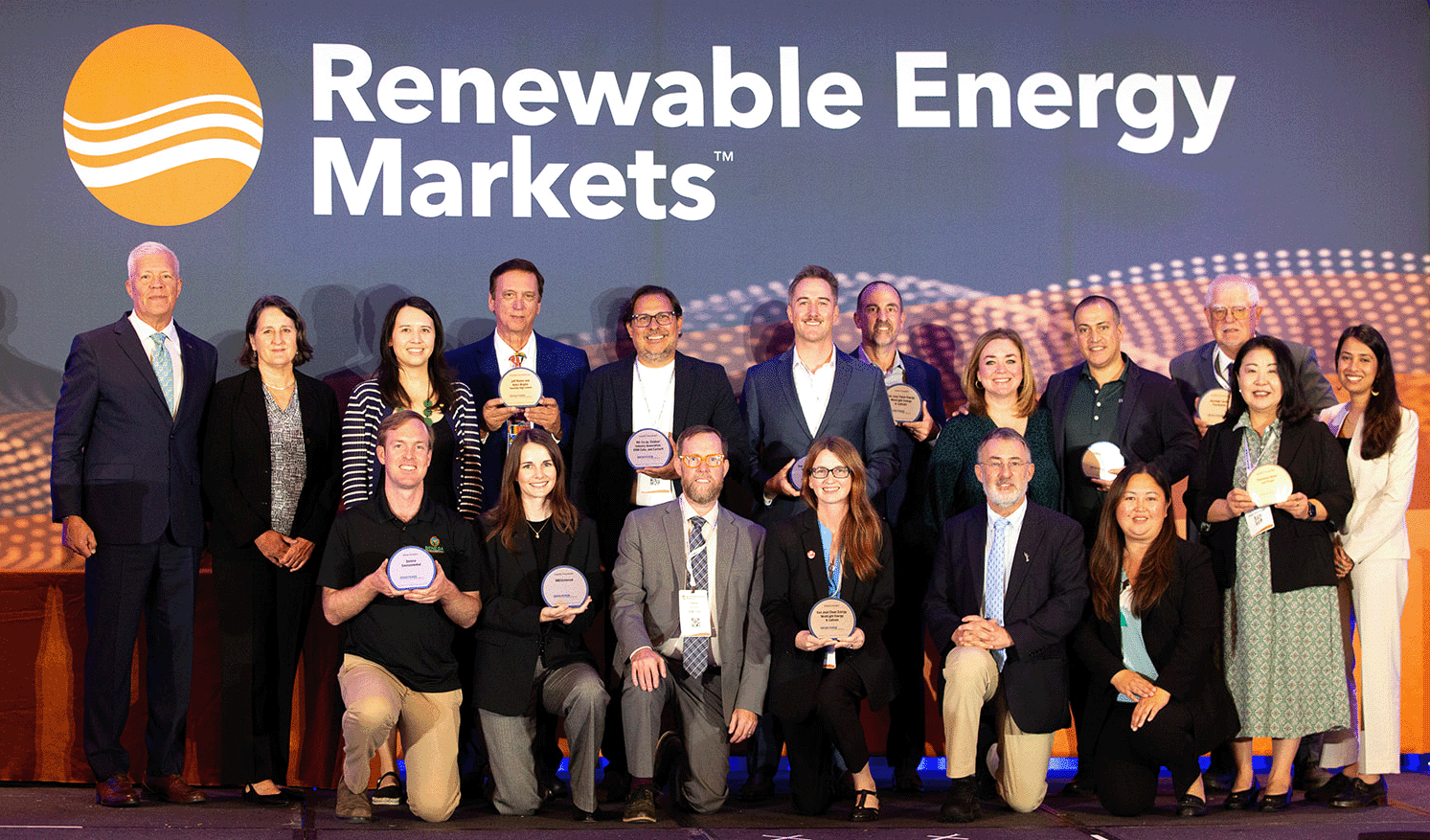
Center for Resource Solutions presented the 2026 Green Power Leadership Awards on Wednesday, September 2, 2026 in Washington, D.C, presenting ten awards to winners promoting and expanding the use of clean, renewable energy (read the release).
The awards were presented during the Renewable Energy Markets 2026 conference in Washington, D.C. in the categories of Education & Awareness, Impactful Procurement, Market Innovation, and Leader of the Year.
QUOTE HERE “This year’s Green Power Leadership Award winners are using their talents and resources to leverage clean energy development in innovative ways with far-reaching benefits,” said Jennifer Martin, CEO of Center for Resource Solutions. “Our winners this year are helping expand clean energy to underserved communities, extend land-use options through agrivoltaics, combine consumer education with career development, and truly move the needle with substantial solar projects that benefit local workforces.”
Education & Awareness
Huisingh Family Foundation
Through the Origami Solar project in Illinois, the Huisingh Family Foundation is demonstrating how clean energy development and environmental stewardship can work hand in hand. Energized in Fall 2025, the community solar garden, developed by US Solar and Equity Solar Illinois, is paired with a dedicated conservation education space and pollinator-friendly native prairie habitat surrounding the array. The Foundation directs lease payments from the solar project back into its mission: restoring native plant diversity, supporting insects and wildlife, and reducing dependency on carbon while educating the public about the importance of preserving Illinois’ native prairie heritage.
The on-site classroom and native plantings give students, community members, and visitors a firsthand opportunity to learn how renewable energy projects can also support biodiversity and long-term environmental health. In 2025, the Foundation welcomed over 132 visitors to the Native Habitat Restorations building, with tours, classroom visits, and events continuing to grow through 2026. By creating a living example of sustainable land use, the Foundation helps challenge the misconception that solar development and conservation are at odds, instead showing how they can strengthen one another.
Foundation founder Dean Huisingh, an Illinois landowner for decades, has made it his mission to ingrain a respect for native habitat into generations to come. By directing clean energy investment directly into education, habitat restoration, and future conservation, he is ensuring that the project’s benefits extend far beyond renewable energy generation. The Foundation’s work serves as a powerful and replicable model for how landowners can use solar projects to create lasting environmental and community impact—proving that solar energy and prairie restoration are not competing interests, but complementary forces for a sustainable future.
LIHI/Surabhi Karambelkar
Surabhi Karambelkar and the Low Impact Hydropower Institute (LIHI) are recognized for their extraordinary ability to connect technical expertise with inclusive, empathetic advocacy in low-impact hydropower. Surabhi understands that advocacy does not work in a vacuum—it requires networks of motivated individuals to bring about grand change. Surabhi has dedicated herself to integrating Tribal knowledge into LIHI programs and market discussions, elevating perspectives that are all too often overlooked at federal and state policy levels. Her work ensures that the science of hydropower is not only accurate but also accessible and actionable for communities historically underrepresented in energy market development.
State and federal representatives consistently turn to Surabhi to inform policy development, and her guidance extends to a wide array of organizations, from Independent System Operators to voluntary REC marketers. She is currently formalizing low-impact hydropower’s inclusion in emerging voluntary markets and co-leading a National Laboratory project assessing U.S. voluntary markets. She serves as an advisor to The Nature Conservancy’s Renewable Energy Standard for People and Planet, the Connecticut Rivers and Hydropower Collaboration, and CRS’s Clean Energy Accounting Project. During the Uncommon Dialogue on Hydropower, River Restoration, and Dam Safety, Surabhi played a leadership role in developing market mechanisms to support dam rehabilitation, retrofit, and removal, as well as greenhouse gas accounting in reservoirs.
Her tireless efforts balance the needs of our rivers with the communities that rely on them. By emphasizing personal connection alongside rigorous analysis, Surabhi promotes engagement and understanding among diverse stakeholders, ensuring that the clean energy transition is both inclusive and effective. Her work exemplifies how education and awareness can drive meaningful market transformation.
Jeff Rivero and Kahri Boykin, Yosemite High School
Kahri Boykin and Jeff Rivero at Yosemite High School in Merced, California, are nominated for their transformative program that merges renewable energy education with civic engagement. Jeff’s students work hands-on with GRID Alternatives to install solar systems on local homes, providing families with access to clean energy while reducing greenhouse gas emissions and lowering utility costs. Through these experiences, students gain technical knowledge in renewable energy systems, workforce readiness skills, and exposure to green career pathways. In partnership with the CCC, students conducted an energy analysis for the school district, professionally presenting their findings to the school board and contributing to the decision to solarize seven campuses.
Kahri collaborates with Jeff by integrating global sustainability into student learning through projects connected to the Daraja Academy, an all-girls school in Kenya. Students research how solar battery storage provides reliable electricity during power outages, study air quality and water sustainability using PurpleAir monitors and atmospheric water generators, and develop professional communication skills by requesting donations from renewable energy companies. As a UN 17 SDG Ambassador, Kahri connects his students to global sustainability networks. A unique aspect of their work is empowering students to present their renewable energy and STEM initiatives at national conferences, including the Green Schools Conference, the California STEAM Symposium, the Green California Schools Summit, and QS Quacquarelli Symonds. Together, Jeff and Kahri bridge the gap between classrooms, community partners, and the clean energy economy, building a replicable model that prepares students to become informed leaders in the future of sustainability.
Impactful Procurement
NBCUniversal
NBCUniversal has demonstrated impactful procurement strategy and industry leadership in advancing renewable energy within the entertainment sector. In 2026, the Universal Studios Lot and Universal Studios Hollywood theme park achieved 100% renewable electricity through programs delivering more than 190,000 MWh annually. This milestone required navigating a uniquely complex energy landscape, as the property spans two county and city jurisdictions served by both SoCal Edison and LADWP.
Across the studio lot, theme park, and Universal CityWalk entertainment district, NBCUniversal built a tailored portfolio including over 2 MW of on-site solar, 100% Green energy subscriptions through Clean Power Alliance, a multi-year renewable energy supply from Constellation Energy backed by 100% Green-e certified RECs, and a new 15-year off-site VPPA providing Green-e Wind project RECs to match remaining usage. This strategy expands market access, supports new clean energy supply, and strengthens Universal Studios Hollywood as a green travel destination.
Beyond procurement, NBCUniversal is transforming production practices. Universal Production Services offers clean-technology rentals including LED lighting, mobile EV chargers, solar-powered electric golf carts, and mobile battery solutions. Charging battery-powered equipment with renewable energy creates multiplier effects throughout the production ecosystem. Through an exclusive partnership with Hollywood Trucks Technologies, Universal Production Services deploys a solar-powered, off-grid Ecoluxe trailer fleet for productions filming in Los Angeles, generating, storing, and distributing clean energy on-site while reducing diesel generator reliance.
Together, these initiatives position NBCUniversal as an industry leader, showing how innovative procurement can advance environmental goals, generate economic value, and catalyze market transformation. They offer a replicable model for entertainment companies worldwide, expanding renewable energy adoption while delivering cost savings and operational excellence.
Pasadena Water and Power
Pasadena Water and Power (PWP) has shown exceptional leadership in advancing one of the nation’s most progressive municipal clean-energy transitions. Under the City’s Optimized Strategic Plan (OSP), which supports Resolution 9977 declaring a climate emergency, PWP is targeting 100% carbon-free electricity by the end of 2030. The OSP establishes a comprehensive framework centered on affordability, rate equity, stability, reliability, and accelerated deployment of renewable energy and storage resources throughout Pasadena and the broader Western grid.
Since adopting its 2023 Integrated Resource Plan (IRP), PWP has rapidly expanded its carbon-free portfolio through long-term procurements that directly incentivize new clean-energy development and strengthen grid reliability. PWP has secured more than 200 MW of renewable resources and 80 MW of battery energy storage systems, positioning itself to meet approximately 83% of its load with carbon-free energy and 76% on an hourly basis once online—while remaining on track toward 100% by 2030.
A distinguishing feature of PWP’s strategy is its aggressive commitment to local solar and storage development. The OSP established goals to implement 20 MW of solar on City sites and to increase customer solar by 50 MW through incentives and educational outreach by the end of 2030. PWP has actively enabled local battery storage deployment by making municipal land and substation infrastructure available for projects such as the Glenarm Battery Energy Storage System (estimated completion in 2027), allowing developers to interconnect directly into existing infrastructure. PWP has also pursued grant funding for enabling infrastructure, including conduit and improvements to connect Glenarm to substations. The OSP further prioritizes utility-scale and distributed solar, microgrids, customer programs, and local resiliency investments designed to reduce transmission constraints and support long-term decarbonization.
REI Co-op, Outdoor Industry Association, ERM Coho, and Carhartt
REI has anchored the first outdoor industry aggregated virtual power purchase agreement, a groundbreaking collaboration with Carhartt as the other offtaker to support new-build solar in Texas. This initiative addresses a persistent challenge within the outdoor industry: almost every member of the Outdoor Industry Association is too small to enter into a VPPA as a standalone buyer, limiting their ability to access impactful renewable energy procurement.
The concept of an aggregated outdoor industry VPPA had been in development for years, but REI’s leadership brought it to fruition. Through partnership with the Outdoor Industry Association and Coho ERM, REI and Carhartt signed parallel agreements that support new solar development, marking a huge breakthrough for two first-time VPPA buyers. This model expands renewable energy access to organizations of all sizes, demonstrating that aggregation can unlock opportunities previously available only to large corporations with substantial energy loads.
By spearheading this approach, REI has created a replicable framework that empowers smaller companies to participate in meaningful clean energy investments without needing the scale or internal resources typically required for standalone procurement. The project not only delivers environmental benefits through new solar capacity but also strengthens the outdoor industry’s collective climate leadership. REI’s commitment to collaboration and innovation shows how market barriers can be overcome through strategic partnerships and shared vision. Their work offers a scalable solution for other industries facing similar challenges, proving that collective action can drive the clean energy transition forward and make renewable energy more accessible to buyers of all sizes.
Market Innovation
ENGIE Resources
ENGIE Resources has commercialized one of the retail power market’s first scalable 24/7 hourly-matched renewable energy solutions, transforming an emerging procurement concept into a deployable, scalable product offering for commercial customers. As greenhouse gas accounting evolves toward temporal and locational precision, the voluntary renewable energy market is moving beyond annual REC accounting and more toward 24/7 hourly matching—aligning renewable generation with electricity consumed in the same hour. Until recently, these structures existed almost exclusively as bespoke agreements for sophisticated consumers with significant energy demand.
In 2025, ENGIE showcased its solution through a 24/7 hourly-matched agreement with Einstein Bros. Bagels covering 25 Texas locations through May 2027. The solution dynamically aligns hourly electricity consumption with renewable generation from named ERCOT wind and solar assets, including ENGIE’s Live Oak Wind Project, while transparently measuring and reporting hourly match performance across all 8,760 annual intervals. The customer receives REC-backed renewable coverage equal to 100% of annual consumption alongside a minimum 90% hourly match.
The innovation extends beyond a single transaction. ENGIE built standardized contract structures, automated hourly-matching infrastructure, transparent reporting protocols, and repeatable operational processes that allow 24/7 agreements to be executed in days rather than months. Rather than market simplified 100% claims, ENGIE reports verifiable hourly matching performance, establishing a more credible standard for renewable procurement transparency. Additionality and locationality are now well established; ENGIE is raising the bar by adding temporality to the clean energy lexicon. With an 11 GW renewable portfolio and multi-state retail platform, ENGIE enables rapid growth across customer segments. The platform continued to expand in 2025 with additional 24/7 agreements executed with two Fortune 500 companies, reinforcing ENGIE’s role in defining the future standard for renewable procurement transparency and temporal accountability.
San José Clean Energy, WestLight Energy and Caltrain
San José Clean Energy has enabled the first commuter rail service in California to transition from diesel to an all-electric system powered by 100% renewable energy. In partnership with Caltrain and Peninsula Clean Energy, SJCE helped electrify Caltrain’s main line between San Francisco and San José. The new electric service delivers a cleaner, smoother ride and sets an example for the nation—all without increasing costs.
In parallel, SJCE and PCE developed a Net Billing Rate that compensates Caltrain for renewable energy returned to the grid. This is the first framework of its kind for transit agencies in the state. Caltrain recaptures about 23% of the energy it uses through regenerative braking. This now generates approximately $1 million in annual savings between SJCE’s and PCE’s Net Billing Rates. The market innovation transformed Caltrain from a one-way energy consumer into a two-way clean-energy contributor. It improves system efficiency, reduces costs, and demonstrates a replicable model for electrified public transit systems.
By receiving 100% clean energy, Caltrain also generates additional revenue through California’s Low Carbon Fuel Standards program. This further lowers its electric fuel costs and strengthens long-term financial sustainability.
According to Caltrain’s Fiscal Year 2025 Annual Report, total ridership increased by 47%. Caltrain attributes a significant portion of this growth to electrification. The new system enables faster, more frequent, and more reliable service. This partnership demonstrates an innovative market approach that aligns clean energy procurement with transportation electrification. It creates a scalable model that reduces emissions, improves efficiency, and unlocks new revenue streams for public transit systems nationwide.
Seneca Environmental
Seneca Environmental has developed a new on-ramp into voluntary renewable energy markets. Their model enables corporate, government, and mission-driven buyers to meet clean energy goals while supporting tribally owned enterprise, pollinator-friendly land stewardship, and future tribal participation in REC markets.
Since January 1, 2025, Seneca has completed documented REC retirements for publicly nameable customers including Pinterest and Wise Ink Media. Together, these retirements total more than 1,000 MWh across two transactions, with retirement dates of May 7, 2026 and March 11, 2026. These transactions show that buyers value renewable energy attributes with credible, community-connected impact—not just commodity RECs.
The Pinterest transaction demonstrated a first-of-its-kind pathway. A tribally owned enterprise served a major global technology company’s renewable energy needs. Wise Ink extends that innovation to a smaller, values-driven publisher. Their first renewable-energy-matched book connects clean energy procurement to storytelling, education, and consumer awareness.
In both cases, Seneca helped buyers translate climate commitments into market action that supports underserved communities and pollinator-friendly renewable energy. Seneca is also creating a replicable model. By proving market demand for RECs sourced from a tribally owned business, Seneca gives other tribes with renewable energy facilities a clearer business case for bringing their certificates into voluntary markets.
One hundred percent of Seneca Environmental profits support the needs of Seneca Nation members. Its REC operations align with the Seneca Nation’s Seventh Generation principle of environmental stewardship. Seneca’s work is innovative because it expands who participates in renewable energy markets, what buyers can support through REC purchasing, and how voluntary markets can recognize community value. Seneca is not only selling RECs. It is building market access, buyer confidence, and a pathway for Native communities to participate more fully in the clean energy transition.
Leader of the Year
Walt Vernon
Walter Vernon is recognized for opening the healthcare industry—one of America’s largest commercial electricity consumers—to renewable power. Over 35 years, through his roles as engineer, attorney, CEO of Mazzetti, and now President of the International Federation of Healthcare Engineering, Walter has systematically transformed how hospitals think about and use energy.
As CEO of Mazzetti, an employee-owned benefit corporation, Walter served as engineer of record on a series of groundbreaking firsts. Kaiser Richmond Medical Center became the first U.S. hospital able to serve its Life Safety Branch from a renewable microgrid instead of diesel. Klickitat Valley Health became the first U.S. hospital with a hydrogen fuel cell power system. And Valley Children’s Hospital will feature the world’s largest hospital battery at 12 MWh of long-duration flow storage, designed with Sandia National Laboratories. Earlier work deployed more than 15 megawatts of solar and 5 MW of fuel cells across Kaiser facilities.
Walter knows that projects alone do not build a market. Healthcare’s reliance on diesel is locked in by code, so he rewrites the code. He helped author the NFPA 99 and NEC provisions that first permitted microgrids in hospitals. This April, he filed a National Electrical Code public input proposing a performance-based “Healthcare Microgrid” compliance pathway. He is also leading an ASHRAE multidisciplinary task group to establish an integrated standard for on-site, low-carbon healthcare energy. Walter serves on the leadership team of the U.S. National Consortium on Long Duration Energy Storage and is convening the LDES for Healthcare Summit this July.
Through the Sextant Foundation, which he founded, Walter deploys solar and storage to health facilities in Burundi, Sierra Leone, Haiti, and beyond—expanding renewable markets to communities the grid forgot. His career’s throughline is simple: remove the barriers, and clean power follows. Few levers move more electricity than the healthcare code. Walter has spent a career pulling that lever.