Electricity disclosure in the U.S. is at a turning point.
Customers, companies, and regulators all rely on accurate information about power sources and emissions—but today’s system is inconsistent, fragmented, and often misleading. Most disclosures reflect regional averages rather than the actual electricity customers purchase, making it difficult to verify claims or track progress toward clean energy goals.
Center for Resource Solutions’ Clean Energy Accounting Project (CEAP) has released Best Practices for Power Source & Emissions Disclosure, a comprehensive framework designed to bring clarity, consistency, and credibility to the market.
We’ve distilled the key insights into a concise overview—and you can explore the full technical guidance for a deeper look at how standardized disclosure can work in practice.
Turning Best Practices into Real-World Implementation
Establishing best practices is only the first step—implementation is where real impact happens.
Best Practices for Power Source & Emissions Disclosure is designed for regulators, utilities, and other market participants working to improve the accuracy, transparency, and credibility of power source disclosure. But translating these principles into consistent, actionable programs requires technical expertise, policy alignment, and practical market insight.
That’s where CRS Advisory Services come in. We partner with state agencies and regulators to design and refine disclosure frameworks. For grid operators and tracking system administrators, we help align with regional EAC tracking systems to enable consistent disclosures. For utilities and electricity providers, we support transparent, customer-facing disclosures that reflect what customers actually purchase. And for corporate buyers , we verify that the clean energy they’ve contracted for was delivered, ensuring their claims and emissions reductions are accurate.
Meeting climate goals starts with transparency into energy sources and what customers can claim. Credible power source disclosure makes that possible.

Why Are We Fighting About GHG Accounting?
The clean energy world is increasingly divided over annual matching, hourly and locational matching, and consequential accounting. But do these approaches really need to be in conflict? What if the fight over GHG accounting is distracting us from the bigger goal?
In our latest article, CRS Head of Policy Todd Jones explores why the debate has become so polarized, and how renewable energy markets, hourly procurement, and consequential accounting can all play important—and complementary—roles in accelerating decarbonization.
Rethinking the Impact of Renewable Energy Certificates
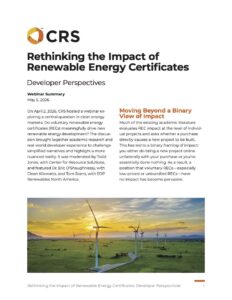
A summary of CRS’s recent webinar, Rethinking the Impact of RECs—Developer Perspectives is now available. The webinar brought together new academic research and real-world developer perspectives to explore a key question in clean energy markets: Do voluntary RECs meaningfully drive new renewable energy development? The discussion challenged overly simplistic narratives about REC impact and highlighted the important role REC revenue plays in supporting renewable energy projects and market growth.

State Policy Updates
In the first quarter of the year, CRS’s policy program was active at the state level in Arizona, where we fought the repeal of the state’s longstanding REST clean energy requirements.
In California, where CARB has begun implementing SB 253’s Climate Corporate Data Accountability Act, CRS is urging clear, consistent, and market-based accounting across all scopes to accurately attribute renewable energy and prevent double counting.
CRS recommends aligning CARB’s framework with the GHG Protocol’s 2015 Scope 2 Guidance and advises against mandating full hourly matching until tracking systems mature, to keep reporting transparent, verifiable, and consistent with established standards.
Green-e® Updates
Welcome new Green-e® participants Gridizen, Nexamp, and OTC Flow.
The certification program recently underwent a logo change. Look for the new identity on products and utility marketing materials over the coming year.
There are currently open comment periods for two issues: adding a Vietnam market appendix to the Green-e® International Standard to allow certification of Vietnamese renewable electricity and REC sales, and an update to how the Green‑e® Energy program considers Concentrated Animal Feeding Operations producing biofuels to align with the Green‑e® Renewable Fuels program.
New Resource: Database of Emerging Large-Load Tariffs (DELTa)
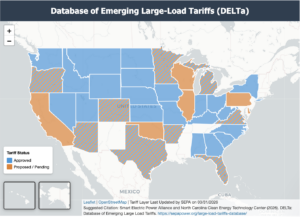
As electricity demand grows from data centers, manufacturing, and electrification, utilities across the U.S. are developing new approaches to large-load customer tariffs. SEPA’s DELTa database offers an interactive map and downloadable resource tracking emerging utility tariffs, contracts, and service rules designed to manage rapid load growth while supporting affordability, reliability, and clean energy goals.
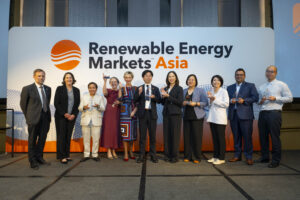
2026 Renewable Energy Markets™ Asia Award Winners
Congratulations to the winners of the 2026 REM™ Asia Awards! CRS presented the awards on 21 April 2026 at the REM™ Asia 2026 conference at the Sofitel Singapore City Centre.
Upcoming Events
FEATURED
Beyond the Grid Mix: Advancing Transparent Electricity Emissions Disclosure
Free Webinar | Wednesday, June 10, 2026 | 10:00 AM PT / 1:00 PM ET
As electricity customers, regulators, and consumer advocates face growing pressure to understand the emissions impact of the power they purchase, it is important to know what electricity attributes are actually being allocated to customers. This webinar will introduce Center for Resource Solutions’ Clean Energy Accounting Project’s (CEAP’s) newest Best Practices for Power Source and Emissions Disclosure Guidance, and explore how states, regulators, utilities, and consumer-facing organizations can advance more accurate and transparent electricity emissions information.
The discussion will examine why product-specific data, delivered attributes, and clearer distinctions between electricity offerings matter for effective policy design, consumer protection, and market transparency. Speakers will also discuss practical pathways for implementing the guidance across different regulatory and market contexts. The session will explore how different stakeholders can apply the guidance in practice to support better regulatory, market, and consumer outcomes. Participants will leave with a clearer understanding of emerging best practices for power source disclosure and how to put them into action.
FEATURED
2026 RECS Market Meeting
Prague | June 2–3, 2026
The RECS Market Meeting (RMM) 2026 is heading to Prague for the first time. The 14th edition of the RMM will take place on 2–3 June 2026, in the Prague Congress Centre with a pre-conference session on 1 June 2026.
At a critical moment for renewable energy markets, the RECS Market Meeting brings the total scope of actors in renewable energy markets together, from producers to traders to (corporate) end consumers. The RMM2026 offers detailed and high-level information about demand-side markets for renewables, as well as a high-value networking opportunity. During the conference, you will hear how renewable energy markets and Energy Attribute Certificates (EACs) are evolving, and how they can better support the energy transition. This year we will have a new and exciting debate format for all sessions, with speakers engaging each other on the pros and cons of their different viewpoints.
Policy Manager Devon Johnson will be speaking on the panel “The Deliverability of Renewable Energy is Important…Or Is It?”
Trellis Impact 26
San Francisco | June 23–25, 2026
We’re excited to be a partner of Trellis Impact 26, taking place June 23–25 in San Francisco. Trellis Impact brings together 3,500+ leaders powering the future of sustainable business, from AI-enabled solutions to emerging technologies reshaping decarbonization, energy, circularity, and beyond.
With 500+ speakers across 100+ sessions, hear directly from the operators, technologists, corporate leaders, researchers, and investors pushing the frontier of climate innovation—so you can accelerate implementation, unlock new opportunities, and drive measurable impact.
Rachael Terada, Head of Clean Energy Programs at CRS, will be presenting “Cracking Scope 3: From SAF to AI, Strategies That Deliver Real Reductions” on Thursday, June 25, 2026 at 10:30 am
Register now and save an extra 20% off with our partner code: TI26CRSP