by Renee O’Donnell
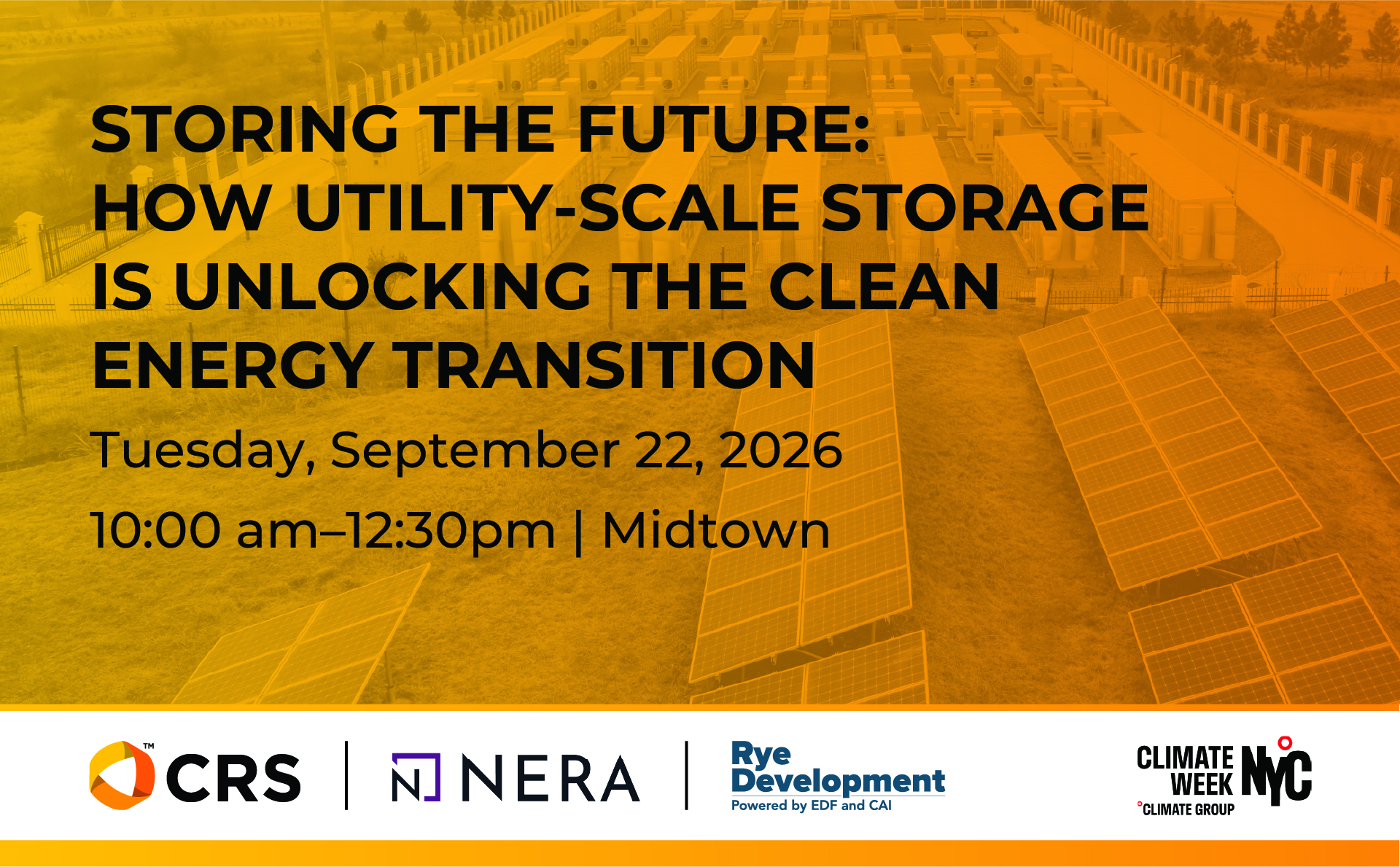
During renewable energy’s most important week, Climate Week NYC, Center for Resource Solutions (CRS) and NERA brought together over 75 developers, investors, policymakers, and buyers at NERA’s Midtown Manhattan offices for panel discussions under the topic Storing the Future: How Utility-Scale Storage is Unlocking the Clean Energy Transition.
The timing of this topic has never been more urgent. CRS’s Clean Energy Accounting Project (CEAP) just wrapped its Accounting for Utility-Scale Clean Energy Storage technical working group, and the Clean Energy Tracking Collaborative (CETC) officially decided that storage will be its core focus for 2027. Storage technology is ready for a much larger role as a flexible technology solution as the grid becomes increasingly stressed. The open question is whether markets and accounting systems are ready to recognize its use.
Seth Dunn of NYSERDA opened with a keynote on how New York is using long-term policy mechanisms to give storage revenue certainty. Tanuj Deora of Sparkfund followed with the numbers on deployment, curtailment, grid constraints, and buyer demand (slides here). Ben Chee and Jane Kim of NERA and Paul Jacob of Rye Development then joined CRS’s Matt Clouse to discuss what makes storage bankable and claimable from developers’ perspectives. The morning wrapped with a discussion moderated by CRS’s Renee O’Donnell, with Harry Singh of Goldman Sachs, Scott Burns of Private Energy Partners, and Rowen VonPlagenhoef of esVolta, LP exploring accounting principles and emerging market instruments for stored clean energy.
A clear theme emerged: much of the value storage provides is understood, but not yet integrated across market mechanisms. Tracking systems were built for generation management, and are not yet well-suited for resources that charge in one time period and discharge in another. Buyers want to make claims about leveraging time-shifted clean energy, but they need confidence that these claims will hold up without the risk of double counting.
These are exactly the problems CRS works on. For nearly 30 years, we have built the standards and verification programs that give clean energy markets their credibility, and both CEAP’s and CETC’s upcoming work on utility-scale storage will provide clarity and consensus around this emerging flexible solution.
CRS is working interdisciplinarily to promote storage’s ability to serve as a clean energy solution, and we’re looking for your partnership.
Our sincere thanks to NERA for co-presenting and hosting the event, and to Rye Development for its generous sponsorship.