You can use search operators like: quotes ("word1 word2"), to match exact terms; asterisk signs inside of quotes ("word1 * word2"), to search for any word; OR to search for any two words (word1 OR word2); AND to search for both words (word1 AND word2)

- Hourly Clean Energy Utility Product Designs: Nine Product Model Examples
- Author: CRS Staff
- Published: June 11th, 2026| Document | 27 Pages
- Document
- 2026
CRS’s Clean Energy Accounting Project (CEAP)’s Hourly Clean Energy Utility Product Designs: Nine Product Model Examples helps vertically integrated utilities in the United States design credible, customer-focused hourly clean electricity products. The guidance includes nine of the most practical Product Model options organized by complexity and risk to the utility, equipping utilities to offer a …
- View
- Rethinking the Impact of Renewable Energy Certificates
- Author: CRS Staff
- Published: May 12th, 2026| Report | 6 Pages
- Report
- 2026
A summary of CRS’s recent webinar, Rethinking the Impact of RECs – Developer Perspectives. The webinar brought together new academic research and real-world developer perspectives to explore a key question in clean energy markets: Do voluntary RECs meaningfully drive new renewable energy development? The discussion challenged overly simplistic narratives about REC impact and highlighted the …
- View
- Best Practices for Power Source & Emissions Disclosure
- Author: CRS Staff
- Published: March 31st, 2026| Document | 27 Pages
- Document
- 2026
Clear power source disclosure helps customers understand what electricity they are buying and the emissions associated with it. CEAP’s new Best Practices for Power Source and Emissions Disclosure offers a practical U.S. framework for more accurate, transparent, and comparable electricity disclosures. The guidance recommends product-specific disclosure; accounting based on delivered attributes rather than utility-wide averages; …
- View
- Comments of CRS on Proposed Amendments to the Regulation for the California Cap on Greenhouse Gas Emissions and Market Based Compliance Mechanisms
- Author: CRS Staff
- Published: March 9th, 2026| Comment | 5 Pages
- Comment
- 2026
Center for Resource Solutions (CRS) urges the California Air Resources Board (CARB) to restore the Voluntary Renewable Electricity Program (VREP) by setting aside 5.5 million allowances for 2025–2030. Without this, voluntary renewable energy purchases will no longer reduce overall emissions under the cap, undermining their integrity. This limited, cost-controlled set-aside preserves environmental impact without harming …
- View
- Preserving the Emissions Impact of Voluntary Renewable Electricity under the Cap-and-Invest Program
- Author: CRS Staff
- Published: March 9th, 2026| Comment | 1 Pages
- Comment
- 2026
This letter urges the California Air Resources Board (CARB) to amend proposed cap-and-trade rules. Without changes, voluntary renewable energy purchases will no longer reduce overall emissions. The signatories recommend a small, limited allowance set-aside (5.5 million credits through 2030) to preserve the environmental integrity and credibility of voluntary green power investments.
- View
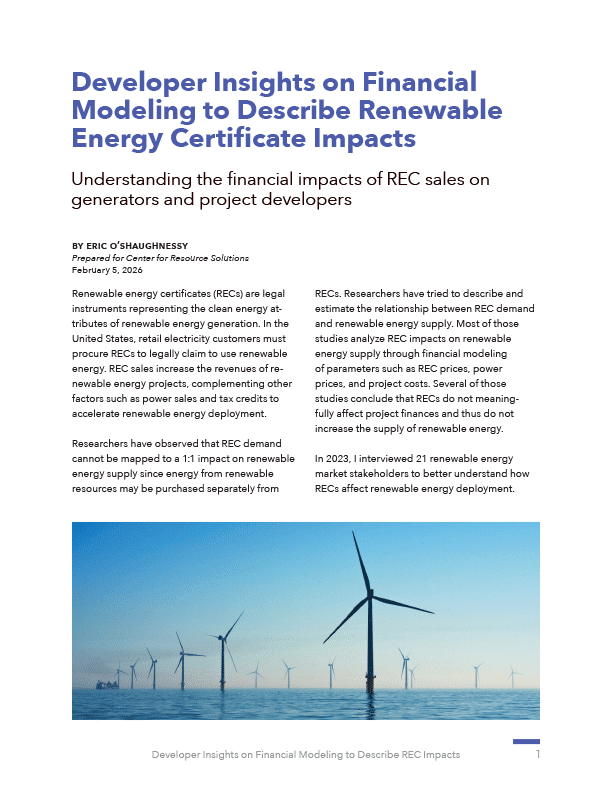
- Developer Insights on Financial Modeling to Describe Renewable Energy Certificate Impacts
- Author: Eric O'Shaughnessy
- Published: February 5th, 2026| Report | 7 Pages
- Report
- 2026
This report by Eric O’Shaughnessy, Ph.D. is the result of a series of interviews in 2023 of renewable energy market stakeholders and follow-up interviews in 2024 with four large renewable energy developers about the financial impact of renewable energy certificates (RECs) on project development. The interviews highlighted that common financial models underestimate how RECs influence …
- View
- CRS Responds to the Greenhouse Gas Protocol’s First Scope 2 Public Consultation Survey
- Author: CRS Staff
- Published: January 20th, 2026| Comment | 44 Pages
- Comment
- 2026
This document reproduces Center for Resource Solutions’ (CRS’s) responses to the Greenhouse Gas Protocol’s first Scope 2 Public Consultation Survey in January 2026. The survey sought stakeholder input on proposed updates and clarifications to the Scope 2 Guidance (2015), which addresses the accounting and reporting of greenhouse gas (GHG) emissions from purchased or acquired electricity, …
- View
- CRS Responds to the Greenhouse Gas Protocol’s Electricity-Sector Consequential Methods Public Consultation
- Author: CRS Staff
- Published: January 20th, 2026| Comment | 8 Pages
- Comment
- 2026
This document reproduces Center for Resource Solutions’ (CRS’s) responses to the Greenhouse Gas Protocol’s Electricity-Sector Consequential Methods Public Consultation in January 2026. The survey sought feedback on consequential accounting methods for estimating avoided emissions from electricity-sector actions, which will feed into work in the Actions and Market Instruments (AMI) workstream. The responses presented here reflect …
- View
- CRS Comments on the draft Advanced and Indirect Mitigation Platform Electricity Annex
- Author: CRS Staff
- Published: December 4th, 2025| Comment | 4 Pages
- Comment
- 2025
CRS welcomes the AIM Electricity Annex and supports its goal of providing electricity-specific guidance for Scope 3 interventions, while recommending targeted revisions to improve clarity, consistency, and guardrails. The comments ask AIM to strengthen electricity-sector direction on additionality; clearly define key regional terms such as “market boundary” and “electricity sourcing or use region” in line …
- View

- CRS Comments in Response to the Advanced and Indirect Mitigation (AIM) Platform, Intervention Quality, Accounting, and Reporting (QAR) Standard
- Author: CRS Staff
- Published: November 24th, 2025| Comment | 9 Pages
- Comment
- 2025
The Advanced and Indirect Mitigation (AIM) Platform, convened by C2ES, Green Market Activation (GMA), and Gold Standard, has put out its Intervention Quality, Accounting, and Reporting (QAR) Standard for public consultation. CRS’s comments center around four key factors: Some requirements do not align with how certain market-based instruments (e.g. EACs) operate in practice. Key terms …
- View
- CRS Guidance for Participation in the GHG Protocol Scope 2 Update Public Consultation
- Author: CRS Staff
- Published: November 18th, 2025| Document | 6 Pages
- Document
- 2025
This guidance summarizes CRS’s key recommendations for organizations commenting on the GHG Protocol’s proposed scope 2 updates. It highlights areas where greater transparency and data quality are needed—such as clarifying SSS treatment and strengthening residual mix rules—while outlining concerns with proposals that would limit participation in voluntary renewable energy markets, including physical deliverability and hourly …
- View
- CRS Comments on the Climate Corporate Data Accountability Act (SB253) Scope 1 and Scope 2 Emissions Draft Reporting Template
- Author: CRS Staff
- Published: October 24th, 2025| Comment | 5 Pages
- Comment
- 2025
CRS recommends several improvements to California’s SB 253 Draft Reporting Template for greenhouse gas emissions in the submitted comments. The comments call for clearer definitions and structure, including explicit totals for both market-based and location-based Scope 2 emissions, as well as a dedicated row for electricity totals within Scope 2. Clarification is requested regarding the …
- View
- CRS Comments on Washington’s Climate Commitment Act Linkage
- Author: CRS Staff
- Published: September 5th, 2025| Comment | 4 Pages
- Comment
- 2025
CRS comments focus on ensuring Washington’s Cap-and-Invest program accurately and fully reflects voluntary renewable electricity purchases by replacing the insufficient fixed 0.33% reserve with a demand-responsive mechanism and implementing automatic allowance retirements based on independent, auditable data sources.
- View
- CRS Comments to WREGIS on New Corporate Structure and Governance
- Author: CRS Staff
- Published: August 29th, 2025| Comment | 5 Pages
- Comment
- 2025
CRS comments to WREGIS on its transition to a stand-alone nonprofit, emphasizing balanced governance, transparency, and key software improvements to support reliable renewable energy tracking.
- View
- CRS Comments to CAISO on the Greenhouse Gas Coordination Accounting & Reporting Draft Final Proposal
- Author: CRS Staff
- Published: August 20th, 2025| Comment | 8 Pages
- Comment
- 2025
CRS comments to the California ISO on its draft final proposal for the development of an Accounting and Reporting Approach—a GHG allocation framework that will produce data that will allow LSEs in the market to see and understand the emissions intensity of their portfolios, along with a residual emissions rate, and public emissions information.
- View
- CRS Comment on EPA Proposed Rulemaking – Repeal of Greenhouse Gas Emissions Standards for Fossil Fuel-Fired Electric Generating Units
- Author: CRS Staff
- Published: August 7th, 2025| Comment | 3 Pages
- Comment
- 2025
CRS strongly opposes the EPA’s plan to repeal greenhouse gas (GHG) standards for power plants, arguing it harms public health, worsens climate change, and undermines clean energy progress. CRS highlights EPA data showing the rules prevent thousands of health issues and save $120 billion in health costs. Repealing them would increase emissions, hurt renewable energy …
- View
- Statement by Chris Cooper on Behalf of CRS at MN PUC Oral Hearing on Compliance Reporting and Implementation of Minnesota’s 100% Carbon-Free Standard (CFS)
- Author: Chris Cooper, Director, Policy
- Published: July 17th, 2025| Comment | 2 Pages
- Comment
- 2025
CRS urges the Minnesota PUC to prevent double-counting in the Carbon-free Standard by requiring RECs and EACs to verify claims. Using a grid-average mix lets utilities claim clean energy attributes already owned by voluntary buyers, undermining climate goals. The Commission should close this loophole, ensuring only retired RECs or EACs justify claims and using a …
- View
- CRS Positions on Proposed Decision Options for Implementing Minnesota’s Carbon-Free Standard (CFS)
- Author: Chris Cooper, Director, Policy
- Published: July 14th, 2025| Letter | 4 Pages
- Letter
- 2025
This letter registers whether CRS supports, opposes, or takes no position on 36 different decision options commissioners of the MN PUC will take up during its July 17 Agenda Meeting. CRS strongly supports procuring and retiring RECs and other Energy Attribute Certificates to demonstrate compliance with the CFS, and strongly opposes applying a grid average …
- View
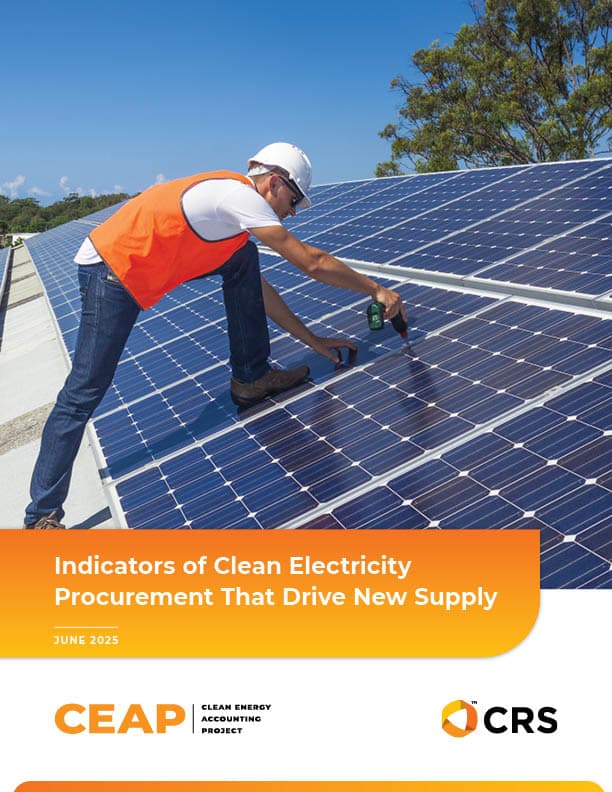
- Indicators of Clean Electricity Procurement That Drive New Supply
- Author: CRS Staff
- Published: June 4th, 2025| Report | 15 Pages
- Report
- 2025
Voluntary clean electricity procurement plays a critical role in accelerating the energy transition—but a lack of consensus on what kind of individual purchases directly drive or have an increased indirect impact on new clean energy and maintaining existing clean energy has led to market fragmentation and uncertainty for buyers and investors. This CEAP initiative produced …
- View
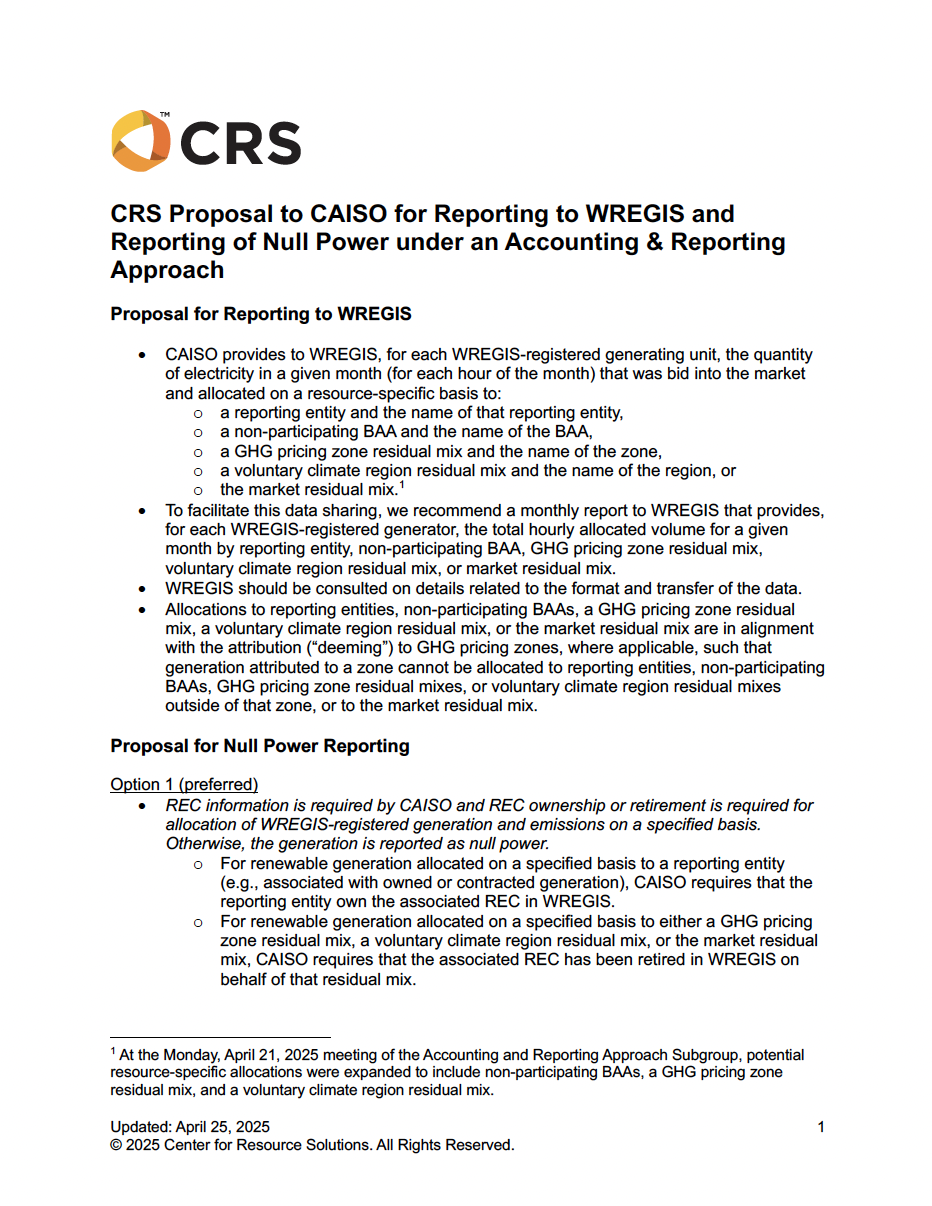
- CRS Proposal to the California Independent System Operator (CAISO) for Reporting to WREGIS and Reporting of Null Power under an Accounting & Reporting Approach
- Author: CRS Staff
- Published: May 5th, 2025| Document | 8 Pages
- Document
- 2025
CRS proposed updates to how the California Independent System Operator (CAISO) reports renewable electricity generation and emissions data to WREGIS (the Western Renewable Energy Generation Information System). The goal is to improve accuracy and transparency in how renewable energy and related emissions are tracked and reported, especially when Renewable Energy Certificates (RECs) are involved.
- View
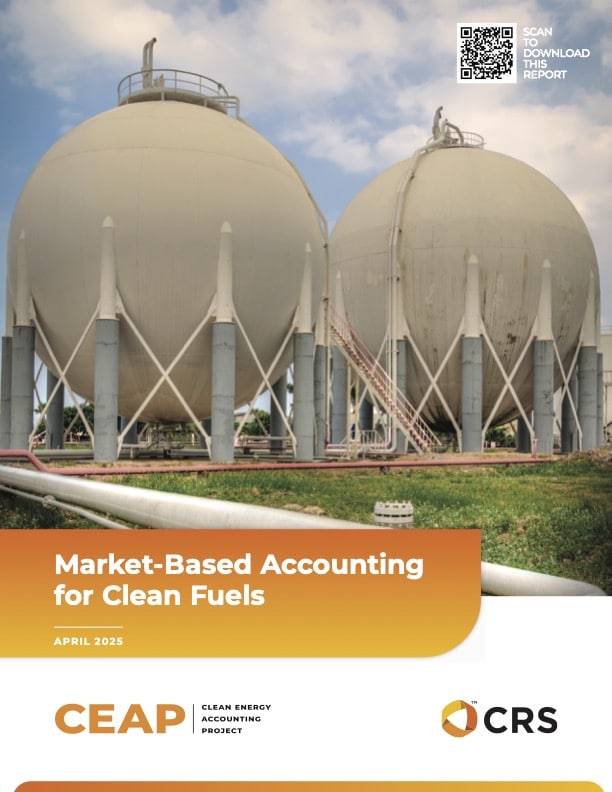
- Market-Based Accounting for Clean Fuels
- Author: CRS Staff
- Published: April 21st, 2025| Report | 31 Pages
- Report
- 2025
Fuel producers and their customers concerned with managing the greenhouse gas (GHG) emissions from using fuels are pursuing ways to replace conventional fossil fuels with biologically derived and lower-emitting alternative fuels. To help spur investment in the production of these nascent fuels, these stakeholders are using markets for contractual instruments like certificates representing the environmental …
- View
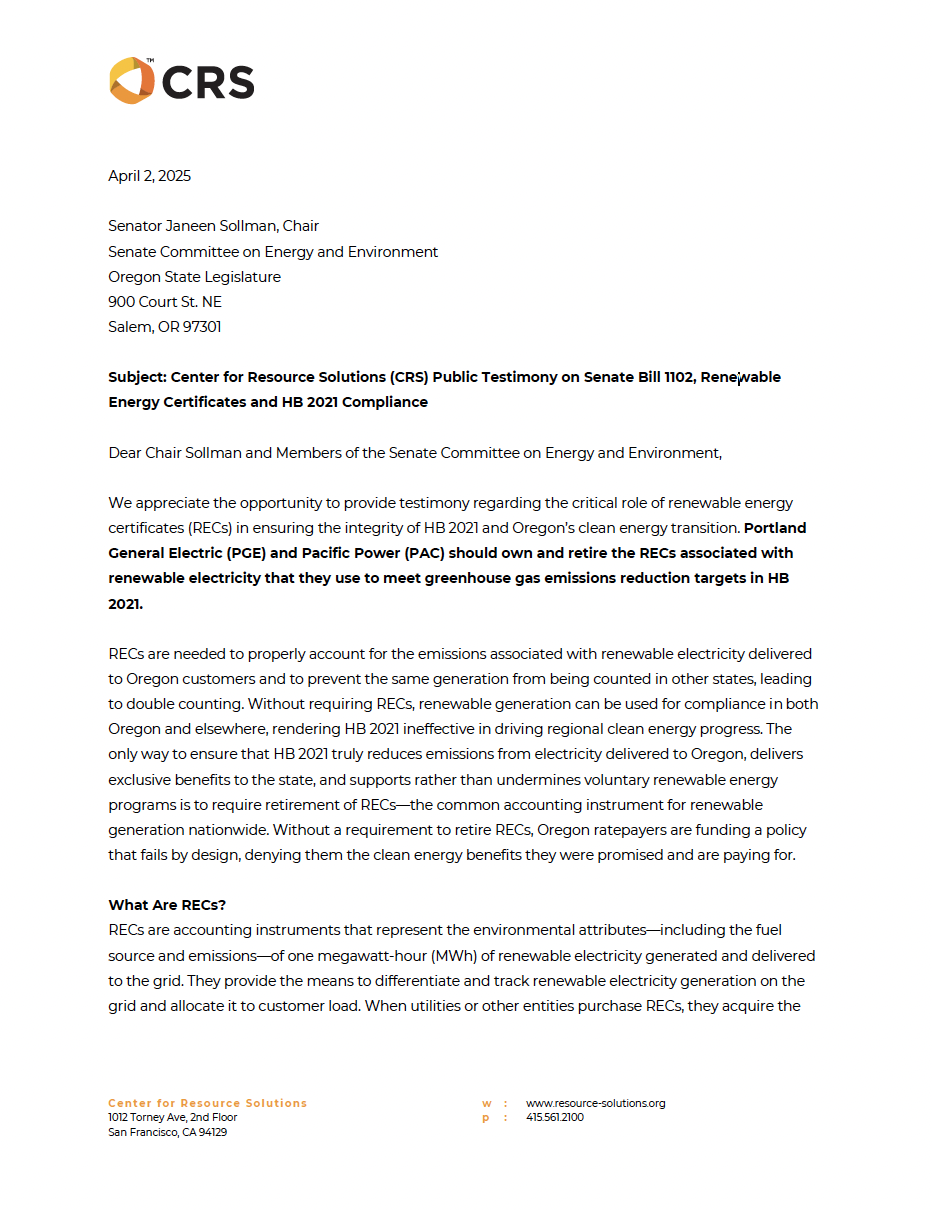
- CRS Public Testimony on Oregon Senate Bill 1102
- Author: CRS Staff
- Published: April 2nd, 2025| Comment | 4 Pages
- Comment
- 2025
CRS urges Oregon lawmakers to strengthen Senate Bill 1102 by requiring electric utilities to retire RECs when reporting clean electricity use under HB 2021. Without this rule, the same clean energy could be claimed by multiple states or programs (double counting).
- View
- Reply to Comments on Compliance Reporting and Verification Under MN Statute 216b.1691, Renewable Energy Standard (RES) and Carbon Free Standard (CFS)
- Author: CRS Staff
- Published: March 19th, 2025| Comment | 6 Pages
- Comment
- 2025
CRS supports comments submitted by other stakeholders regarding compliance reporting and verification under Minnesota Statute 216B.1691, Minnesota’s Renewable Energy Standard (RES) and the newly created Carbon Free Standard (CFS). These comments pertain to requiring the use of renewable energy certificates (RECs) and alternative energy certificates (AECs), as well as using a residual mix to represent …
- View
- Hourly Utility Product Design Background Report
- Author: CRS Staff
- Published: March 3rd, 2025| Document | 37 Pages
- Document
- 2025
Electricity providers are exploring product options to meet increasing demand for “hourly matched” carbon-free energy (CFE), in which CFE generation is matched to customer load in each hour. This background report summarizes current hourly product offerings; previous initiatives to facilitate or provide guidance, tools, or standards related to hourly CFE procurement; outcomes from previous technical …
- View

- Transparency and Accurate Accounting in the Electricity Sector: The Importance of All-Generation Tracking and Residual Mixes for State Programs
- Author: Todd Jones
- Published: February 21st, 2025| Document | 4 Pages
- Document
- 2025
All-generation electricity certificate tracking and residual mixes are two related and essential tools that can help states ensure transparency and accuracy in their electricity programs and in retail electricity markets more generally. These mechanisms help establish an accurate picture of electricity generation and consumption, prevent double counting, and support state renewable energy and climate policies.
- View
- State Clean Energy Standards: Designing Programs for Effective Emission Reductions
- Author: CRS Staff
- Published: February 14th, 2025| Report | 3 Pages
- Report
- 2025
State Clean Energy Standards (CESs), which set carbon-free energy or greenhouse gas (GHG) emissions goals for electric utilities, represent a new approach over traditional renewable portfolio standard (RPS) programs—one that focuses on renewable energy instead of emissions. This policy brief, aimed at state public utility commissioners and their staffs, discusses the critical importance of renewable …
- View
- CRS Comment on the Climate Corporate Data Accountability Act (SB253)
- Author: CRS Staff
- Published: February 13th, 2025| Comment | 11 Pages
- Comment
- 2025
CRS provided input on the implementation of SB 253 and SB 261. CRS emphasized the importance of ensuring that market-based emissions accounting, particularly for Scope 2 emissions, is properly integrated into the regulations, and that reporting aligns with widely used GHG accounting standards while addressing California’s specific needs.
- View
- Double-Counting Risks in New Market Accounting Frameworks for State Clean Energy Programs
- Author: CRS Staff
- Published: February 11th, 2025| Document | 2 Pages
- Document
- 2025
This policy brief for state policymakers and regulators describes how proposed frameworks for tracking and reporting greenhouse gas (GHG) emissions in new regional wholesale electricity markets for the Western Interconnection could impact the integrity of state clean energy and GHG programs. It provides recommendations including data coordination between these markets and the Western Renewable Energy …
- View
- 2024 Green-e® Verification Report (2023 Data)
- Author: CRS Staff
- Published: December 1st, 2024| Report | 1 Pages
- Report
- 2024
The 2024 Green-e® Verification Report (2023 Data) is an annual, year-end report that aggregates reporting data from participants in the three Green-e® programs—Green-e® Climate, Green-e® Energy, and Green-e® Marketplace. The 2024 report, which was compiled from data gathered during the 2023 reporting year, highlighted significant market trends, including: Over 125 million retail megawatt-hours (MWh) were …
- View

- Background Report: GHG Allocation and RECs in Western Markets
- Author: CRS Staff
- Published: November 21st, 2024| Report | 19 Pages
- Report
- 2024
This background report explores how new market frameworks for greenhouse gas (GHG) accounting and allocation impact renewable energy credits (RECs) in the Western U.S. These frameworks aim to meet state-specific emissions requirements but face challenges around double counting and REC tracking. Recommendations are provided to increase transparency and alignment between market frameworks and WREGIS for …
- View
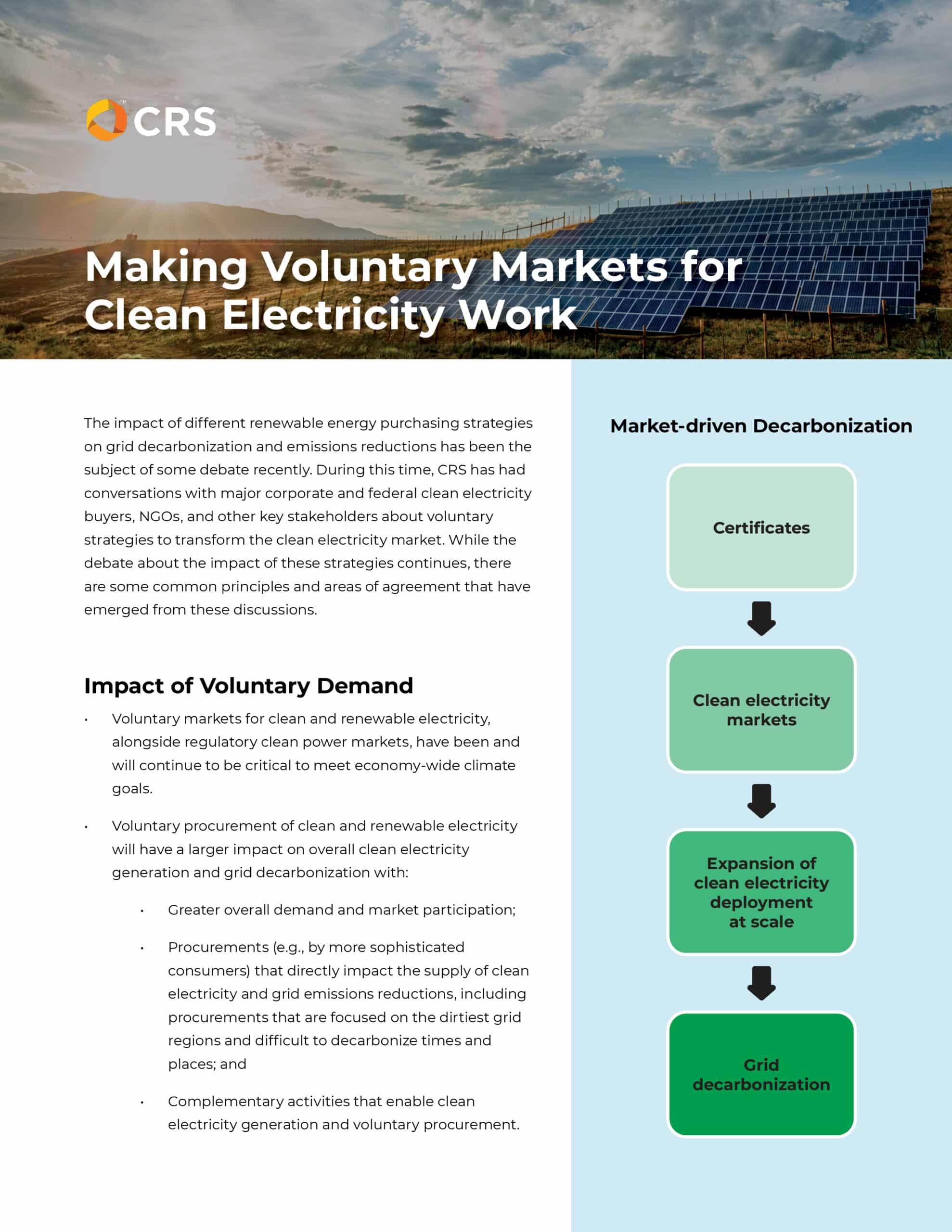
- Making Voluntary Markets for Clean Electricity Work
- Author: CRS Staff
- Published: September 5th, 2024| Report | 2 Pages
- Report
- 2024
In 2023 and 2024, CRS brought together a small group of market-leading corporate and federal clean electricity buyers, key non-governmental organizations, and other leading voices to discuss voluntary strategies to transform the clean electricity market. While the group had diverse perspectives on impactful clean electricity procurement and grid decarbonization pathways, several shared core principles and …
- View
- Clean Fuels in the Maritime Shipping Sector
- Author: CRS Staff
- Published: August 30th, 2024| Report | 11 Pages
- Report
- 2024
The largest maritime shipping vessels consume a gallon of fuel every 15 feet. This prodigious consumption is one reason international shipping accounted for nearly 3% of global warming by 2018. The International Maritime Organization (IMO) is leading a global effort to reduce the carbon intensity of shipping by switching to low-carbon fuels and modernizing aging …
- View
- Clean Fuels in the Residential and Commercial Sector
- Author: CRS Staff
- Published: August 29th, 2024| Report | 9 Pages
- Report
- 2024
The residential and commercial sector contributes significantly to greenhouse gas (GHG) emissions. Heating and cooking are typically the main fuel consuming activities within the sector. There is increasing interest and support for clean fuels such as biomethane and bioLPG in this sector, evident from their adoption in countries like the UK and other European nations. …
- View
- Clean Fuels in the Ground Transportation Sector
- Author: CRS Staff
- Published: August 28th, 2024| Document | 12 Pages
- Document
- 2024
The ground transportation sector, which includes personal and public transportation, trucking, rail, and off-road vehicles, is seeing a surge in clean fuel options, from renewable hydrogen to biodiesel. These fuels offer the potential for significant emissions reductions, especially when integrated into existing vehicles and infrastructure. Our report outlines the current landscape, challenges in distribution, and …
- View
- Clean Fuels in the Industrial Sector
- Author: CRS Staff
- Published: August 27th, 2024| Report | 12 Pages
- Report
- 2024
The industrial sector has unique energy demands, often requiring high temperatures for manufacturing processes. Clean fuels like renewable hydrogen, geothermal energy, and renewable methanol are emerging as viable solutions. However, market-based accounting methodologies are still developing, making it challenging to track and trade these fuels effectively. This background report, the second sector-specific background report released …
- View
- Clean Fuels in the Aviation Sector
- Author: CRS Staff
- Published: August 26th, 2024| Report | 12 Pages
- Report
- 2024
Aviation contributes significantly to global greenhouse gas emissions, and sustainable aviation fuels (SAFs) offer a promising pathway to decarbonize the industry. However, despite their potential, SAFs currently make up less than 0.1% of global aviation fuel. This background report, the first sector-specific background report released by CRS’s Clean Energy Accounting Project (CEAP) as part of …
- View
- Comments on Rhode Island Voluntary and Compliance Market (Docket 24-26-EL)
- Author: CRS Staff
- Published: July 22nd, 2024| Comment | 4 Pages
- Comment
- 2024
CRS comments pertain to the Rhode Island Public Utilities Commission Investigation into the current state of the voluntary and compliance renewable energy market in Rhode Island and the request for information regarding counting voluntary renewable energy certificates (RECs) towards the state’s Renewable Energy Standard (RES) compliance.
- View
- Comments on Implementation of Changes to Minnesota’s Renewable Energy Standard and Carbon Free Standard
- Author: CRS Staff
- Published: June 28th, 2024| Comment | 9 Pages
- Comment
- 2024
CRS’s comments focus on the implementation of changes to Minnesota’s Renewable Energy Standard and the newly created Carbon Free Standard under amendments to Minnesota Statute 216B.1691 adopted in 2023. CRS proposes use of a residual mix calculation as a more accurate method for determining the carbon-free characteristics of net electricity purchases by a utility, one …
- View
- Comments on North Carolina HB 951 and Duke Customer Programs
- Author: CRS Staff
- Published: June 5th, 2024| Comment | 2 Pages
- Comment
- 2024
CRS comments pertain to the effects of the implementation of HB 951 on voluntary renewable energy (VRE) generation in North Carolina and Duke’s Customer Programs.
- View
- Comments on Clean Energy Transition Act April 9 Notice and Draft Rules
- Author: CRS Staff
- Published: May 10th, 2024| Comment | 3 Pages
- Comment
- 2024
CRS comments pertain to the use of “Non-Power Attribute” to comply with the greenhouse gas neutral standard, definition of “use” of electricity, and avoiding double-counting.
- View
- Comments on the Proposed Draft SPP Markets+ GHG Reporting Protocol
- Author: CRS Staff
- Published: April 30th, 2024| Comment | 3 Pages
- Comment
- 2024
CRS suggests several edits to the draft reporting protocol, including clarifying terms and market boundaries, encouraging the use of third-party reporting protocols, standardizing null power generation accounting, and defining the use and limitations of entity average and null-power-adjusted entity average mixes.
- View
- Response to the Proposed Decision Modifying Green Access Program Tariffs and Adopting a Community Renewable Energy Program
- Author: CRS Staff
- Published: April 2nd, 2024| Comment | 12 Pages
- Comment
- 2024
CRS believes the proposed decision modifying California’s Green Access Program Tariffs orders substantial negative changes to the existing Disadvantaged Communities Green Tariff program (DAC-GT). Specifically the proposals to eliminate the requirement to retire Renewable Energy Credits, abolish VREP reporting, and eliminate Green-e® certification, which will create a program that offers a lesser clean power product …
- View
- Guidance for Calculating Residual Mix
- Author: CRS Staff
- Published: March 6th, 2024| Document | 31 Pages
- Document
- 2024
Residual mixes are the attributes of unallocated or unclaimed energy delivered to customers on the electricity grid and are a critical tool that prevents the double counting of clean energy and supports accurate calculations of greenhouse gas emissions resulting from electricity use. To date, there has been no consensus on what data is needed and …
- View
- 2023 Green-e® Verification Report (2022 Data)
- Author: CRS Staff
- Published: March 5th, 2024| Report | 1 Pages
- Report
- 2024
The 2023 Green-e® Verification Report (2022 Data) is an annual, year-end report that aggregates reporting data from participants in the three Green-e® programs—Green-e® Climate, Green-e® Energy, and Green-e® Marketplace. The 2023 report, which was compiled from data gathered during the 2022 reporting year, highlighted significant market trends, including: More than 114 million retail megawatt-hours (MWh) …
- View
- Comments to the California Air Resource Board on Low Carbon Fuels Standard
- Author: CRS Staff
- Published: March 3rd, 2024| Comment | 2 Pages
- Comment
- 2024
CRS comments pertain to updating the lookup table pathways for the Low Carbon Fuel Standard (LCFS) to using a utility-specific carbon intensity (CI) value of electricity.
- View
- Comments on Power Source Disclosure Pre-Rulemaking Draft Regulation for SB 1158
- Author: CRS Staff
- Published: February 21st, 2024| Comment | 7 Pages
- Comment
- 2024
CRS comments pertain to replacing loss-adjusted load with retail sales, renewable energy certificate (REC) retirement for annual and hourly reporting, use of the term “avoided emissions,” and the emission factors assigned to unspecified power and hourly claimed renewable generation.
- View
- Comments to the California Air Resource Board on Low Carbon Fuels Standard Updates
- Author: CRS Staff
- Published: February 20th, 2024| Comment | 6 Pages
- Comment
- 2024
CRS comments pertain to the definitions of environmental attributes and book-and-claim accounting, and book-and-claim accounting best practices for biomethane and hydrogen.
- View

- 2023 Year in Review
- Author: CRS Staff
- Published: December 21st, 2023| Document | 1 Pages
- Document
- 2023
In 2023, CRS highlighted a year of progress in advancing clean, sustainable energy through policy advocacy, education, and market certification. CRS strengthened renewable energy markets by ensuring the integrity of renewable energy certificates (RECs) and greenhouse gas (GHG) accounting. The Clean Energy Accounting Project (CEAP) developed guidance on renewable procurement for complex supply chains and …
- View

- CRS NewSolutions (Fall/Winter 2023)
- Author: CRS Staff
- Published: December 1st, 2023| Document | 1 Pages
- Document
- 2023
In This Issue: Growth in Green-e® • CEAP Updates • Upcoming Webinars • Green-e® International Standard • State Policy and Advocacy • SBTi • Green-e® Program Updates • REM™ 2024 Conferences • On the Road • Recently Published • Welcome New Staff
- View
- CRS Comment to the Oregon Public Utility Commission in Response to November 17, 2023 Oral Argument – OPUC Docket UM 2273
- Author: CRS Staff
- Published: November 29th, 2023| Comment | 3 Pages
- Comment
- 2023
CRS responded to oral arguments in Oregon PUC Docket UM 2273 regarding HB 2021, which sets GHG reduction targets for electricity. CRS argues that Oregon must choose between a load-based or generation-based accounting method for GHG emissions. CRS strongly supports a load-based approach requiring the use of RECs to prevent double-counting of emissions reductions. Requiring …
- View
- Comments in Response to the California Public Workshop: Potential Amendments to the Cap-and-Trade Regulation
- Author: CRS Staff
- Published: October 24th, 2023| Comment | 5 Pages
- Comment
- 2023
CRS comments pertain specifically to reinstating the allocation of allowances to the Voluntary Renewable Electricity Program (VREP) and the Renewable Energy Certificate (REC) Reporting Requirement for Specified Source Imports.
- View
- Comments in Response to the California Energy Commission Rulemaking to Amend Regulations Governing the Power Source Disclosure (PSD) Program
- Author: CRS Staff
- Published: October 23rd, 2023| Comment | 4 Pages
- Comment
- 2023
CRS comments pertain specifically to supporting the changes to the annual reporting requirements and keeping those requirements separate from hourly reporting. Our comments also provide information about how to communicate with stakeholders regarding these changes to the PSD program.
- View
- CRS Comments to Arizona Corporate Commission on Arizona Public Service Company Implementation Plan
- Author: CRS Staff
- Published: October 5th, 2023| Comment | 3 Pages
- Comment
- 2023
Comments of Center for Resource Solutions (CRS) on Arizona Public Service Company (APS) application to the Arizona Corporation Commission (ACC) for approval of its 2024 Renewable Energy Standard (RES) Implementation Plan. CRS comments pertain to APS’ requests “to waive the RES requirement for APS to rely upon the use and retirement of renewable generation (RG) …
- View
- Residual Mix Applications and Existing Data
- Author: CRS Staff
- Published: September 13th, 2023| Document | 11 Pages
- Document
- 2023
This document, released by CRS’s Clean Energy Accounting Project (CEAP), is intended to provide background on how residual mixes (electricity delivered as part of system mix and untracked or unclaimed energy) and associated emissions should be defined and calculated in the U.S. for different uses. Residual mix calculations are often used for greenhouse gas emissions …
- View
- CRS Comment to the Oregon Public Utility Commission in Response to Opening Briefs and Comments – OPUC Docket UM 2273
- Author: CRS Staff
- Published: August 21st, 2023| Comment | 9 Pages
- Comment
- 2023
CRS submitted comments to the Oregon Public Utility Commission regarding RECs and their role in meeting Oregon’s clean energy goals under HB 2021. CRS emphasized the importance of preventing “double counting,” where the same renewable energy is claimed by multiple parties or programs. RECs should be retired (not sold) when used to meet HB 2021 …
- View
- Scope 3 GHG Accounting for Upstream Clean Electricity Use
- Author: CRS Staff
- Published: August 11th, 2023| Report | 19 Pages
- Report
- 2023
In recent years, companies have begun working to reduce electricity-related greenhouse gas (GHG) emissions in their upstream supply chains and support supply chain practices that advance clean energy worldwide. However, companies implementing these actions struggle to reflect the carbon free attributes of supplier clean electricity use in their scope 3 footprints. This Clean Energy Accounting Project …
- View

- Guidance for Supplier Clean Electricity Procurement
- Author: CRS Staff
- Published: August 11th, 2023| Report | 47 Pages
- Report
- 2023
Companies working to increase clean electricity use in their upstream supply chains have lacked guidance on how to design clean electricity procurement programs with comparable criteria and metrics that meet their unique needs while supporting global supplier action. This Clean Energy Accounting Project (CEAP) Guidance for Supplier Clean Electricity Procurement (the guidance) was designed through …
- View
- Comments to the EPA on Clean Air Act (CAA) Section 111 Proposed Rule
- Author: CRS Staff
- Published: August 8th, 2023| Comment | 8 Pages
- Comment
- 2023
CRS proposes that Section 111 of the Environmental Protection Agency’s Clean Air Act require retirement of energy attribute certificates (EACs) to demonstrate use of low-GHG electrolytic hydrogen and that renewable fuel certificates be obtained and retired for low-GHG hydrogen produced by steam methane reforming with biomethane or renewable natural gas to avoid double counting. Low-GHG …
- View
- CRS Comment to the Oregon Public Utility Commission on Order No. 23-194 and the June 29, 2023 Commission Workshop on Renewable Energy Certificates – OPUC Docket UM 2273
- Author: CRS Staff
- Published: July 24th, 2023| Comment | 13 Pages
- Comment
- 2023
CRS urges the Oregon Public Utility Commission to require REC retirement for compliance with HB 2021 to prevent double-counting and ensure clean energy delivery to Oregon customers. Without REC retirement, renewable energy claims may be misleading, voluntary markets could be undermined, and regional renewable energy growth may suffer. CRS also recommends excluding voluntary …
- View
- Comments to DOE’s Office of Clean Energy’s DE-NOI-0202301 (Clean Hydrogen Hubs)
- Author: CRS Staff
- Published: July 21st, 2023| Comment | 6 Pages
- Comment
- 2023
CRS’s comments pertain to DOE’s potential demand-side support mechanisms for clean hydrogen hubs (H2Hubs). Key recommendations include ensuring support for both compliance and voluntary market demand and designing an eligibility-based selection process that considers the amount of renewable resources used to produce hydrogen the carbon intensity of particular products as well as social impact and …
- View

- CRS NewSolutions (Summer 2023)
- Author: CRS Staff
- Published: June 21st, 2023| Other | 1 Pages
- Other
- 2023
In This Issue: Policy and Advocacy • Voluntary Market Impact • CEAP Updates • Green-e Program Updates • Renewable Energy Markets Conferences • On the Road • Recently Published • New Staff
- View
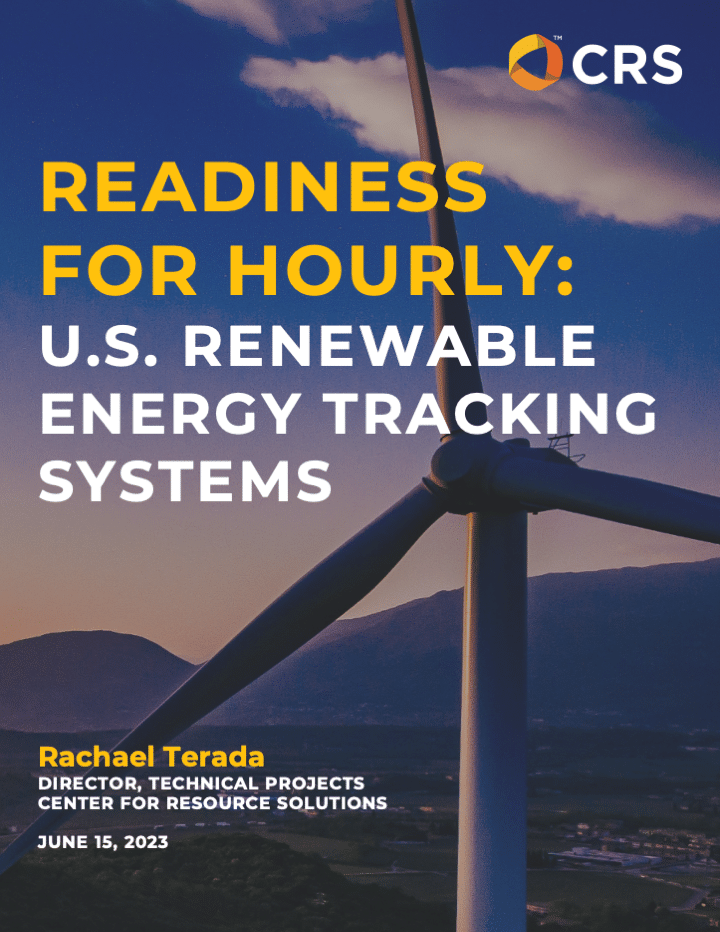
- Readiness for Hourly: U.S. Renewable Energy Tracking Systems
- Author: CRS Staff
- Published: June 15th, 2023| Report | 51 Pages
- Report
- 2023
This report provides an overview of the current readiness of established U.S. renewable energy certificate (REC) tracking systems to track on an hourly basis, based on interviews with the system operators. Topics include current capabilities, goals, challenges for implementation, and estimated timeframes. This report is intended to be a resource for stakeholders interested in learning …
- View
- Responses to Greenhouse Gas Protocol’s Corporate Standards and Guidance Update Surveys
- Author: CRS Staff
- Published: May 30th, 2023| Document | 11 Pages
- Document
- 2023
CRS responded to three surveys and submitted two proposals addressing potential changes to the Greenhouse Gas (GHG) Protocol’s Corporate GHG emissions and accounting standards guidance. 1. Corporate Accounting and Reporting Survey Addresses identifying the primary goal of the standard, favoring the most precise data, and defining the emissions reductions claims enabled by the standard. Download …
- View
- The Legal Basis for Renewable Energy Certificates
- Author: various authors
- Published: April 30th, 2023| Report | 19 Pages
- Report
- 2023
There is a strong legal basis for the use of renewable energy certificates (RECs) as instruments that represent the attributes of renewable electricity generation and are used to demonstrate renewable electricity purchasing, delivery, and use within the broader context of functioning voluntary and compliance renewable electricity markets. This document provides a summary of different selected …
- View
- Comments to the U.S. Federal Trade Commission (FTC) on Regulatory Review and Request for Public Comment on the Green Guides
- Author: CRS Staff
- Published: April 24th, 2023| Comment | 15 Pages
- Comment
- 2023
CRS comments are focused on the Renewable Energy Claims (§ 260.15), Carbon Offsets (§ 260.5), and Certifications and Seals of Approval (§ 260.6) sections of the Guides, as well as claims not currently covered by the Guides.
- View
- CRS Comment to the Oregon Public Utility Commission in Response to Scoping Questions for Investigation into HB2021 Implementation Issues – OPUC Docket UM 2273
- Author: CRS Staff
- Published: April 11th, 2023| Comment | 2 Pages
- Comment
- 2023
CRS submitted comments to the Oregon Public Utility Commission regarding HB 2021 implementation, emphasizing the need to clarify how RECs should be handled to avoid double-counting and ensure compliance with GHG targets. CRS recommended prioritizing this issue and suggested an open process allowing experts and stakeholders to contribute without formal legal representation.
- View
- Comments in Response the California Air Resources Board (CARB) February 23, 2023 Public Workshop to Discuss Potential Changes to the Low Carbon Fuel Standard (LCFS)
- Author: CRS Staff
- Published: March 15th, 2023| Comment | 5 Pages
- Comment
- 2023
CRS’s comments pertain to a utility-specific carbon intensity (CI) value of electricity and book-and-claim accounting for biomethane and hydrogen.
- View
- Comments to the U.S. General Services Administration (GSA) on the Request for Information – Retail Supply of Carbon Pollution-Free Electricity (PMPB01-2023CFE)
- Author: CRS Staff
- Published: March 6th, 2023| Comment | 8 Pages
- Comment
- 2023
CRS provided general feedback on the Request for Information regarding the Retail Supply of Carbon Pollution-Free Electricity (CFE) to inform the United States Government’s (USG’s) procurement of CFE to meet the objectives of Executive Order 14057 focused on the availability of Energy Attribute Certificates and best practices for claiming standard delivery CFE.
- View
- Comments in Response to the Massachusetts Department of Energy Resources (DOER) Forward Clean Energy Market (FCEM) Design Proposal
- Author: CRS Staff
- Published: February 17th, 2023| Comment | 5 Pages
- Comment
- 2023
CRS’s comments pertain to the overall viability and desirability of different certificates within the Proposal and their impacts on existing markets and program, with specific concerns regarding the disaggregation of energy attributes and the creation of multiple new certificates.
- View
- Comments in Response to the Proposed Rule on Federal Acquisition Regulation (FAR): Disclosure of GHG Emissions and Climate-Related Financial Risk (Far Case 2021-015)
- Author: CRS Staff
- Published: February 13th, 2023| Comment | 5 Pages
- Comment
- 2023
CRS’s comments pertain to the use of a market-based Scope 2 total for GHG accounting, the use of market-based instruments in Scopes 1 and 3, the proposed exclusive use of the Greenhouse Gas Protocol (GHGP) standard, and verification of GHG inventories.
- View
- Comment to the US Environmental Protection Agency on the Renewable Fuel Standard (RFS) Program Standards for 2023–2025 and Other Changes
- Author: CRS Staff
- Published: February 10th, 2023| Comment | 6 Pages
- Comment
- 2023
CRS submitted comments on proposed regulatory changes to the RFS program focusing on new regulations governing the generation of Renewable Identification Numbers for electricity made from renewable biomass that is used for transportation fuel (eRINs).
- View
- Comment to Washington Department of Ecology on Draft Rules for the Climate Commitment Act Cap-and-Invest Program
- Author: CRS Staff
- Published: January 26th, 2023| Comment | 4 Pages
- Comment
- 2023
CRS submitted comments as part of the informal rulemaking process for the Climate Commitment Act Program, Chapters 173-446 WAC, focused on implementation of the voluntary renewable reserve account and compliance obligations for certain renewable energy imports.
- View
- 2022 Green-e® Verification Report (2021 Data)
- Author: CRS Staff
- Published: January 24th, 2023| Report | 1 Pages
- Report
- 2023
The 2022 Green-e® Verification Report (2021 Data) is an annual, year-end report that aggregates reporting data from participants in the three Green-e® programs—Green-e® Climate, Green-e® Energy, and Green-e® Marketplace. The 2022 report, which was compiled from data gathered during the 2021 reporting year, highlighted significant market trends, including: 110 million retail megawatt-hours (MWh) reported from Green-e® …
- View
- CRS Comment to Oregon Public Utility Commission regarding an Application for Rehearing or Reconsideration submitted under the Staff HB 2021 Investigation into Clean Energy Plans and a November 1, 2022 OPUC Public Meeting
- Author: CRS Staff
- Published: January 11th, 2023| Comment | 5 Pages
- Comment
- 2023
CRS submitted information on the topics of REC Accounting and REC Retirement as addressed in the Application, and in response to comments made by the Commissioners in their discussion about RECs under HB 2021 following public comment at the November 1, 2022 Public Meeting.
- View
- CRS NewSolutions (Year in Review 2022)
- Author: CRS Staff
- Published: December 16th, 2022| Document | 1 Pages
- Document
- 2022
In This Issue: Letter from the Executive Director • Policy and Advocacy • CEAP • Green-e® Program Update • Renewable Energy Markets Conferences • On the Road • Recently Published • Welcome New Staff
- View
- Comments on the California Energy Commission (CEC) Clean Hydrogen Program under AB209 (Docket 22-ERDD-03)
- Author: CRS Staff
- Published: December 14th, 2022| Comment | 6 Pages
- Comment
- 2022
CRS’s comments include general support for the CEC’s Clean Hydrogen Program and detailed recommendations on the use of Renewable Energy Credits (RECs) for hydrogen produced by electrolysis, and Renewable Thermal Credits (RTCs) for hydrogen produced by steam methane reforming (SMR) for clean hydrogen production and use claims that meet the requirements of AB 209.
- View
- Comments in response to the Internal Revenue Service (IRS) request for comments on credits for clean hydrogen and clean fuel production (Notice 2022-58)
- Author: CRS Staff
- Published: December 2nd, 2022| Comment | 8 Pages
- Comment
- 2022
CRS’s comments in responses to questions in the Stakeholder Feedback section of the Draft Guidance include general support for DOE’s Clean Hydrogen Program and detailed recommendations on the use of Renewable Energy Credits (RECs) for hydrogen produced by electrolysis, and Renewable Thermal Credits (RTCs) for hydrogen produced by steam methane reforming (SMR) for clean hydrogen …
- View
- Comments in NC in response to the Verified Petition for Approval of Carbon Plan filed in docket NO. E-100, SUB 179 on behalf of Duke Energy Progress, LLC and Duke Energy Carolinas, LLC
- Author: CRS Staff
- Published: November 14th, 2022| Comment | 5 Pages
- Comment
- 2022
CRS’s comments pertain to the effects of the implementation of HB 951 on voluntary renewable energy (VRE) generation in North Carolina, considerations for electricity imports, reporting requirements, offset requirements, and the economic, environmental, and equity benefits of VRE markets.
- View
- Comments on the U.S. Department of Energy (DOE) Clean Hydrogen Production Standard (CHPS) Draft Guidance
- Author: CRS Staff
- Published: November 11th, 2022| Comment | 7 Pages
- Comment
- 2022
CRS’s comments in responses to questions in the Stakeholder Feedback section of the Draft Guidance include general support for DOE’s Clean Hydrogen Program and detailed recommendations on the use of Renewable Energy Credits (RECs) for hydrogen produced by electrolysis, and Renewable Thermal Credits (RTCs) for hydrogen produced by steam methane reforming (SMR) for clean hydrogen …
- View
- Guide to Electricity Sector Greenhouse Gas Emissions Totals
- Author: CRS Staff
- Published: November 3rd, 2022| Report | 29 Pages
- Report
- 2022
This guide defines different GHG emissions totals for electricity generation that can be used by electricity suppliers and consumers to set goals, measure progress, and make claims, and by policymakers and regulators to design reporting and compliance programs.
- View
- CRS Comment to the Oregon Public Utility Commission on OPUC Staff’s Straw Proposals on Analytical Improvements – OPUC Docket UM 2225
- Author: CRS Staff
- Published: September 30th, 2022| Comment | 5 Pages
- Comment
- 2022
CRS supports the inclusion of RECs in Oregon’s Clean Energy Plans (CEPs) to ensure transparency and prevent double-counting of renewable energy. CRS recommends detailed reporting on REC usage and ownership to align with Oregon’s HB 2021 law and avoid legal, market, and environmental issues. Proper REC accounting is crucial for meeting clean energy goals, …
- View
- CRS Comment on the California Independent System Operator’s (CAISO’s) August 16, 2022 Extended Day-ahead Market (EDAM) Revised Straw Proposal
- Author: CRS Staff
- Published: September 26th, 2022| Comment | 9 Pages
- Comment
- 2022
CRS commented on CAISO’s proposed Extended Day-Ahead Market (EDAM), focusing on GHG accounting and RECs. CRS recommended better coordination with WREGIS to track which renewable energy is attributed to which states, avoiding double-counting. CRS also suggests clear disclaimers to clarify that REC ownership isn’t transferred in market transactions, protecting the integrity of renewable energy claims.
- View
- Comments on the International Sustainability Standards Board’s (ISSB) March 2022 Exposure Draft IFRS S2 Climate-related Disclosures
- Author: CRS Staff
- Published: July 29th, 2022| Comment | 10 Pages
- Comment
- 2022
CRS’s comments on the ISSB’s March 2022 Exposure Draft IFRS S2 Climate-related Disclosures pertain to the transition plans and carbon offsets and cross-industry metric categories and greenhouse gas emissions. CRS’ comments emphasize the importance of not conflating carbon offsets and renewable energy certificates (RECs), disclosure specifically related to voluntary renewable energy procurement, information about voluntary …
- View

- Comments to the U.S. Securities and Exchange Commission (SEC) on Proposed Climate-Related Disclosures for Investors
- Author: CRS Staff
- Published: June 17th, 2022| Comment | 38 Pages
- Comment
- 2022
CRS’s comments include general support for required climate-related disclosures and detailed recommendations and background related to renewable energy certificates (RECs) and Scope 2 emissions accounting.
- View
- CRS Comment to the Oregon Public Utility Commission in Response to the May 20, 2022 UM 2225 Clean Energy Plan Investigation Roadmap Acknowledgement Questionnaire
- Author: CRS Staff
- Published: June 10th, 2022| Comment | 4 Pages
- Comment
- 2022
CRS responded to Oregon’s Clean Energy Plan questionnaire, emphasizing the need to prevent double-counting of RECs. CRS recommends requiring utilities to retain RECs for clean energy used in Oregon, ensuring that they aren’t sold elsewhere. This protects the integrity of Oregon’s emissions reductions and ensures customers truly receive clean energy as promised under the law.
- View
- Comments on the WA Clean Fuels Program Electricity 2021 Notice of Proposed Rulemaking and Draft Rules
- Author: CRS Staff
- Published: April 20th, 2022| Comment | 9 Pages
- Comment
- 2022
CRS provided feedback to the Washington State Department of Ecology on the March 15, 2022 draft of the Washington Clean Fuel Standard (WAC Chapter 173-424). Our comments primarily focused on proposed reporting and documentation requirements for renewable energy certificates (RECs) and proposed rules for calculating incremental credits, proposed requirements for RECs and use of offsite …
- View
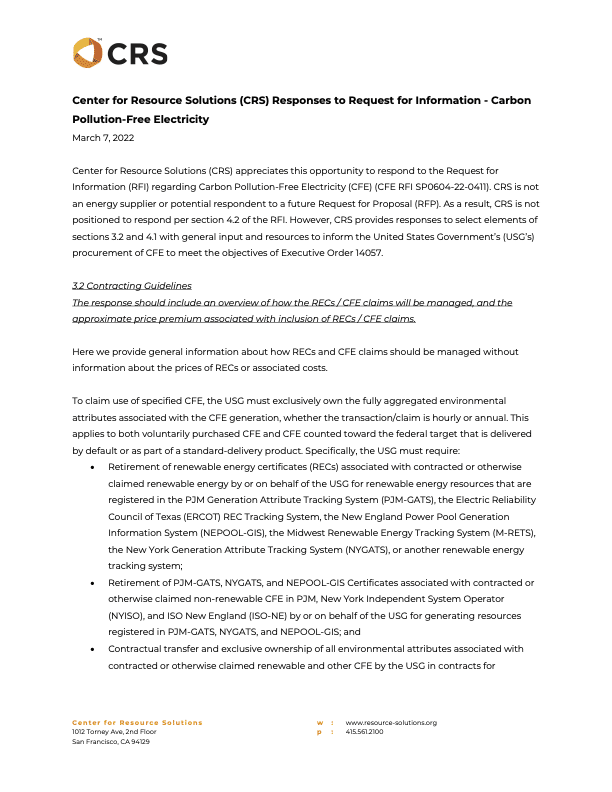
- Response to the Request for Information on Carbon Pollution-Free Electricity From the Defense Logistics Agency and the U.S. General Services Administration
- Author: CRS Staff
- Published: March 7th, 2022| Comment | 6 Pages
- Comment
- 2022
CRS submitted responses to the RFI (CFE RFI SP0604-22-0411) with general input and resources to inform the United States Government’s procurement of CFE to meet the objectives of Executive Order 14057.
- View
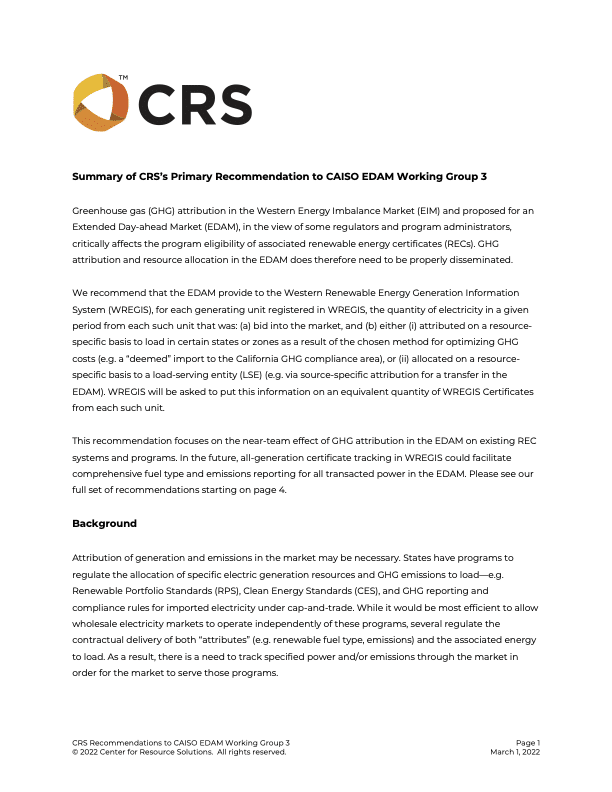
- Recommendations to the California Independent System Operator (CAISO) Extended Day-Ahead Market (EDAM) Working Group on Greenhouse Gas Accounting and Costs
- Author: CRS Staff
- Published: March 1st, 2022| Comment | 6 Pages
- Comment
- 2022
CRS submitted recommendations to CAISO as a part of its stakeholder initiative to develop a Western EDAM regarding GHG attribution and reporting requirements in the market.
- View
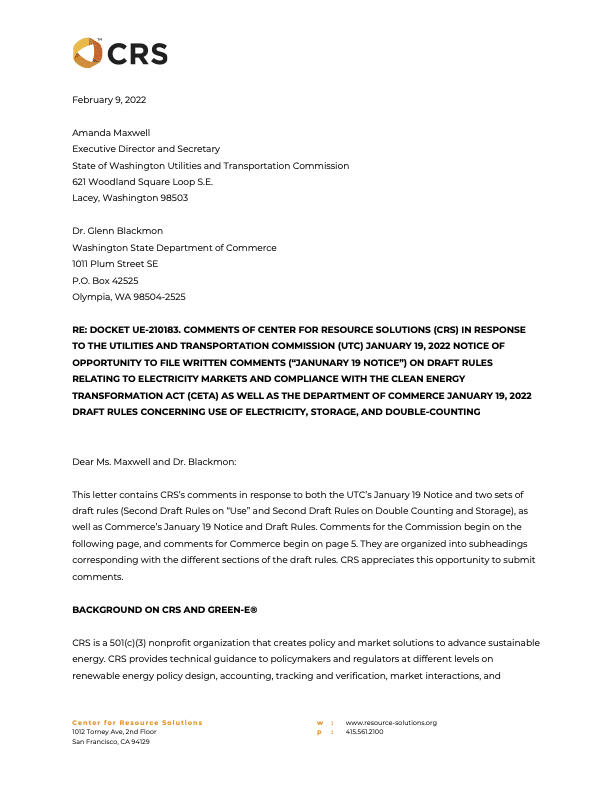
- Comments to the Washington Utilities and Transportation Commission and Department of Commerce on January 19, 2022 Draft Rules Concerning Use of Electricity, Storage, and Double-Counting
- Author: CRS Staff
- Published: February 9th, 2022| Comment | 6 Pages
- Comment
- 2022
CRS submitted comments in response to January 19, 2022 draft rules on Use of Electricity, Storage, and Double-counting under the Clean Energy Transformation Act (CETA) from both the UTC and the Department of Commerce.
- View
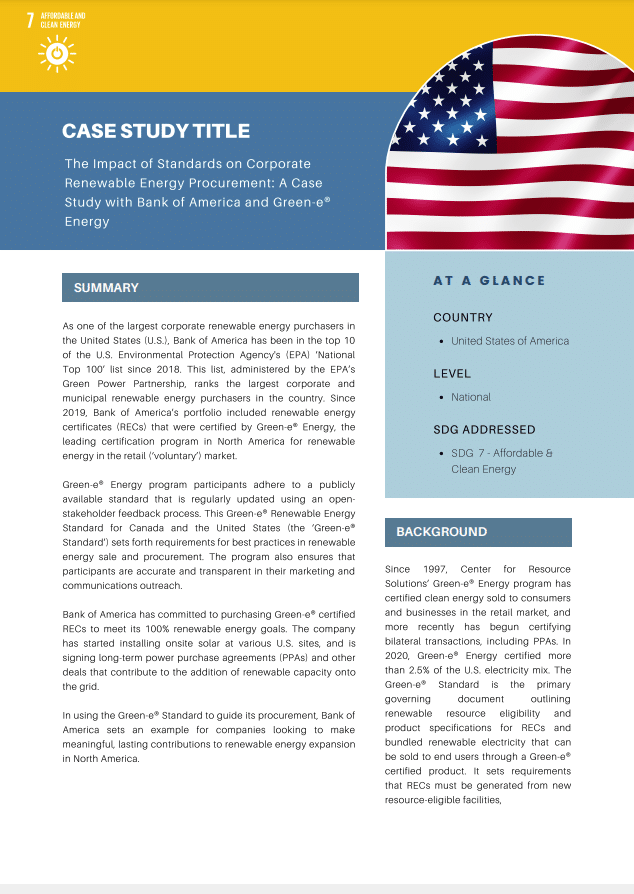
- The Impact of Standards on Corporate Renewable Energy Procurement: A Case Study with Bank of America and Green-e® Energy
- Author: CRS Staff
- Published: February 1st, 2022| Report | 3 Pages
- Report
- 2022
The UNECE Portal on Standards for the SDGs features a CRS case study of Bank of America’s purchase of renewable energy certificates (RECs) that were certified by Green-e® Energy. In 2019, Bank of America purchased enough Green-e® certified RECs to match 100% of its North American operations, including retail locations, ATMs, data centres, and corporate …
- View
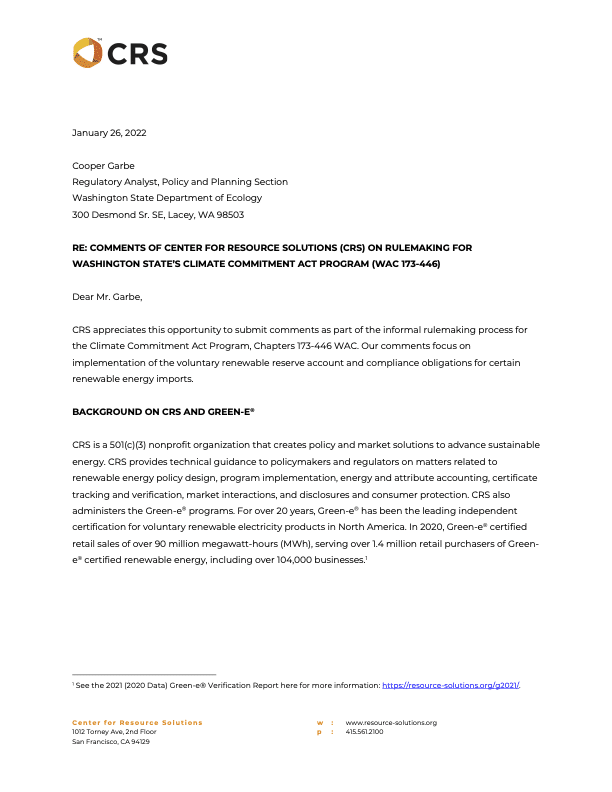
- Comments to the Washington Department of Ecology on Rulemaking for Washington State’s Climate Commitment Act Program (WAC173-446)
- Author: CRS Staff
- Published: January 26th, 2022| Comment | 4 Pages
- Comment
- 2022
CRS submitted comments as part of the informal rulemaking process for the Climate Commitment Act Program, Chapters 173-446 WAC. Our comments focus on implementation of the voluntary renewable reserve account and compliance obligations for certain renewable energy imports.
- View
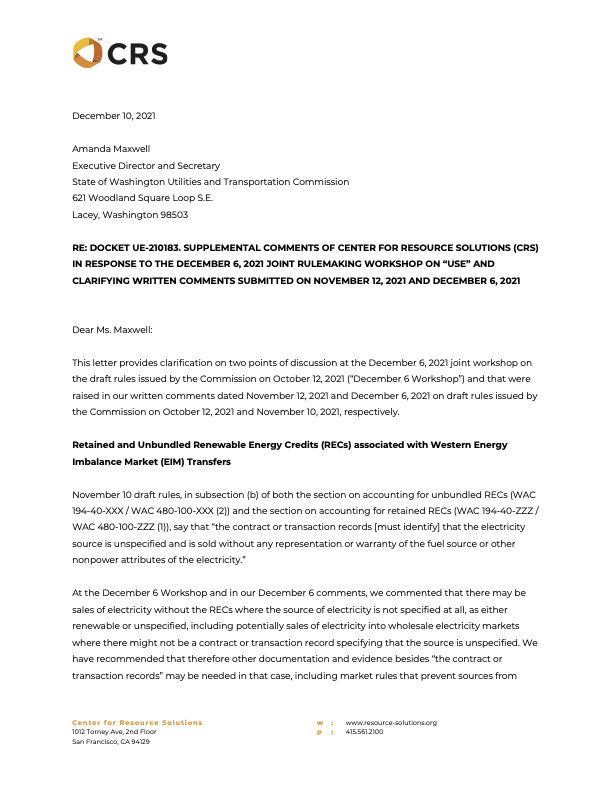
- Supplemental Comments to the Washington Utilities and Transportation Commission on Draft Rules for Implementation of the Clean Energy Transformation Act (CETA)
- Author: CRS Staff
- Published: December 10th, 2021| Comment | 4 Pages
- Comment
- 2021
CRS submitted comments under Docket UE-210183 in response to a December 6, 2021 Joint Rulemaking Workshop on “use” and clarifying written comments submitted on November 12, 2021 and December 6, 2021.
- View
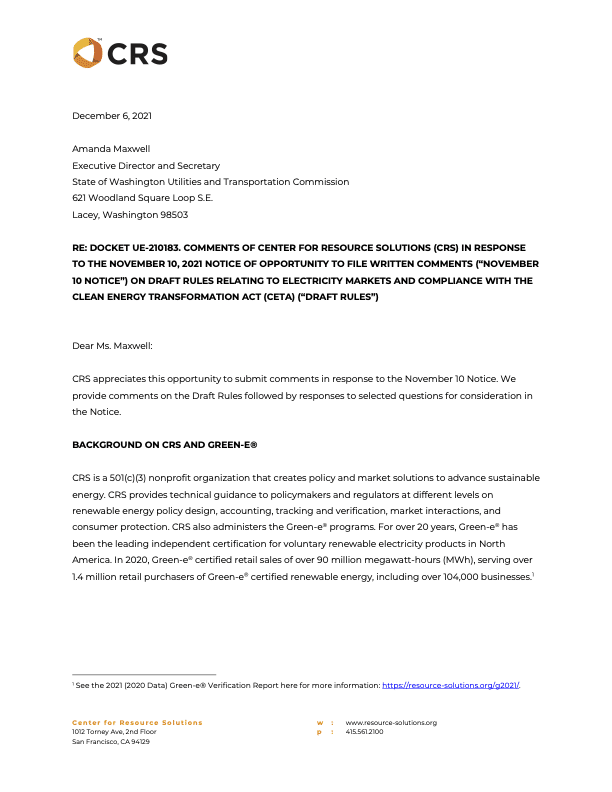
- Comments to the Washington Utilities and Transportation Commission on Draft Rules for Implementation of the Clean Energy Transformation Act
- Author: CRS Staff
- Published: December 6th, 2021| Comment | 6 Pages
- Comment
- 2021
CRS submitted comments under Docket UE-210183 in response to a the November 10, 2021 Notice of Opportunity to File Written Comments on Draft Rules Relating to Electricity Markets and Compliance with CETA.
- View
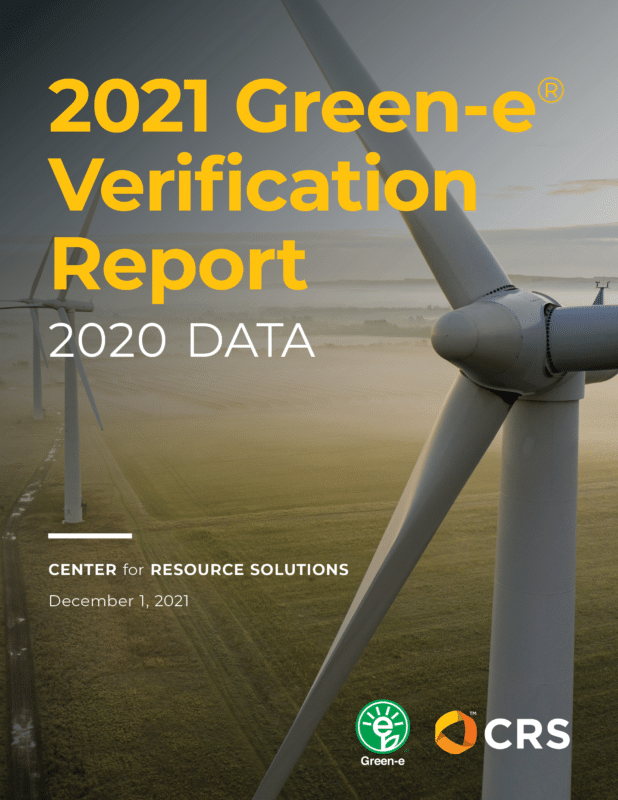
- 2021 Green-e® Verification Report (2020 Data)
- Author: CRS Staff
- Published: December 1st, 2021| Report | 1 Pages
- Report
- 2021
The 2021 Green-e® Verification Report (2020 Data) is an annual, year-end report that aggregates reporting data from participants in the three Green-e® programs—Green-e® Climate, Green-e® Energy, and Green-e® Marketplace. The 2021 report, which was compiled from data gathered during the 2020 reporting year, highlighted significant market trends, including: 90 million retail megawatt-hours (MWh) reported from …
- View
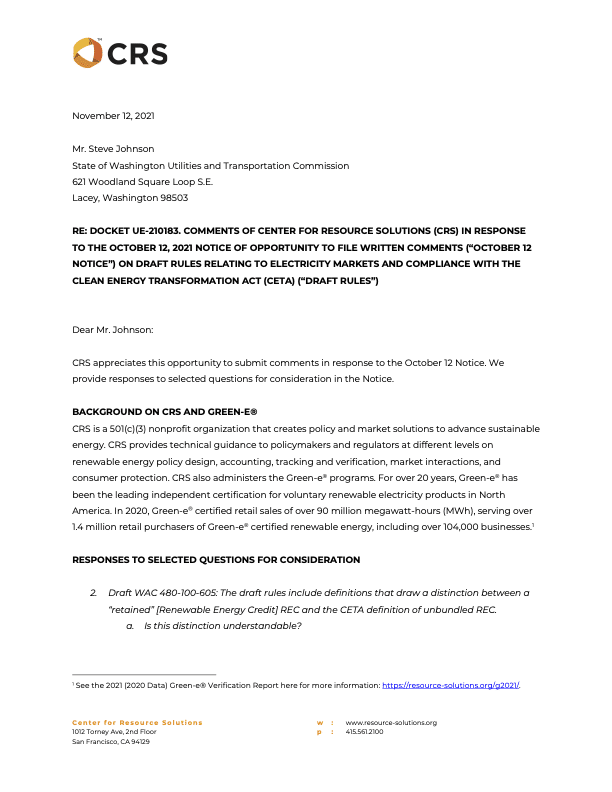
- Comments to the Washington Utilities and Transportation Commission on Draft Rules for Implementation of the Clean Energy Transformation Act (CETA)
- Author: CRS Staff
- Published: November 12th, 2021| Comment | 4 Pages
- Comment
- 2021
CRS submitted comments under Docket UE-210183 in response to an October 12, 2021 Notice of Opportunity to File Written Comments on Draft Rules Relating to Electricity Markets and Compliance with CETA.
- View
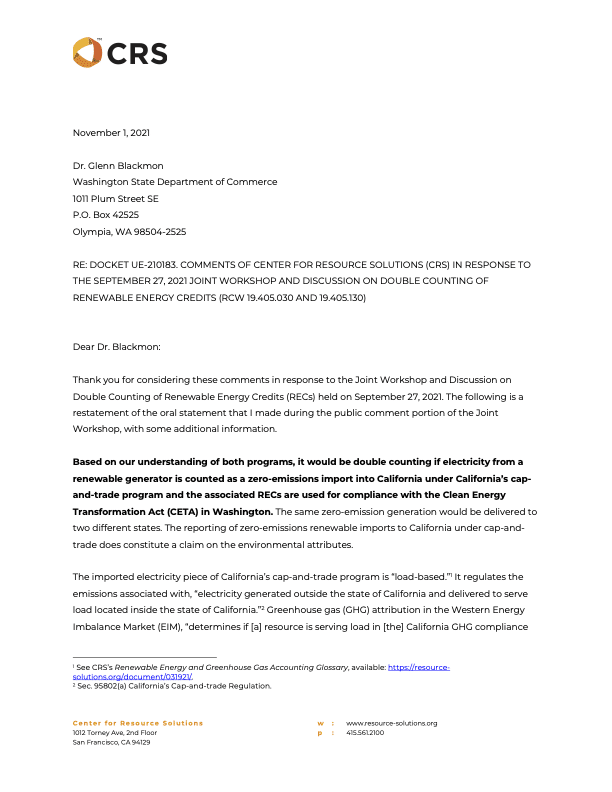
- Comments to the Washington State Department of Commerce in Response to a Joint Workshop and Discussion on Double Counting of Renewable Energy Credits Under the Clean Energy Transformation Act (CETA)
- Author: CRS Staff
- Published: November 1st, 2021| Comment | 6 Pages
- Comment
- 2021
CRS submitted comments under Docket UE-210183 in response to a September 27, 2021 Joint Workshop and Discussion on Double Counting of Renewable Energy Credits (RECs).
- View
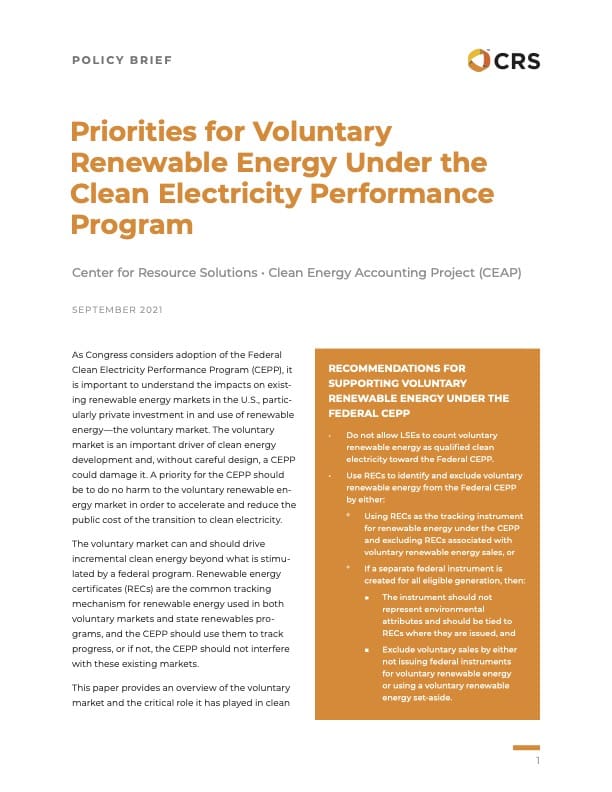
- Priorities for Voluntary Renewable Energy Under the Clean Electricity Performance Program
- Author: CRS Staff
- Published: September 14th, 2021| Report | 7 Pages
- Report
- 2021
As Congress considers adoption of the Federal Clean Electricity Performance Program (CEPP), it is important to understand the impacts on existing renewable energy markets in the U.S., particularly private investment in and use of renewable energy—the voluntary market. This policy brief from CRS’s Clean Energy Accounting Project (CEAP) provides an overview of the critical role …
- View
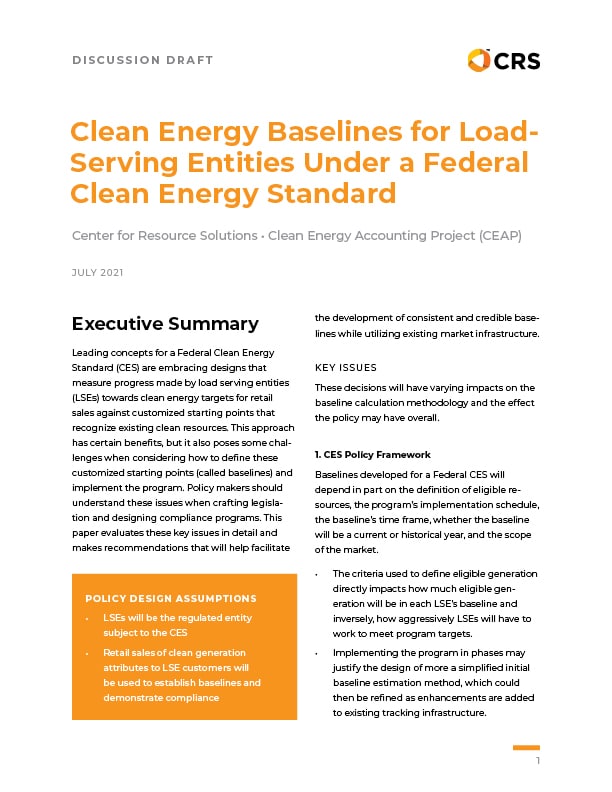
- Clean Energy Baselines for Load-Serving Entities Under a Federal Clean Energy Standard
- Author: CRS Staff
- Published: July 30th, 2021| Document | 11 Pages
- Document
- 2021
Current proposals for the federal Clean Energy Standard (CES) incorporate existing renewable energy resources and may require the establishment of baselines to measure progress made by load serving entities towards compliance targets. This discussion draft, released by CRS’s Clean Energy Accounting Project (CEAP), evaluates several key issues for establishing baselines including the criteria used to define eligible …
- View
- Measuring What an LSE Manages Under a Federal Clean Energy Standard
- Author: CRS Staff
- Published: July 28th, 2021| Report | 4 Pages
- Report
- 2021
There are many different ways to design a Federal Clean Energy Standard (CES) for the load-serving entities (LSEs) that sell and deliver electricity to end-use customers. But to implement an aggressive policy quickly, policymakers must choose metrics for measuring electricity that LSEs can meet accurately and efficiently. This policy brief explores four potential options for …
- View
- Comments to the Washington Utilities and Transportation Commission in Response to a Notice Seeking Feedback on Double Counting, Market Purchases of Electricity and the Interpretation of “Use” in the Clean Energy Transformation Act
- Author: CRS Staff
- Published: June 14th, 2021| Comment | 10 Pages
- Comment
- 2021
CRS submitted comments under Docket UE-210183 in response to the May 17, 2021 Notice of Opportunity to File Written Comments on Issues Related to Double Counting, Market Purchases of Electricity and the Interpretation of Compliance with RCW 19.405.040(1)(a).
- View
- Comments to the Washington State Department of Commerce in Response to Questions Regarding Energy Storage Accounting
- Author: CRS Staff
- Published: June 2nd, 2021| Comment | 6 Pages
- Comment
- 2021
CRS submitted comments in response to a May 5, 2021 notice and request for comments on energy storage accounting issues.
- View
- CRS NewSolutions (Spring 2021)
- Author: CRS Staff
- Published: May 17th, 2021| Report | 1 Pages
- Report
- 2021
In This Issue: Policy Guidance for Clean Energy Accounting • EVs Driving Renewable Energy in Oregon • State Policy Update • Just Published • Resilient Schools Collaborative • Green-e® Renewable Fuels • Getting Started Guide for Carbon Offsets • Residual Mix Emissions Rates • Renewable Energy Markets Conference • Green-e® Marketplace Participant Spotlight • New Green-e® Participants • In the Media • Recent Events • Green-e® in Chile and Taiwan • On the Road • 5th Annual Environmental Justice Summit • Staff News
- View
- Comments to ISO-NE and the NEPOOL Participants Committee on the Straw Forward Clean Energy Market Framework
- Author: CRS Staff
- Published: April 6th, 2021| Comment | 5 Pages
- Comment
- 2021
CRS provided feedback on the Straw FCEM Framework. Our comments are primarily focused on “Interaction with existing state programs (RECs, etc.)” and pertain to the overall viability and desirability of different approaches within the FCEM pathway and their impacts on existing markets and programs.
- View
- Renewable Energy and Greenhouse Gas Accounting Glossary
- Author: CRS Staff
- Published: March 19th, 2021| Document | 4 Pages
- Document
- 2021
This Glossary provides definitions of common terms used when tracking and accounting for renewable energy and greenhouse gas (GHG) emissions associated with electricity, with a focus on Attributional Accounting.
- View
- Recognition of Standard Delivery Renewable Energy in Different Programs and Standards
- Author: CRS Staff
- Published: March 15th, 2021| Report | 8 Pages
- Report
- 2021
Many voluntary standards and programs have policies around recognizing the use of renewable energy that is not actively procured by the reporting entity (Standard Delivery Renewable Energy). These policies are communicated explicitly, implicitly or in the use of greenhouse gas (GHG) emissions factors. This document presents a representative summary and comparison of current program requirements …
- View
- Data Sources: Accounting for Standard Delivery Renewable Energy
- Author: CRS Staff
- Published: March 15th, 2021| Report | 11 Pages
- Report
- 2021
Developed in 2020 to support the Accounting for Standard Delivery Renewable Energy report published under CRS’s Clean Energy Accounting Project (CEAP), this document explores a representative sample of data sources available for accounting for renewable energy across the U.S., including utility-specific data, Renewable Portfolio Compliance data, Residual Mix data, and grid average data. It examines …
- View
- Accounting for Standard Delivery Renewable Energy
- Author: CRS Staff
- Published: March 9th, 2021| Report | 13 Pages
- Report
- 2021
Inconsistent approaches to accounting for Standard Delivery Renewable Energy—renewable energy that is not actively procured—have led to confusion for companies actively managing electricity and greenhouse gas emissions targets. In 2020, CRS facilitated a series of virtual workshops through its Clean Energy Accounting Project (CEAP) to identify areas of consensus and quantification best practices. This report …
- View
- Comments on the Oregon Clean Fuels Program Electricity 2021 Notice of Proposed Rulemaking and Draft Rules
- Author: CRS Staff
- Published: January 29th, 2021| Comment | 11 Pages
- Comment
- 2021
Comments on the Clean Fuels Program (CFP) Electricity 2021 Notice of Proposed Rulemaking (NOPR) and Draft Rules dated December 22, 2020 (“Draft Rules”). These comments pertain to proposed requirements for RECs and use of offsite renewable electricity in Sec. 340-253-0470(5), proposed requirements for utility renewable electricity products in Sec. 340-253-0470(7), proposed reporting and documentation requirements …
- View
- Comments on Modifications to the Arizona Corporation Commission’s (ACC’s) Energy Rules and Notice of Proposed Rulemaking (Docket No. RU-00000A-18-0284)
- Author: CRS Staff
- Published: January 20th, 2021| Comment | 8 Pages
- Comment
- 2021
Comments on proposed modifications to the Arizona Corporation Commission’s (ACC’s) Energy Rules (“Proposed Rules”) and the December 1, 2020 Notice of Proposed Rulemaking. Our primary comments focus on required documentation for an electric utility to “demonstrate its ability to deliver energy from Clean Energy Resources and Renewable Energy Resource to its Customers” in Sec. R14-2-2704(D).
- View
- Introductory Framework for a Discussion of Objectives for Hourly RECs
- Author: CRS Staff
- Published: December 14th, 2020| Report | 6 Pages
- Report
- 2020
A framework for the discussion of objectives for hourly renewable energy certificates (RECs) that includes a glossary of selected terms, background and history, and key questions.
- View
- 2020 Green-e® Verification Report (2019 Data)
- Author: CRS Staff
- Published: December 9th, 2020| Report | 1 Pages
- Report
- 2020
CRS’s Green-e® Energy certification program certified nearly 69 million megawatt-hours in retail transactions in 2019, representing an overall year-over-year increase of 11%. This is the highest number of certified retail MWh to date. This includes over 6.1 million MWh from solar generation, an increase of 60%. Almost half of the energy supplying certified sales came …
- View
- Comments in Response to the Nov. 5 Notice Relating to Clean Energy Implementation Plans and Compliance with the WA Clean Energy Transformation Act (Docket UE-190698 and Docket UE-191023)
- Author: CRS Staff
- Published: December 3rd, 2020| Comment | 11 Pages
- Comment
- 2020
Comments in response to the November 5, 2020 Notice of Opportunity to File Written Comments (“November 5 Notice”). Comments on the proposed rule language in Attachment A (joint recommendations from the Public Generating Pool, Puget Sound Energy, Pacific Power, and Avista Corporation) and Attachment B (joint recommendations from Climate Solutions and Northwest Energy Coalition). We …
- View
- Comments on the Rulemaking Advisory Committee #3 Discussion Paper for the Oct. 22, 2020 Advisory Committee Meeting for the OR Clean Fuels Program Electricity 2021 Rulemaking
- Author: CRS Staff
- Published: November 5th, 2020| Comment | 8 Pages
- Comment
- 2020
Comments on the Rulemaking Advisory Committee #3 Discussion Paper (“Third Discussion Paper”) for the October 22, 2020 Rulemaking Advisory Committee (RAC) Meeting #3 (“October 22 Meeting”) as a part of the Oregon Clean Fuels Program (CFP) Electricity 2021 Rulemaking. Comments pertain mostly to the proposed requirement for Green-e® certification of RECs used for the CFP. …
- View
- Comments on CA October 14-15, 2020 Low Carbon Fuel Standard Public Workshop to Discuss Potential Regulation Revisions
- Author: CRS Staff
- Published: November 4th, 2020| Comment | 2 Pages
- Comment
- 2020
Comments in response to the LCFS Public Workshops to Discuss Potential Regulation Revisions held on October 14 and 15, 2020. Comments pertain specifically to staff proposals for new requirements for REC retirements for low-carbon-intensity electricity.
- View
- Comments to Colorado Department of Public Health and Environment (CDPHE) on the September 25, 2020 Clean Energy Plan (CEP) Guidance Draft Release for Public Comment
- Author: CRS Staff
- Published: October 16th, 2020| Document | 11 Pages
- Document
- 2020
Comments on September 25, 2020 Clean Energy Plan (CEP) Guidance Draft Release for Public Comment and Appendices. Comments and background information on renewable energy certificates and their role in utility greenhouse gas emissions reporting.
- View
- Comments to Oregon Department of Environmental Quality (ODEQ) on the Discussion Paper and September 24 Meeting for the Clean Fuels Program (CFP) Electricity 2021 Rulemaking
- Author: CRS Staff
- Published: October 2nd, 2020| Comment | 12 Pages
- Comment
- 2020
Comments on the Rulemaking Advisory Committee #1 Discussion Paper for the September 24, 2020 Rulemaking Advisory Committee (RAC) Meeting #1 as a part of The Clean Fuels Program (CFP) Electricity 2021 Rulemaking. Also responses to consultation questions in the Discussion Paper and discussion questions from the September 24 Meeting.
- View
- Comments to Oregon Department of Environmental Quality (ODEQ) on Clean Fuels Program Electricity 2021 Rulemaking
- Author: CRS Staff
- Published: October 2nd, 2020| Comment | 12 Pages
- Comment
- 2020
Comments on the Rulemaking Advisory Committee #1 Discussion Paper (“Discussion Paper”) for the September 24, 2020 Rulemaking Advisory Committee (RAC) Meeting #1 (“September 24 Meeting”) as a part of The Clean Fuels Program (CFP) Electricity 2021 Rulemaking. Our comments are organized by topic area. We also provide responses to consultation questions in the Discussion Paper …
- View
- Comments to Arizona Corporation Commission (ACC) on Possible Modifications to the Commission’s Energy Rules and the Special Open Meeting Held September 24, 2020
- Author: CRS Staff
- Published: September 24th, 2020| Comment | 4 Pages
- Comment
- 2020
Comments on elements of Arizona Corporation Commission (ACC) staff’s July 29, 2020 Proposed Draft Rules (“Staff Proposal”), Commissioner Kennedy’s proposed amendments no. 2 dated September 16, 2020, a letter from Commissioner Dunn to the Commissioners dated September 23, 2020, and the Special Open Meeting held September 24, 2020.
- View
- Comments to Washington State Department of Commerce on Second Discussion Draft Rule Language for Implementation of the Clean Energy Transformation Act (CETA)
- Author: CRS Staff
- Published: September 14th, 2020| Comment | 8 Pages
- Comment
- 2020
CRS comments on second discussion draft rule language for implementation of Washington State’s Clean Energy Transformation Act (CETA).
- View
- Comments on the Cradle to Cradle Certified Version 4 Draft Standard
- Author: CRS Staff
- Published: September 1st, 2020| Comment | 4 Pages
- Comment
- 2020
Feedback from CRS on the Cradle to Cradle Certified Version 4 draft standard, to be reviewed by the Institute’s Certification Standards Board and considered in the development of the final Cradle to Cradle Certified Version 4 standard.
- View
- Comments to the Washington Utilities and Transportation Commission (UTC) relating to Clean Energy Implementation Plans (CEIPs) and compliance with the Clean Energy Transformation Act (CETA)
- Author: CRS Staff
- Published: June 29th, 2020| Comment | 9 Pages
- Comment
- 2020
Responses to questions from the commission regarding the interpretation of “use” of renewable and nonemitting electricity and use of “bundled” renewable and nonemitting electricity, and related CETA compliance options.
- View
- Comments to the Public Utilities Commission of the State of Colorado on Proposed Amendments to the Renewable Energy Standard (RES) Rules and Net Metering Rules
- Author: CRS Staff
- Published: June 19th, 2020| Comment | 4 Pages
- Comment
- 2020
Comments on Decision No. C19-0197 Notice of Proposed Rulemaking (NOPR) dated February 27, 2019 (“2-27-2019 NOPR”) and appendices. Comments are limited to proposed changes to the Renewable Energy Standard (RES) Rules and Net Metering Rules.
- View
- Comments to the U.S. House Energy and Commerce Committee on Discussion Draft of the Climate Leadership And Environmental Action For Our Nation’s (CLEAN) Future Act
- Author: CRS Staff
- Published: April 28th, 2020| Comment | 7 Pages
- Comment
- 2020
Feedback on the January 2020 Discussion Draft of the CLEAN Future Act. CRS strongly supports comprehensive climate policy at the federal level, and feedback is primarily aimed at the Federal Clean Electricity Standard (CES) with input and recommendations on several other sections of the draft bill.
- View
- Comments to the Colorado Department of Public Health and Environment (CDPHE) on the Clean Energy Plan (CEP) Guidance Discussion Outline
- Author: CRS Staff
- Published: April 22nd, 2020| Comment | 3 Pages
- Comment
- 2020
Comments generally clarifying the relationship between the CEPs and reporting for the economy-wide goal under HB19-1261 and per proposed Regulation No. 22.
- View
- Comments to the Arizona Corporation Commission (ACC) on Possible Modifications to Energy Rules
- Author: CRS Staff
- Published: March 16th, 2020| Comment | 8 Pages
- Comment
- 2020
Comments on elements of Staff’s February 18, 2020 Third Revised Proposed Draft Rules (“Staff’s Draft Rules”), the Joint Stakeholder Proposal for New Energy Rules (“the Joint Stakeholder Proposal”), and Stakeholder Meetings and Workshops held March 10-11, 2020 (“the Workshops”). Comments are focused on requirements for demonstrating compliance with the Renewable Energy Standard and Tariff (REST) …
- View
- Comments to the California Energy Commission (CEC) on November 25, 2019 Proposed Changes to the Express Terms (15-Day Language) for Modification of Regulations Governing the Power Source Disclosure Program and Implementation of Assembly Bill 1110
- Author: Todd Jones
- Published: December 9th, 2019| Comment | 3 Pages
- Comment
- 2019
Comments on the proposed changes to the Express Terms (15-Day Language) for California’s Power Source Disclosure program under Assembly Bill 1110 (Ting), which requires that retail suppliers of electricity disclose to consumers the greenhouse gas emissions intensity of the supplier’s electric service products.
- View
- Comments to the California Energy Commission (CEC) on the November 18, 2019 SB 100 Technologies & Scenarios Workshop
- Author: Todd Jones
- Published: December 2nd, 2019| Comment | 4 Pages
- Comment
- 2019
Comments on the Technical Workshop for the SB100 Joint Agency Report Charting a Path to a 100% Clean Energy Future. Comments pertaining to options for defining eligible electricity resources and whether it is advisable to consider the alignment of accounting methodologies under SB 100.
- View

- CRS NewSolutions (Fall/Winter 2019)
- Author:
- Published: November 21st, 2019| Other | 1 Pages
- Other
- 2019
In This Issue: Green-e® 2019 Verification Report • Renewable Energy in China • Green-e® Renewable Fuels • Spotlight: Bank of America • State Policy Update • Philippine and Tunisian Delegations • REM Asia Announced • REM 2020 • Spotlight: Rock Canyon Coffee • Welcome New Participants • Congratulations GPLA Winners • In the News • …
- View
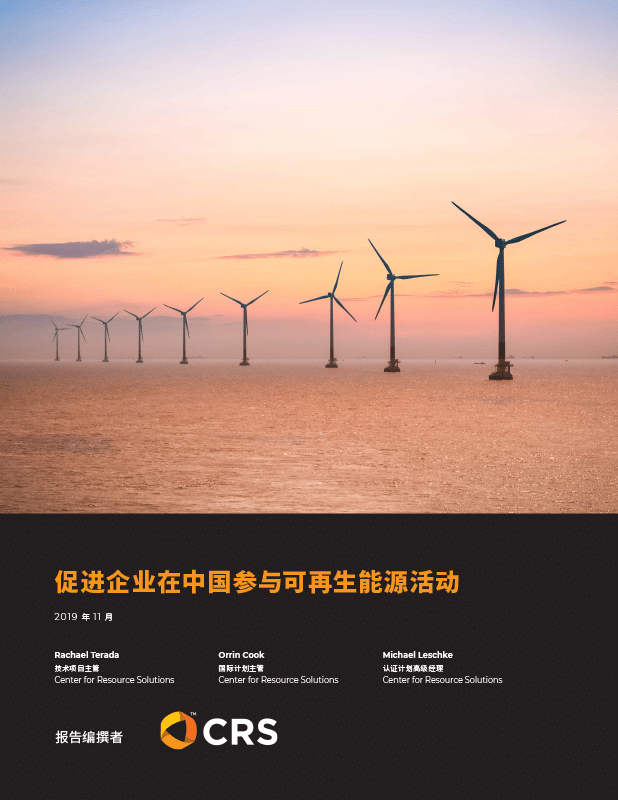
- 促进企业在中国参与可再生能源活动
- Author: Rachael Terada, Orrin Cook, Michael Leschke
- Published: November 13th, 2019| Report | 24 Pages
- Report
- 2019
This is the Chinese version of Accelerating Corporate Renewable Energy Engagement In China.
- View
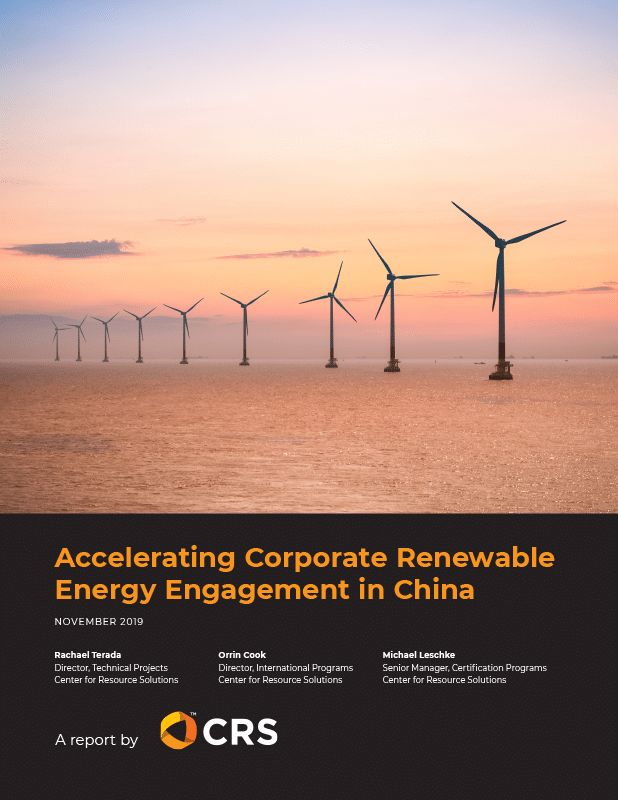
- Accelerating Corporate Renewable Energy Engagement in China
- Author: Rachael Terada, Orrin Cook, Michael Leschke
- Published: November 13th, 2019| Report | 24 Pages
- Report
- 2019
While there are many new and existing mechanisms in China that enable companies to access renewable energy, the Chinese voluntary market is still early in its development, and much more can be done to create market conditions that facilitate a significant scale-up of private investment. This report, released by CRS with funding by Google, LLC., …
- View
- Comments to Public Utilities Commission of the State of Colorado on Public Service Company of Colorado’s Proposed Certified Renewable Percentage Offering
- Author: Todd Jones
- Published: November 8th, 2019| Comment | 3 Pages
- Comment
- 2019
Comments on Public Service Company of Colorado’s (XcelEnergy, Inc.’s) proposed Certified Renewable Percentage (CRP) offering.
- View
- Comments to Public Utilities Commission of the State of Colorado on Public Service Company of Colorado’s Renewable Energy Compliance Plan
- Author: Todd Jones
- Published: November 8th, 2019| Comment | 3 Pages
- Comment
- 2019
Comments on Public Service Company of Colorado’s (XcelEnergy, Inc.’s) WindSource® product offering.
- View
- Comments to the Massachusetts Department of Energy Resources (DOER) on the Clean Peak Standard (CPS) Draft Regulation
- Author: Peggy Kellen
- Published: October 30th, 2019| Comment | 2 Pages
- Comment
- 2019
Comments on the CPS Draft Regulation regarding how Clean Peak Energy Certificates (CPECs) affect consumer claims and may interact with renewable energy certificates (RECs).
- View
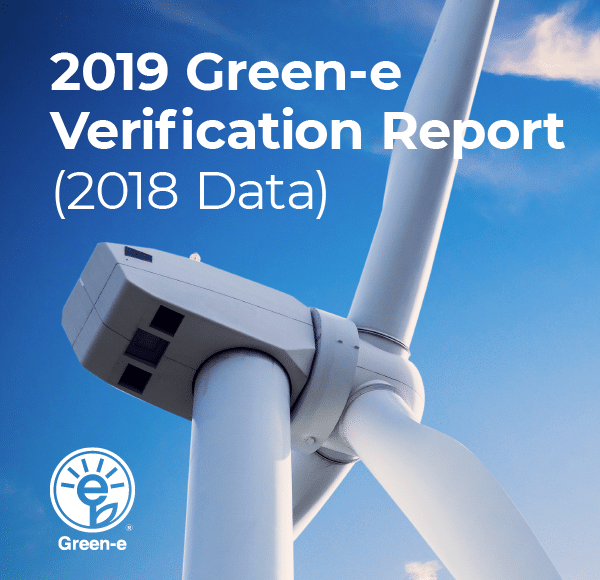
- 2019 Green-e® Verification Report (2018 Data)
- Author: CRS Staff
- Published: October 30th, 2019| Report | 1 Pages
- Report
- 2019
CRS’s Green-e® certification programs certified over 62 million megawatt-hours in retail transactions in 2018, representing an overall increase of 4% compared to 2017 sales. This is the highest number of certified retail MWh to date, and enough to power over half of U.S. households for a month.
- View
- Comments to the California Energy Commission (CEC) on September 6, 2019 Express Terms and Initial Statement of Reasons for Power Source Disclosure and Implementation of Assembly Bill 1110
- Author: Todd Jones
- Published: October 28th, 2019| Comment | 25 Pages
- Comment
- 2019
CRS comments on the regulatory proposal and initial statement of reasons for updating California’s Power Source Disclosure program under Assembly Bill 1110 (Ting), which requires that retail suppliers of electricity disclose to consumers the greenhouse gas emissions intensity of the supplier’s electric service products.
- View
- Comments to Cradle to Cradle Products Innovation Institute on the Cradle to Cradle Certified v4 Draft Standard
- Author: Todd Jones
- Published: September 20th, 2019| Comment | 2 Pages
- Comment
- 2019
Comments on the Cradle to Cradle Certified v4 Draft Standard for sustainable products on renewable energy and climate requirements.
- View
- Comments to the Western Energy Imbalance Market (EIM) on the June 2019 Carbon Workshop Summary of Issues
- Author: Todd Jones
- Published: September 20th, 2019| Comment | 2 Pages
- Comment
- 2019
Comments on the Summary of Issues for the June 2019 Carbon Workshop at the Western Energy Imbalance Market (EIM) Regional Issues Forum (RIF), which summarizes what was discussed and questions raised during the Workshop in order to guide and inform future discussions.
- View
- Comments to the U.S.Energy and Commerce Committee on Approaches to Achieve a 100 Percent Clean Economy by 2050
- Author: Peggy Kellen
- Published: September 13th, 2019| Comment | 2 Pages
- Comment
- 2019
Comments on the request for input on approaches to achieve a 100 percent clean economy by 2050 pertaining to protecting voluntary renewable energy markets and corporate renewable energy demand, purchasing, and emissions benefits.
- View
- Comments to California’s Independent Emissions Market Advisory Committee (IEMAC) to Inform the 2019 Annual Report
- Author: Todd Jones
- Published: August 22nd, 2019| Comment | 4 Pages
- Comment
- 2019
Comments for the 2019 IEMAC Annual Report and the Markets Overlap Subcommittee pertaining to greenhouse gas (GHG) accounting for California electricity imports and potential interactions with Washington State’s Clean Energy Transformation Act.
- View

- CRS NewSolutions (Summer 2019)
- Author:
- Published: August 21st, 2019| Other | 1 Pages
- Other
- 2019
In This Issue: Green-e® Partners With Apple In Asia • Green-e® Renewable Fuels • Policy Update: LCFS • REM 2019 • Just Published • Green-e® Marketplace Certified Events • Lithium Mining in Chile • New Green-e® Participants • In the News • On the Road • Welcome New Staff
- View
- Comments to the Climate Action Reserve on the Climate Forward Draft Solar Photovoltaic Forecast Methodology
- Author: Todd Jones
- Published: July 12th, 2019| Comment | 5 Pages
- Comment
- 2019
Comments on June 6, 2019, Climate Forward Solar Photovoltaic Forecast Methodology v1.0 Draft for Public Comment, which addresses emission reductions associated with the installation of solar photovoltaic systems at existing buildings.
- View
- Comments to The Gold Standard Foundation on the “Envisioning the Voluntary Carbon Market Post-2020” Working Group Statement
- Author: Todd Jones
- Published: July 3rd, 2019| Comment | 4 Pages
- Comment
- 2019
Comments on the Working Group Statement on the future role and design of the voluntary carbon off setmarket, “Envisioning the Voluntary Carbon Market Post-2020. ”Comments pertain assurances and benefits related to additionality and the creation of and accounting for new instruments that finance the acceleration of the global transition to net-zero rather than reducing emissions …
- View
- Comments to the Massachusetts Department of Energy Resources (DOER) on the Clean Peak Standard (CPS) Straw Proposal
- Author: Todd Jones
- Published: April 12th, 2019| Comment | 4 Pages
- Comment
- 2019
Comments on the CPS Straw Proposal presented on April 2, 2019. Comments pertain to avoiding potential double-counting with RECs and ensuring regulatory surplus for the voluntary renewable energy market, as well as verifying that qualified energy storage systems store and discharge renewable energy.
- View
- Comments to the California Energy Commission (CEC) on February 20, 2019 Draft Regulations for Power Source Disclosure and Implementation of Assembly Bill 1110
- Author: Todd Jones
- Published: March 20th, 2019| Comment | 8 Pages
- Comment
- 2019
CRS comments on draft regulations to update California’s Power Source Disclosure requirements under Assembly Bill 1110 (Ting), which requires that retail suppliers of electricity disclose to consumers the greenhouse gas emissions intensity of the supplier’s electric service products.
- View
- Comments to The Climate Registry (TCR) on the Draft General Reporting Protocol Version 3.0
- Author: Todd Jones
- Published: February 28th, 2019| Comment | 11 Pages
- Comment
- 2019
Comments on the draft v3.0 of the General Reporting Protocol, for TCR’s voluntary greenhouse gas (GHG) emissions reporting program. Comments pertain to quantification methodologies for indirect emissions from electricity use, simplified estimation methods, default emissions factors, and offsets.
- View
- Comments to the U.S. Green Building Council (USGBC) on the LEED for Cities and Communities: Existing (Beta) Rating System
- Author: Todd Jones
- Published: February 7th, 2019| Comment | 5 Pages
- Comment
- 2019
Comments on the December 12, 2018 LEED for Cities and Communities: Existing (Beta) rating system, regarding the “EN Credit: Clean and Green Power” and the “EN Prerequisite: Energy Performance.”
- View
- Comments to the Massachusetts Department of Energy Resources (DOER) on the Clean Peak Standard (CPS), Responses to Stakeholder Questions
- Author: Todd Jones
- Published: February 5th, 2019| Comment | 3 Pages
- Comment
- 2019
Responses to questions for stakeholders regarding how DOER should interpret the requirement that a Qualified Energy Storage System operate “primarily to store and discharge renewable energy,” and how resources participating in other state programs should interact with the CPS.
- View
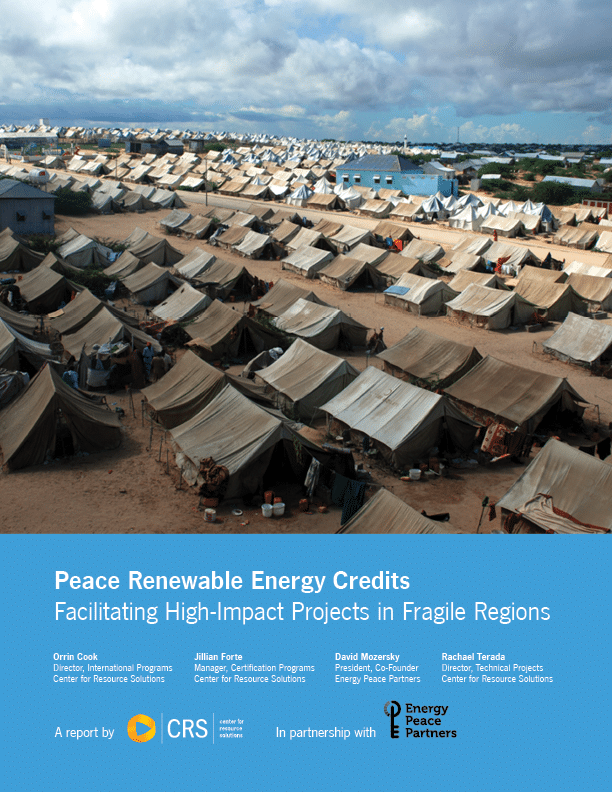
- Peace Renewable Energy Credits: Facilitating High-Impact Projects in Fragile Regions
- Author: CRS and Energy Peace Partners
- Published: January 24th, 2019| Report | 18 Pages
- Report
- 2019
Over 135 million people worldwide are in need of immediate humanitarian assistance because of conflict and climate impacts, with more than 68 million forcibly displaced in 2017. Record numbers of refugees are stretching resources, and global institutions are struggling to respond. At the same time, many of the countries at greatest risk of conflict also …
- View
- 2018 Year in Review
- Author: CRS Staff
- Published: December 22nd, 2018| Document | 1 Pages
- Document
- 2018
In 2018, CRS achieved significant growth, certifying over 60 million MWh of renewable energy through Green-e. We expanded Green-e internationally, introducing standards for Singapore and Chile, and worked with stakeholders in Asia and Latin America to develop renewable energy markets. CRS engaged in state-level policy advocacy on renewable energy regulations and continued educational efforts through …
- View
- Comments on CenterPoint Energy Minnesota Gas Petition to Introduce a Five-Year Renewable Natural Gas Pilot Program
- Author: Todd Jones
- Published: December 14th, 2018| Comment | 4 Pages
- Comment
- 2018
Comments on the August 23, 2018 initial filing of a petition to introduce a five-year Renewable Natural Gas (RNG) pilot program by CenterPoint Energy. Comments address two topics: introduction of the Green-e® Renewable Thermal Certification Standard development process, and CenterPoint Energy’s sponsorship of that process and its role on the Green-e Renewable Thermal Working Group; …
- View

- CRS NewSolutions (Fall/Winter 2018)
- Author: CRS Staff
- Published: December 6th, 2018| Other | 8 Pages
- Other
- 2018
In This Issue: Green-e 2017 Verification Report • Chile Standard • P&G Case Study • Just Published • In the News • IN Case Study • On the Road • New Green-e Participants • International Market Development •AmazonSmile • REM 2019 • Staff Updates
- View
- Information Related to the Impact of a Cap-and-Trade Program in OR on Voluntary Renewable Energy Markets
- Author: Todd Jones
- Published: December 5th, 2018| Comment | 5 Pages
- Comment
- 2018
Comments on the design of a cap-and-trade program in Oregon, with two main issues of concern at this stage: the inclusion of a voluntary renewable energy (VRE) set-aside; and accounting for specified renewable imports, including whether renewable energy certificate (REC) delivery/retirement is required to assign a specified renewable emissions factor to imported power.
- View
- 2017 Green-e Verification Report
- Author: CRS Staff
- Published: November 14th, 2018| Report | 21 Pages
- Report
- 2018
The 2017 Green-e Verification Report highlights the clean-energy market movers for 2017—including generation, utility and community green power programs, PPAs, renewable energy certificates, and more. Green-e certified over 60 million megawatt-hours in retail transactions in 2017, the highest number of certified retail MWh to date, and enough to power over half of U.S. households for …
- View

- Clean Energy Certificates and Emissions Trading in Mexico: Reciprocal Effects and Interactions
- Author: CRS Staff
- Published: November 1st, 2018| Report | 55 Pages
- Report
- 2018
A report written by CRS that examines interactions between a new Mexican Emissions Trading System and the existing “clean energy certificate” quota system. Published by the German international development company Deutsche Gesellschaft für Internationale Zusammenarbeit (GIZ) in partnership with the Mexican Ministry for the Environment and Natural Resources (SEMARNAT).
- View
- Comments on October 9, 2018 CA Assembly Bill 1110 Implementation Proposal for Power Source Disclosure, Third Version
- Author: Todd Jones
- Published: October 25th, 2018| Comment | 13 Pages
- Comment
- 2018
CRS comments on recent proposals for changes to California’s Power Source Disclosure requirements under Assembly Bill 1110 (Ting), which require that retail suppliers of electricity disclose to consumers the greenhouse gas emissions intensity of the supplier’s electric service products. CRS comments propose updates to the current version of the requirements.
- View
- Comments in response to the Second Revision of the Discussion Draft of the 2019 Bill Request for Fuel Mix Disclosure in WA
- Author: Todd Jones
- Published: October 12th, 2018| Comment | 5 Pages
- Comment
- 2018
Comments on the September 6, 2018 draft of the WA Department of Commerce’s proposed fuel mix legislation for 2019, and additional comments following the October 1, 2018 revised draft. Specifically, additional feedback on treatment of renewable energy certificates (RECs) that have been unbundled from the energy and used for compliance with Washington’s Renewable Portfolio Standard …
- View
- Comments on IEMAC Meeting Materials for Sept. 21, 2018 and Draft Subcommittee Reports
- Author: Todd Jones
- Published: October 5th, 2018| Comment | 5 Pages
- Comment
- 2018
Comments focused on potential double counting and leakage due to accounting for the emissions associated with imported electricity under the Mandatory Reporting Regulation (MRR). This pertains to both the Subcommittee Report on Overlapping Policies and the Report on Emissions Leakage.
- View
- Comments on CA EPA’s Independent Emissions Market Advisory Committee (IEMAC) Meeting Materials and Draft Subcommittee Reports
- Author: Todd Jones
- Published: October 5th, 2018| Comment | 5 Pages
- Comment
- 2018
Comments focused on potential double counting and leakage due to accounting for the emissions associated with imported electricity under the Mandatory Reporting Regulation (MRR). Comments pertain to both the Subcommittee Report on Overlapping Policies and the Report on Emissions Leakage.
- View

- Best Practices for Marketing Community Solar Programs
- Author: CRS Staff
- Published: September 24th, 2018| Document | 2 Pages
- Document
- 2018
A handout given out at the 2018 Solar Power International conference that offers guidance for developers marketing community solar programs to retail customers, including best practices, example marketing statements, and case studies.
- View

- How Markets Can Move the Needle on Climate Change (IETA Insights No. 3)
- Author: Todd Jones
- Published: September 5th, 2018| Document | 3 Pages
- Document
- 2018
CRS contributed to the International Emissions Trading Association (IETA)’s IETA Insights: Greenhouse Gas Market Report, published in September 2018. The article, by CRS’s Todd Jones, is a look at the intersection of voluntary renewable energy purchasing by corporates with emissions markets, drawing from experience in the U.S.
- View
- Impactful Corporate Renewable Energy Procurement in States With Carbon Policies
- Author: Todd Jones
- Published: August 31st, 2018| Report | 3 Pages
- Report
- 2018
The impact of renewable energy purchases by corporations may be reduced in states with cap-and-trade and other greenhouse gas (GHG) regulations covering the power sector. Commercial buyers should ensure that their projects are reducing emissions in states with cap-and-trade and other GHG policies.
- View

- Advocacy Positions to Support Corporate Renewable Energy Procurement Under Greenhouse Gas Regulation in the Power Sector
- Author: Todd Jones
- Published: August 31st, 2018| Report | 6 Pages
- Report
- 2018
Corporate and other voluntary green power procurement strategies can offer additional greenhouse gas (GHG) benefits on top of regulations like cap-and-trade—provided the right policy and accounting mechanisms are in place. This document highlights the advocacy positions CRS developed to support GHG regulations in the power sector.
- View
- Guide to Purchasing Green Power: Renewable Electricity, Renewable Energy Certificates, and On-Site Renewable Generation
- Author: EPA, the U.S. Department of Energy (DOE), World Resources Institute (WRI), and Center for Resource Solutions (CRS), and the National Renewable Energy Laboratory (NREL)
- Published: August 14th, 2018| Report | 149 Pages
- Report
- 2018
The Guide provides current and potential buyers of green power with information about green power purchasing. It covers the green power procurement process, different green power supply options, benefits of green power purchasing, as well as information on how to capture the greatest benefit from your purchase.
- View
- Comments in Response to the July 6th Questions for Stakeholder Comment on the New Jersey Community Solar Energy Pilot Program (Docket No. QO18060646)
- Author: Noah Bucon
- Published: July 31st, 2018| Document | 4 Pages
- Document
- 2018
These comments to the State of New Jersey Board of Public Utilities provides information on industry best practices for consumer protection and the treatment of Renewable Energy Certificates (RECs) associated with community solar programs. These comments echo much of what CRS stated in its previous comments on the BPU Generic Solar Proceeding that were submitted …
- View
- Comments on Virginia’s January 8, 2018 Proposed Regulation 9VAC5-140, Regulation for Emissions Trading Programs
- Author: Todd Jones
- Published: April 9th, 2018| Comment | 13 Pages
- Comment
- 2018
Comments on the benefits of incorporating a renewable energy set-aside mechanism into Virginia’s proposed emissions trading program that would protect voluntary and corporate renewable energy demand, purchasing, and emissions benefits in VA as the state looks to join the Regional Greenhouse Gas Initiative (RGGI).
- View
- Comments to the U.S. Environmental Protection Agency on Advanced Notice of Proposed Rulemaking on State Guidelines for Greenhouse Gas Emissions from Existing Sources
- Author: Todd Jones
- Published: February 26th, 2018| Comment | 5 Pages
- Comment
- 2018
Comments on the benefits of incorporating a mechanism to protect voluntary and corporate renewable energy demand, purchasing, and emissions benefits under potential regulation of greenhouse gas emissions from electric utility generating units.
- View
- Comments to the California Energy Commission on the Revised Proposal for Implementation of AB 1110 and Power Source Disclosure
- Author: Todd Jones
- Published: February 23rd, 2018| Comment | 26 Pages
- Comment
- 2018
CRS issues a second set of comments regarding fundamental misunderstandings and conflations of important concepts that continue to persist and are again reflected in the Revised Proposal for implementation of AB 1110. Our first set of comments were submitted on July 28, 2017 for the June 27, 2017 Initial Proposal, which do not appear to …
- View
- Overview of Renewable Portfolio Standard Design Options from the U.S. Experience
- Author: Jillian Forte, Todd Jones, Michael Leschke, Jennifer Martin, Alex Pennock, Rachael Terada, Ryan Wiser
- Published: December 28th, 2017| Report | 10 Pages
- Report
- 2017
This report highlights the main principles and options that inform Renewable Portfolio Standard (RPS) program design based on experiences in the United States. Applicable examples are highlighted throughout the report, and an overview of implications for China is included at the end of the report. This report is also available in Mandarin.
- View
- Comments in Response to the November 27th Questions for Stakeholder Comment on the New Jersey Board of Public Utilities (BPU) Generic Solar Proceeding
- Author: Noah Bucon
- Published: December 15th, 2017| Comment | 4 Pages
- Comment
- 2017
Comments in response to the recently published questions for stakeholders to address regarding the New Jersey Generic Solar Proceeding. The intent of these comments is to provide information on industry best practices in regard to the treatment of Renewable Energy Certificates (RECs) and consumer protection standards for solar energy marketing and consumption claims. CRS strongly …
- View
- Comments following the November 6, 2017 Public Workshop on the California Air Resources Board Preliminary Draft of Potential Regulatory Amendments to the Low Carbon Fuel Standard (LCFS)
- Author: Noah Bucon
- Published: December 4th, 2017| Comment | 4 Pages
- Comment
- 2017
Comments in response to the potential regulatory amendments to the Low Carbon Fuel Standard. The intent of these comments is to provide information on industry best practices in regard to the treatment of Renewable Energy Certificates (RECs) in the fuel pathway involving the use of renewable energy to charge electric vehicles, specifically the use of …
- View
- Comments on the Illinois Power Agency (IPA) Long-Term Renewable Resources Procurement Plan
- Author: Noah Bucon
- Published: November 13th, 2017| Comment | 4 Pages
- Comment
- 2017
The intent of these comments is to provide information on industry best practices in regard to Section 7.6.3: Marketing Claims Related to the Ownership of RECs and Community Renewable Generation Subscriptions. Specifically, the decision to allow utilities to retire the associated Renewable Energy Certificates (RECs) for Renewable Portfolio Standard (RPS) compliance raises significant issues for …
- View
- Voluntary Renewable Energy Set-Asides For Cap-And-Trade (Fact Sheet)
- Author: CRS Staff
- Published: October 17th, 2017| Report | 4 Pages
- Report
- 2017
A companion piece to Corporate and Voluntary Renewable Energy in State Greenhouse Gas Policy: An Air Regulator’s Guide, this fact sheet details the options available to states as they consider adoption and implementation of cap-and-trade or similar carbon regulation programs, and the impacts of these programs on renewable energy development and the voluntary renewable energy …
- View
- Corporate and Voluntary Renewable Energy in State Greenhouse Gas Policy: An Air Regulator’s Guide
- Author: Todd Jones, Noah Bucon
- Published: October 17th, 2017| Report | 40 Pages
- Report
- 2017
This guide evaluates the effect of GHG regulations for the power sector on voluntary renewable energy, and vice-versa. It includes guidance for states to prevent GHG regulation from removing the grid emissions benefits of voluntary renewable energy and maintain private investment in emissions-reducing renewable energy.
- View
- Supplemental comments to the California Energy Commission on GHG Emissions Intensity Calculation Proposal for Implementation of AB 1110 and Power Source Disclosure
- Author: Todd Jones
- Published: October 3rd, 2017| Comment | 3 Pages
- Comment
- 2017
Supplemental comments in response to PG&E’s Supplemental Comments Regarding Greenhouse Gas (GHG) Methodology and Supplemental GHG Metric Presentation (Docketed August 23, 2017). CRS expresses a concern that if RECs are not required as a part of demonstrating an LSE’s share of GHG-free from renewables delivered in a given hour, there is a potential for double …
- View
- Comments Following the September 7 Workshop on the Iowa Utilities Board (IUB) Renewable Energy Percentage Verification
- Author: Noah Bucon
- Published: September 19th, 2017| Comment | 2 Pages
- Comment
- 2017
Additional comments in response to the September 7 Workshop on Renewable Energy Percentage Verification. The intent of these comments is primarily to reiterate our previous written and oral comments. CRS supports the use of verified Renewable Energy Certificates (RECs) to account for the delivery and consumption of renewable energy, regardless of whether the RECs were …
- View
- Voluntary and Corporate Renewable Energy in New York: Challenges to Maximizing Voluntary Benefits and Meeting State Goals
- Author: CRS Staff
- Published: September 11th, 2017| Report | 6 Pages
- Report
- 2017
The last of three policy briefs prepared with the Pace Energy and Climate Center focusing on voluntary renewable energy in the Northeast United States, this brief focuses on New York state in particular. It describes the unique regulatory landscape for voluntary renewable energy, identifies potential barriers to voluntary renewable energy development in the state as …
- View
- Voluntary and Corporate Renewable Energy in New York: Challenges to Maximizing Voluntary Benefits and Meeting State Goals (Executive Summary)
- Author: CRS Staff
- Published: September 11th, 2017| Report | 2 Pages
- Report
- 2017
The last of three policy briefs prepared with the Pace Energy and Climate Center focusing on voluntary renewable energy in the Northeast United States, this brief focuses on New York state in particular. It describes the unique regulatory landscape for voluntary renewable energy, identifies potential barriers to voluntary renewable energy development in the state as …
- View
- Voluntary Renewable Energy and the Regional Greenhouse Gas Initiative: Solutions for Positive Interactions and Greater Impact
- Author: CRS Staff
- Published: September 11th, 2017| Report | 7 Pages
- Report
- 2017
The second of three policy briefs prepared with the Pace Energy and Climate Center focusing on voluntary renewable energy in the Northeast United States, this brief identifies interactions between the voluntary renewable energy market and the Regional Greenhouse Gas Initiative (RGGI). It also provides recommendations for strengthening mechanisms that protect voluntary demand in RGGI states.
- View
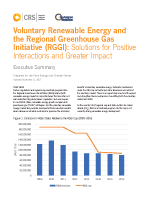
- Voluntary Renewable Energy and the Regional Greenhouse Gas Initiative: Solutions for Positive Interactions and Greater Impact (Executive Summary)
- Author: CRS Staff
- Published: September 11th, 2017| Report | 2 Pages
- Report
- 2017
The second of three policy briefs prepared with the Pace Energy and Climate Center focusing on voluntary renewable energy in the Northeast United States, this brief identifies interactions between the voluntary renewable energy market and the Regional Greenhouse Gas Initiative (RGGI). It also provides recommendations for strengthening mechanisms that protect voluntary demand in RGGI states. …
- View
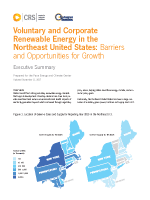
- Voluntary and Corporate Renewable Energy in the Northeast United States: Barriers and Opportunities for Growth (Executive Summary)
- Author: CRS Staff
- Published: September 11th, 2017| Report | 2 Pages
- Report
- 2017
The first of three policy briefs prepared with the Pace Energy and Climate Center focusing on voluntary renewable energy in the Northeast United States, this brief explains the current and potential value of voluntary renewable energy to meet state goals in the region. It also identifies key barriers to renewable energy development to meet voluntary …
- View
- Voluntary and Corporate Renewable Energy in the Northeast United States: Barriers and Opportunities for Growth
- Author: CRS Staff
- Published: September 11th, 2017| Report | 7 Pages
- Report
- 2017
The first of three policy briefs prepared with the Pace Energy and Climate Center focusing on voluntary renewable energy in the Northeast United States, this brief explains the current and potential value of voluntary renewable energy to meet state goals in the region. It also identifies key barriers to renewable energy development to meet voluntary …
- View
- Comments on the July 28, 2017 Order Setting Reply Comments on Rule Making for Renewable Energy Percentage Verification (Iowa)
- Author: Noah Bucon
- Published: August 7th, 2017| Comment | 4 Pages
- Comment
- 2017
CRS comments in response to the July 28, 2017 Order Setting Reply Comments on Renewable Energy Percentage Verification. The intent of these comments is to inform the Iowa Utilities Board (IUB) of industry best practices for renewable energy accounting, especially in regard to the treatment of Renewable Energy Certificates (RECs). While CRS supports the intent …
- View
- Comments to the California Energy Commission on the Initial Proposal for Implementation of AB 1110 and Power Source Disclosure
- Author: Todd Jones
- Published: July 28th, 2017| Comment | 14 Pages
- Comment
- 2017
CRS is providing comments to the CEC to help illuminate fundamental misunderstandings of important concepts among Commission Staff, Air Resources Board (ARB) Staff, and other stakeholders. These comments include a section on Accuracy to try to address misunderstandings and conflations. Following that, we provide our comments on the Proposal, which are divided into Primary and …
- View
- Two Markets, Overlapping Goals: Exploring The Intersection Of RPS And Voluntary Markets For Renewable Energy In The U.S.
- Author: Todd Jones
- Published: July 1st, 2017| Report | 22 Pages
- Report
- 2017
This paper, produced for the RPS Collaborative, a project of the Clean Energy States Alliance (CESA), explores interactions between RPS and voluntary markets for renewable energy in the U.S. and outlines principles for supporting continued growth of both markets. These principles preserve the ability of each market to make separate and incremental contributions to renewable …
- View
- Comments on April 17, 2017 Joint California Agency Workshop on Potential Methodologies to Establish Greenhouse Gas Reduction Targets for Publicly Owned Utility Integrated Resource Plans
- Author: Todd Jones
- Published: May 1st, 2017| Comment | 3 Pages
- Comment
- 2017
- View
- Policies for Enabling Corporate Sourcing of Renewable Energy Internationally
- Author: Todd Jones, Orrin Cook, Various
- Published: May 1st, 2017| Document | 63 Pages
- Document
- 2017
This paper from the National Renewable Energy Laboratory (NREL), co-authored by Todd Jones and Orrin Cook from CRS, explores the policy and regulatory enabling environment for corporate sourcing of renewables. It was developed in support of the Corporate Sourcing of Renewables Campaign, which was launched at the Clean Energy Ministerial (CEM) meeting in June 2016. …
- View
- Comments to the California Air Resources Board (CARB) on 45-day Proposed Amendments to the Regulation for the Mandatory Reporting of Greenhouse Gas Emissions (MRR)
- Author: Todd Jones
- Published: April 28th, 2017| Document | 5 Pages
- Document
- 2017
- View
- Supplemental Comments to the California Air Resources Board (CARB) on 45-day Proposed Amendments to the California Cap on Greenhouse Gas Emissions and Market-based Compliance Mechanisms, and California Voluntary Renewable Electricity Program (VREP) Projections
- Author: Todd Jones
- Published: April 28th, 2017| Document | 8 Pages
- Document
- 2017
- View
- Comments to the Michigan Public Service Commission (MPSC) in response to request for comments on voluntary green pricing programs under MCL 460.1061
- Author: Todd Jones
- Published: April 28th, 2017| Document | 4 Pages
- Document
- 2017
- View
- Comments to the Oregon Public Utility Commission (OPUC) in response to Final Draft Rules for Oregon’s Community Solar Program
- Author: Todd Jones
- Published: April 20th, 2017| Document | 3 Pages
- Document
- 2017
- View
- Comments to the California Air Resources Board (CARB) on the Scoping Plan Update: The Proposed Strategy for Achieving California’s 2030 Greenhouse Gas Target and Draft Environmental Analysis
- Author: Todd Jones
- Published: April 10th, 2017| Document | 2 Pages
- Document
- 2017
Comments regarding preserving emission benefits of voluntary renewable energy (VRE) beyond 2020. The comments pertain specifically to continuing allocations to the VRE Reserve Account.
- View
- Comments to the Western Renewable Energy Generation Information System (WREGIS) on Proposed Appendix G addition to the WREGIS Operating Rules
- Author: Michael Leschke
- Published: March 27th, 2017| Document | 2 Pages
- Document
- 2017
Comments regarding the Appendix G addition to the WREGIS Operating Rules specifically pertaining to issuance of TRECs and RECs.
- View
- Comments to the California Energy Commission (CEC) on proposed Pre-Rulemaking Updates to Power Source Disclosure (PSD) Regulations, scoping questions
- Author: Todd Jones
- Published: March 15th, 2017| Document | 9 Pages
- Document
- 2017
Comments on Preliminary Scoping Questions for the February 21 Workshop on Updates to PSD Regulations.
- View
- Comments to the New Jersey Clean Energy Program (NJCEP) in response to Preliminary Draft Solar Disclosure Statements and website content
- Author: Todd Jones
- Published: March 10th, 2017| Document | 3 Pages
- Document
- 2017
- View
- Comments on the EPA Renewables Enhancement and Growth Support Rule, Docket ID No. EPA-HQ-OAR-2016-0041
- Author: Maya Kelty
- Published: February 16th, 2017| Comment | 4 Pages
- Comment
- 2017
CRS’s comments focus on Section VII of the proposed rule, Generating RINs for Renewable Electricity—the proposal to include a pathway in the Renewable Fuel Standard (RFS) regulations that allows for Renewable Identification Number (RIN) generation for the use of renewable electricity generated from biogas as a transportation fuel.
- View
- Comments to the CA Air Resources Board on Renewable Electricity in the Low Carbon Fuel Standard (LCFS)
- Author: Maya Kelty
- Published: January 6th, 2017| Comment | 4 Pages
- Comment
- 2017
Comments to the California Air Resources Board (ARB) regarding potential changes to how electricity used as a transportation fuel is treated in the ARB’s Low Carbon Fuel Standard (LCFS) Program (pursuant to California Assembly Bill AB 32 and the Governor’s Executive Order S-01-07). These comments pertain to the use of renewable electricity as a transportation …
- View

- Solar Energy on Campus (Part IV: Community Purchasing Campaigns and Renewable Energy Usage Claims)
- Author: CRS Staff
- Published: December 29th, 2016| Report | 3 Pages
- Report
- 2016
This document focuses on Solarize Campaigns, a community solar option available to higher education institutions.
- View
- Solar Energy on Campus (Part III: Key Considerations for Solar Developers Working With Higher Education Institutions)
- Author: CRS Staff
- Published: December 29th, 2016| Report | 2 Pages
- Report
- 2016
This document outlines best practices for developers marketing renewable energy products to customers, some of the risks and consequences associated with misleading marketing, and additional factors that solar developers need to consider when creating a marketing strategy and associated materials.
- View

- 2016 Year in Review
- Author: CRS Staff
- Published: December 22nd, 2016| Document | 1 Pages
- Document
- 2016
In 2016, CRS expanded its global reach, developing renewable energy certification frameworks for Asia and Europe, including a new standard for Singapore. Domestically, CRS advanced clean energy policy by collaborating with state regulators and federal agencies like the EPA and FTC, influencing initiatives such as the Clean Power Plan. The Green-e program, CRS’s flagship initiative, …
- View
- Comments to the NY PSC on “Notice Soliciting Comments on Staff Report and Recommendations” on the Value of Distributed Energy Resources Proceeding, Case 15-E-0715
- Author: Maya Kelty
- Published: December 5th, 2016| Comment | 4 Pages
- Comment
- 2016
CRS’s comments relate to Section “2.5.5 Environmental Value” of Staff’s Report and Recommendations, and focus on the assignment of RECs from renewable energy distributed energy resource (DER) generation projects.
- View
- The Greenhouse Gas Benefits of Renewable Energy Purchases
- Author: CRS Staff
- Published: November 30th, 2016| Report | 2 Pages
- Report
- 2016
A fact sheet providing guidance on communicating the benefits of renewable energy purchases.
- View
- Comments regarding the Arizona Corporation Commission’s (ACC’s) Docket No. E-00000Q-16-0289, on An Examination into the Modernization of the Expansion of the Arizona Renewable Energy Standard and Tariff
- Author: Maya Kelty
- Published: November 30th, 2016| Comment | 10 Pages
- Comment
- 2016
- View
- Comments on CPUC Energy Division Staff White Paper on Implementing GHG Planning Targets in the Integrated Resource Planning Process (Proceeding R.16-02-007)
- Author: Todd Jones
- Published: November 30th, 2016| Comment | 3 Pages
- Comment
- 2016
Comments on the California Public Utilities Commission (CPUC) Energy Division Staff’s White Paper on Implementing GHG Planning Targets in the IRP Process. Comments are focused on Question for Parties no. 6, the methodologies for developing and reporting against GHG planning targets and the relevance of other methodologies/protocols developed for other state programs, and the treatment …
- View
- Comments in response to the October 21, 2016 California Cap-and-Trade Regulation Amendments Workshop
- Author: Todd Jones
- Published: November 4th, 2016| Comment | 2 Pages
- Comment
- 2016
CRS comments regarding potential 2016 amendments to the California Cap-and-Trade Regulation discussed at the workshop held on October 21, 2016. Comments focus on post-2020 allowance allocation to Electrical Distribution Utilities (EDUs) and, in particular, on Staff’s most recent proposal regarding the RPS Adjustment, included in the Post-2020 Electrical Distribution Utility Allocation Informal Proposal. Comments also …
- View
- Comments on EPA Clean Energy Incentive Program Design Details, Docket ID No. EPA–HQ–OAR–2016–0033
- Author: Todd Jones
- Published: November 1st, 2016| Comment | 2 Pages
- Comment
- 2016
Comments to the U.S. EPA on the June 2016 Clean Energy Incentive Program (CEIP) Design Details (“CEIP Proposed Rule”).
- View
- Comments regarding the City of San Diego’s RFI 10079755-17-A, Solutions to Support the City of San Diego’s Goal of 100% Renewable Energy
- Author: Maya Kelty
- Published: October 21st, 2016| Comment | 8 Pages
- Comment
- 2016
Comments in response to the 10 questions outlined in the RFI issued on September 23, 2016 on solutions to support the City of San Diego’s Goal of 100% renewable energy.
- View

- 2015 Green-e Verification Report
- Author: CRS Staff
- Published: October 16th, 2016| Report | 12 Pages
- Report
- 2016
Results and analysis of the 2015 reporting year for the Green‑e certification program. Green‐e Energy certified retail sales reached over 44 million megawatt‐hours (MWh) in 2015, the highest number of certified retail MWh in Green-e history and equivalent to over 1.2% of the total U.S. electricity mix.
- View
- Comments to the New York Public Service Commission in Response to Notice Soliciting Comments on Request for Clarification Issued September 12, 2016
- Author: Todd Jones
- Published: September 30th, 2016| Comment | 4 Pages
- Comment
- 2016
Comments on the New York State Energy Research and Development Authority’s (NYSERDA’s) petition requesting clarification regarding the status of attributes associated with NY-Sun and other Customer-Sited Tier (CST) projects in light of the Clean Energy Standard (CES) Order’s filing requirements requesting NYSERDA to publish the number of Renewable Energy Credits (RECs) that will be available …
- View

- Solar Energy on Campus (Part II: Solar Purchasing Options and Communicating Renewable Energy Use)
- Author: CRS Staff
- Published: September 30th, 2016| Report | 6 Pages
- Report
- 2016
This report examines the solar purchasing options available to higher education institutions, and the fundamental components of each deal that affect renewable energy certificate (REC) ownership, claims, and the environmental value of solar investments.
- View
- Comments on Proposed Amendments to the California Cap on Greenhouse Gas Emissions and Market-based Compliance Mechanisms
- Author: Todd Jones
- Published: September 19th, 2016| Comment | 9 Pages
- Comment
- 2016
Comments focusing on future allocations to the Voluntary Renewable Electricity (VRE) Reserve Account and the proposal to remove the requirement that Renewable Energy Credit (REC) serial numbers be reported with specified renewable energy (RE) imports.
- View
- Voluntary Renewable Energy Set-Asides For Mass-Based State Plans
- Author: CRS Staff
- Published: August 26th, 2016| Report | 6 Pages
- Report
- 2016
An exploration of how mass-based states under the EPA’s Clean Power Plan can avoid damaging the voluntary market for renewable energy through careful plan design that ensures the impact of voluntary demand for and private investment in renewable energy.
- View
- Solar Energy on Campus (Part I: Renewable Energy Usage Claims)
- Author: CRS Staff
- Published: August 8th, 2016| Report | 3 Pages
- Report
- 2016
This report describes renewable energy certificates (RECs), why they are important, and what kinds of statements can be made depending on who owns them.
- View
- Comments regarding the U.S. Department of Energy SunShot Initiative’s Request for Information (RFI) DE-FOA-0001614, on the Community Solar Challenge
- Author: Michael Leschke
- Published: July 27th, 2016| Comment | 3 Pages
- Comment
- 2016
Comments submitted in response to the Request for Information issued on the SunShot Initiative’s proposed Community Solar Challenge. Comments focus on the importance of accurate claims and Renewable Energy Certificate (REC) ownership in community solar projects and the benefits of Green-e certification.
- View
- Comments on Chapter 173-442 WAC, Clean Air Rule Draft Proposal
- Author: Todd Jones
- Published: July 22nd, 2016| Comment | 8 Pages
- Comment
- 2016
CRS applauds the state of Washington for proposing such a comprehensive system for reducing greenhouse gas (GHG) emissions, and comments on the Clean Air Rule (CAR) draft proposal. Comments are focused on potential interactions with existing renewable energy (RE) markets and market instruments.
- View
- Comments in response to the June 16, 2016 Additional 15-Day Notice and Express Terms for the Power Source Disclosure Program (DOCKET NO. 14-OIR-01)
- Author: Todd Jones
- Published: July 1st, 2016| Comment | 4 Pages
- Comment
- 2016
Comments to the California Energy Commission on the Additional 15-Day Language for Power Source Disclosure (PSD) Program Implementation Rulemaking (“June 2016 Additional 15-Day Language”), released for public comment on June 16, 2016.
- View
- Comments on the MD Notice of Proposed Action 16-104-P, Subtitle 62 Community Solar Energy Generation Systems (CSEGS)
- Author: Todd Jones
- Published: May 27th, 2016| Comment | 5 Pages
- Comment
- 2016
Comments on the Maryland Public Service Commission’s (PSC’s) Proposed Action 16-104-P to adopt new regulations under Subtitle 62 Community Solar Energy Generation Systems (CSEGS), as described in the Maryland Register, Volume 43, Issue 9, Friday, April 29, 2016. Comments focus on Renewable Energy Credit (REC) ownership under the Pilot Program and consumer protection requirements for …
- View
- Comments for the NY Public Service Commission, Proposed Rulemaking I.D. No. PSC-14-16-00008-P Resetting Retail Markets for ESCO Mass Market Customers
- Author: Todd Jones
- Published: May 12th, 2016| Comment | 5 Pages
- Comment
- 2016
Comments submitted in response to the April 6, 2016 Proposed Rulemaking I.D. No. PSC-14-16-00008-P Resetting Retail Markets for ESCO Mass Market Customers. Comments focus on providing information about the function and value of carbon offset natural gas programs offered by retail natural gas providers, and the benefits of Green-e certification.
- View
- Comments of CRS for consideration at the FTC’s “Something New Under the Sun: Competition and Consumer Protection Issues in Solar Power” Workshop
- Author: Todd Jones
- Published: May 9th, 2016| Comment | 73 Pages
- Comment
- 2016
Comments on the topics to be covered at the workshop focusing specifically on the consumer protection issues to be covered. Also a selection of materials developed by CRS to educate and inform solar consumers, suppliers, and other interested parties. And short responses to certain questions included in the Workshop Notice related to consumer protection.
- View
- Comments from CRS for the April 29, 2016 Regional Greenhouse Gas Initiative (RGGI) Stakeholder Meeting for the 2016 Program Review
- Author: Todd Jones
- Published: May 5th, 2016| Comment | 3 Pages
- Comment
- 2016
CRS comments as part of the April 29, 2016 RGGI Stakeholder Meeting and 2016 Program Review. Comments focus on incorporating a mechanism for voluntary retirement of RGGI Allowances as a program design element and new functionality in the RGGI CO2 Allowance Tracking System (COATS).
- View
- Making Credible Renewable Electricity Usage Claims
- Author: Jared Braslawsky, Todd Jones, Mary Sotos
- Published: May 3rd, 2016| Report | 16 Pages
- Report
- 2016
“Making credible renewable electricity usage claims” from RE100 is a technical deep-dive into corporate transparency and credibility, and shows companies how to accurately describe their use of renewable electricity. It is authored by members of the RE100 Technical Advisory Group, which provides RE100 companies with best practice guidance on the use of renewable power, to …
- View
- Comments of Center for Resource Solutions (CRS) in response to the California Air Resources Board’s March 29, 2016 Workshop on Cap-and-Trade Regulation Post-2020 Emissions Caps and Allowance Allocation
- Author: Todd Jones
- Published: April 12th, 2016| Comment | 4 Pages
- Comment
- 2016
- View
- Comments of Center for Resource Solutions (CRS) in response to the California Energy Commission’s March 2016 Power Source Disclosure Program Implementation 15-Day Language
- Author: Todd Jones
- Published: April 12th, 2016| Comment | 9 Pages
- Comment
- 2016
- View
- Comments of Center for Resource Solutions (CRS) on February 25, 2016 Cap and Trade Regulatory Proposal and Revised Guideline for Greenhouse Gas Emissions Reporting in Ontario, Canada
- Author: Todd Jones
- Published: April 7th, 2016| Comment | 4 Pages
- Comment
- 2016
- View
- Comments of Center for Resource Solutions (CRS) in response to the California Energy Commission’s March 17, 2016 Workshop on Future Edition of Renewable Portfolio Standard (RPS) Eligibility Guidebook
- Author: Todd Jones
- Published: March 29th, 2016| Comment | 2 Pages
- Comment
- 2016
- View
- Summary of Information on California Assembly Bill (AB) 1110
- Author: Todd Jones
- Published: March 9th, 2016| Report | 2 Pages
- Report
- 2016
This document summarizes information presented in a letter from CRS to California Assembly Member Phil Ting dated August 18, 2015 regarding AB 1110.
- View
- How Renewable Energy Certificates Make a Difference
- Author: Todd Jones
- Published: March 7th, 2016| Report | 2 Pages
- Report
- 2016
A fact sheet explaining the impacts and benefits of buying renewable energy through renewable energy certificates (RECs).
- View
- Additionality and Renewable Energy Certificates
- Author: Todd Jones
- Published: March 7th, 2016| Report | 2 Pages
- Report
- 2016
A fact sheet that explains the role of additionality in understanding the value of renewable energy certificate (REC) claims.
- View
- Comments of Center for Resource Solutions (CRS) in response to California Air Resource Board’s February 24, 2016 Workshop on Potential Amendments to the Greenhouse Gas Mandatory Reporting and Cap-and-Trade Regulations
- Author: Todd Jones.
- Published: March 4th, 2016| Comment | 4 Pages
- Comment
- 2016
- View
- Joint Stakeholder Comments Regarding the Preservation and Continued Use of a Voluntary Renewable Energy Set-Aside Mechanism to Accommodate the Voluntary Markets for Renewable Energy in the RGGI States
- Author: Acadia Center, Center for Resource Solutions, CLF, Environment America, Environment Connecticut, Environment Maine, Environment Maryland, Environment Massachusetts, Environment New Hampshire Environment New York, Environment Rhode Island, Natural Resources Council of Maine, Natural Resources Defense Council, Pace Energy and Climate Center, Sierra Club, Union of Concerned Scientists
- Published: March 1st, 2016| Comment | 2 Pages
- Comment
- 2016
- View
- Joint Stakeholder Comments for the March 1, 2016 Public Workshop and Listening Session Regarding the Delaware Clean Power Plan
- Author: Acadia Center CRS, CLF, Environment America, Natural Resources Council of Maine, NRDC, Pace Energy and Climate Center, Sierra Club, Union of Concerned Scientists
- Published: March 1st, 2016| Comment | 4 Pages
- Comment
- 2016
- View

- Green-e Energy Federal Option FAQs
- Author: CRS Staff
- Published: February 23rd, 2016| Other | 3 Pages
- Other
- 2016
Information on the Green-e Energy Federal Option Product type, which allows certified sales to federal departments and agencies under Executive Order 13693.
- View
- Comments of Center for Resource Solutions (CRS) on California Energy Commission’s Modification of Regulations Governing the Power Source Disclosure Program, Docket No. 14-OIR-01
- Author: Todd Jones
- Published: February 19th, 2016| Comment | 5 Pages
- Comment
- 2016
- View
- Comments of Center for Resource Solutions (CRS) on modifying the Environmental Disclosure Labeling Program (EDP) for consistency with the proposed New York Generation Attribute Tracking System (NYGATS)
- Author: Todd Jones
- Published: February 8th, 2016| Comment | 16 Pages
- Comment
- 2016
- View
- Comments of Center for Resource Solutions (CRS) on Proposed Federal Plan and Model Trading Rules for the Clean Power Plan
- Author: Todd Jones
- Published: January 21st, 2016| Comment | 7 Pages
- Comment
- 2016
- View
- Informal Comments of Center for Resource Solutions (CRS) regarding the California Air Resources Board (ARB) Cap‐and‐Trade Regulation 2016 Amendments
- Author: Todd Jones
- Published: January 20th, 2016| Comment | 3 Pages
- Comment
- 2016
- View
- Comments on Sustainability Accounting Standards Board (SASB) Public Exposure Draft Standards ‐ Infrastructure
- Author: Todd Jones
- Published: January 4th, 2016| Comment | 4 Pages
- Comment
- 2016
- View
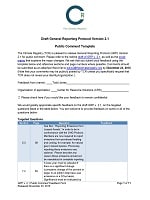
- Comments of Center for Resource Solutions (CRS) on The Climate Registry’s Draft General Reporting Protocol Version 2.1
- Author: Todd Jones
- Published: December 22nd, 2015| Comment | 11 Pages
- Comment
- 2015
- View

- 2015: New Pathways for Clean Energy
- Author: CRS Staff
- Published: December 21st, 2015| Document | 1 Pages
- Document
- 2015
CRS highlights global progress in promoting renewable energy adoption, environmental sustainability, and global clean energy markets. CRS made notable advancements through its Green-e® programs, which certify renewable energy and carbon offset products, ensuring their integrity and transparency. CRS also supported policymakers and market stakeholders by providing technical expertise on renewable energy tracking systems and greenhouse …
- View
- Comments of Center for Resource Solutions (CRS) on November 2015 Ontario Cap and Trade Program Design Options
- Author: Todd Jones
- Published: December 14th, 2015| Comment | 3 Pages
- Comment
- 2015
- View
- Comments of Green-e Program Staff on New York Generation Attribute Tracking System (NYGATS) Draft Operating Rules
- Author: Todd Jones
- Published: December 4th, 2015| Comment | 4 Pages
- Comment
- 2015
- View
- 2014 Green-e Verification Report
- Author: CRS Staff
- Published: October 19th, 2015| Report | 12 Pages
- Report
- 2015
Results and analysis of the 2014 reporting year for the Green-e certification program.
- View

- Renewable Energy in the EPA Clean Power Plan. Part 1: Introduction to Emission Rate Credits
- Author: Todd Jones
- Published: October 16th, 2015| Report | 10 Pages
- Report
- 2015
The U.S. Environmental Protection Agency (EPA) released the final Clean Power Plan (CPP) on August 3, 2015. In Part 1 of Renewable Energy in the EPA Clean Power Plan, we explain what the CPP says about Emission Rate Credits (ERCs).
- View
- Renewable Energy in the EPA Clean Power Plan. Part 2: Interactions With and Impacts on RECs and Renewable Energy Markets
- Author: Todd Jones
- Published: October 16th, 2015| Report | 9 Pages
- Report
- 2015
The U.S. Environmental Protection Agency (EPA) released the final Clean Power Plan (CPP) on August 3, 2015. In Part 2 of Renewable Energy in the EPA Clean Power Plan, we explore how the creation and trading of Emission Rate Credits (ERCs) may affect renewable energy certificate markets.
- View
- SREC + Electricity = Renewable Energy
- Author: Sarah Busch
- Published: September 14th, 2015| Other | 1 Pages
- Other
- 2015
A graphical illustration of the importance of renewable energy certificates to substantiating solar claims. Developed as a poster displayed at the 2015 Solar Power International conference.
- View
- Comments of Center for Resource Solutions (CRS) on California Assembly Bill (AB) 1110
- Author: Todd Jones
- Published: August 18th, 2015| Comment | 46 Pages
- Comment
- 2015
Letter to CA Assembly Member Ting on Assembly Bill #1110.
- View
- Comments to the Sustainability Accounting Standards Board (SASB) on Public Exposure Draft Standards-Consumption II
- Author: Todd Jones
- Published: July 6th, 2015| Comment | 4 Pages
- Comment
- 2015
CRS comments on the April 2015 Exposure Draft Standards for Public Comment for Consumption II sectors, including Apparel, Accessories & Footwear; Appliance Manufacturing; Building Products & Furnishings; Toys & Sporting Goods; Food Retailers & Distributors; Drug Retailers & Convenience Stores; Multiline and Specialty Retailers & Distributors; and E-commerce
- View
- Comments on Version 2.0 of the Association for the Advancement of Sustainability in Higher Education’s (AASHE’s) Sustainability Tracking, Assessment & Rating System (STARS) Technical Manual
- Author: Todd Jones
- Published: June 30th, 2015| Comment | 5 Pages
- Comment
- 2015
CRS comments strongly support the Sustainability Tracking, Assessment & Rating System (STARS), and particularly the inclusion of criteria and points for measuring and reducing GHG emissions; generating, using, and/or purchasing clean and renewable energy; sustainable purchasing, and referencing Green-e.
- View
- Guidelines for Quantifying the Carbon Emissions Benefits of Green-e Energy Certified Products
- Author: CRS Staff
- Published: June 24th, 2015| Report | 3 Pages
- Report
- 2015
This document is intended as a guide to resources that can help participants advise their customers on defensible carbon claims and comply with Green-e marketing compliance rules.
- View
- Comments on Rulemaking to Consider Modifications to the Electricity Generation Source Disclosure Regulations and Pre-Rulemaking Draft Regulations to the Power Source Disclosure Program
- Author: Todd Jones
- Published: June 12th, 2015| Comment | 7 Pages
- Comment
- 2015
CRS comments on the Power Source Disclosure (PSD) Program Pre-Rulemaking Draft Regulations, released by the California Energy Commission for public comment on May 14, 2015.
- View
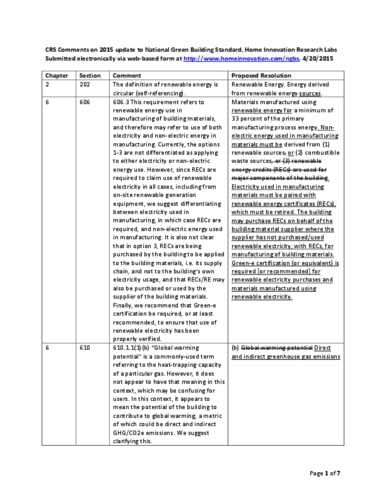
- CRS Comments on 2015 update to National Green Building Standard, Home Innovation Research Labs
- Author: CRS Staff
- Published: April 20th, 2015| Comment | 7 Pages
- Comment
- 2015
Comments on definitions, concepts in the National Green Building Standard.
- View
- Comments of CRS on SASB Public Exposure Draft Standards‐ Consumption I
- Author: Todd Jones, CRS Staff
- Published: April 14th, 2015| Comment | 3 Pages
- Comment
- 2015
CRS comments on the January 2015 Sustainability Accounting Standards Board (SASB) Exposure Draft Standards for Public Comment for Consumption I sectors, including Agricultural Products, Processed Foods, Non‐Alcoholic Beverages, Alcoholic Beverages, Household & Personal Care Products, and Meat, Poultry, and Dairy.
- View
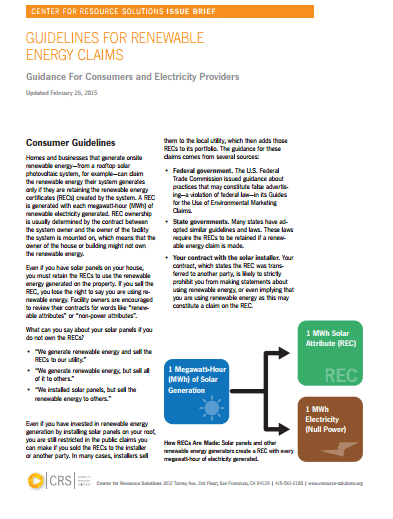
- Guidelines for Renewable Energy Claims: Guidance for Consumers and Electricity Providers
- Author: CRS Staff
- Published: February 25th, 2015| Report | 2 Pages
- Report
- 2015
A description of how ownership of renewable energy attributes remains with the renewable energy certificate, and examples of claims issues between hosts, utilities, and owners.
- View
- Comments of CRS on Request for Information for EERE Definition of Zero Energy Buildings, Docket No. EERE-2014-BT-BLDG-0050
- Author: Todd Jones, CRS Staff
- Published: February 20th, 2015| Comment | 3 Pages
- Comment
- 2015
CRS responds to the January 2015 U.S. Department of Energy Office of Energy Efficiency and Renewable Energy (EERE) RFI for the Definition of Zero Energy Buildings and the Public Comment Period Draft of the “A Common Definition for Zero Energy Buildings” report prepared by the National Institute of Building Sciences
- View
- Navigating EPA’s Clean Power Plan for Compliance With Renewable Energy
- Author: David Farnsworth
- Published: February 11th, 2015| Report | 20 Pages
- Report
- 2015
In this paper, CRS and the Regulatory Assistance Project have collaborated to help readers to understand some of the ways in which states are using renewable energy today, and appreciate how existing renewable energy compliance practices provide well-established and suitable approaches for regulators to use as part of their efforts to demonstrate compliance under the …
- View
- Supporting State Compliance With the EPA Clean Power Plan
- Author: Jennifer Martin and Alex Pennock
- Published: February 11th, 2015| Report | 12 Pages
- Report
- 2015
In this paper, CRS and the Regulatory Assistance Project have collaborated to describe how the existing functionality of the regional renewable energy tracking systems can be used by states to track renewable energy and support compliance with the EPA Clean Power Plan, as well as to identify enhancements that may be needed to support state …
- View
- Letter in Support of WCI Complementary Policies Committee
- Author: Canadian Parks & Wilderness Society, Center for Energy Efficiency and Renewable Technologies, Center for Resource Solutions, Citizens' Utility Board of Oregon, Climate Solutions, Environment Arizona, Environment California, Environment New Mexico, Environment Oregon, Environment Washington, National Wildlife Federation, Natural Resources Defense Council, NW Energy Coalition, Oregon Environmental Council, Pacific Forest Trust, Renewable Northwest Project, Sightline Institute, Union of Concerned Scientists, Utah Clean Energy
- Published: February 9th, 2015| Other | 2 Pages
- Other
- 2015
This committee can put forth solutions that will make implementation of a regional or federal economy-wide cap more achievable by helping to meet greenhouse gas (GHG) reductions targets in each sector. Complementary policies can also produce low-cost reductions that cap-and-trade alone would miss. Therefore, a robust set of complementary policies in addition to cap-and-trade alone …
- View
- CRS Comments on the Washington State Department of Commerce’s Proposed Revisions to WAC 194-37-110, 194-37-120, and 194-37-210 Related to RPS Implementation
- Author: Robin Quarrier
- Published: January 30th, 2015| Comment | 2 Pages
- Comment
- 2015
Comments in support of the proposed revisions clarifying that bundled or unbundled RECs must be used under all three methods for complying with the RPS and must be retired once they are claimed for compliance.
- View
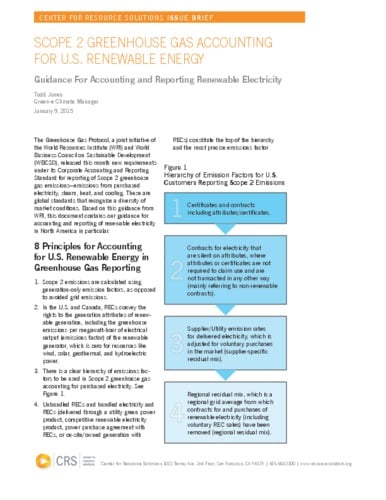
- Scope 2 Greenhouse Gas Accounting for U.S. Renewable Energy
- Author: Todd Jones
- Published: January 9th, 2015| Report | 6 Pages
- Report
- 2015
Guidance for accounting and reporting of renewable electricity in North America under the World Resources Institute’s Corporate Accounting and Reporting Standard for reporting of Scope 2 greenhouse gas emissions.
- View
- 2014 Year in Review
- Author: CRS Staff
- Published: December 30th, 2014| Document | 1 Pages
- Document
- 2014
In 2014, CRS highlighted significant advancements in promoting clean energy and sustainability. We expanded our Green-e certification program, facilitating widespread adoption of renewable energy by certifying millions of megawatt-hours of clean energy use. CRS played a vital role in influencing energy policy by engaging with state and federal regulators to ensure effective renewable energy standards. …
- View
- Comments on Supplemental Notice of Proposed Rulemaking (SNOPR), Fossil Fuel‐Generated Energy Consumption Reduction for New Federal Buildings and Major Renovations of Federal Buildings, Docket No. EERE-2010-BT-STD-0031
- Author: Todd Jones
- Published: December 15th, 2014| Comment | 7 Pages
- Comment
- 2014
CRS expresses support for several requirements proposed in the SNOPR, responds to DOE concerns, and responds to certain specific requests for comment. Specifically: RECs are required for any renewable electricity usage claim, Off‐site renewable electricity usage and low‐cost options should be available to federal agencies, concerns with federal agencies’ lack of control over off‐site renewable …
- View
- UM 1690, the Implementation of HB 4126 – Voluntary Renewable Energy Tariffs (VRETs) Comments of Center for Resource Solutions (CRS) on Staff Models and Issues List
- Author: Robin Quarrier
- Published: December 12th, 2014| Comment | 16 Pages
- Comment
- 2014
Comments by CRS on Oregon’s HB 4126 – Voluntary Renewable Energy Tariff (VRET) proposal.
- View
- Green-e Direct
- Author: CRS Staff
- Published: December 2nd, 2014| Other | 1 Pages
- Other
- 2014
A graphic 1-page description of the Green-e Direct option.
- View
- 2013 Green-e Verification Report
- Author: CRS Staff
- Published: December 2nd, 2014| Report | 12 Pages
- Report
- 2014
In 2013 Green-e Energy certified retail sales of 33.5 million megawatt-hours (MWh), enough to power over a quarter of U.S. households for a month, or 1% of the total U.S. electricity mix. Over half of the installed wind capacity in the U.S. is participating in Green-e Energy certified transactions.
- View
- Overview of International Voluntary Renewable Electricity Procurement and Public Claims
- Author: Orrin Cook, Jan Hamrin, Todd Jones, Alex Pennock
- Published: December 1st, 2014| Report | 27 Pages
- Report
- 2014
This document provides an overview of best practices and options for purchasing and using renewable electricity globally, as well as guidance for clear and accurate communication of renewable electricity claims within the context of national or regional renewable electricity markets.
- View
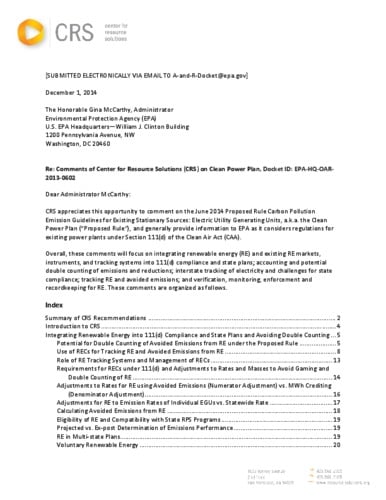
- Comments on the U.S. EPA’s Clean Power Plan, Section 111(d)
- Author: Todd Jones
- Published: December 1st, 2014| Comment | 30 Pages
- Comment
- 2014
CRS comments on the June 2014 Proposed Rule Carbon Pollution Emission Guidelines for Existing Stationary Sources: Electric Utility Generating Units (the Clean Power Plan “Proposed Rule”). The comments focus on integrating renewable energy (RE) and existing RE markets, instruments, and tracking systems into 111(d) compliance and state plans; accounting and potential double counting of emissions …
- View
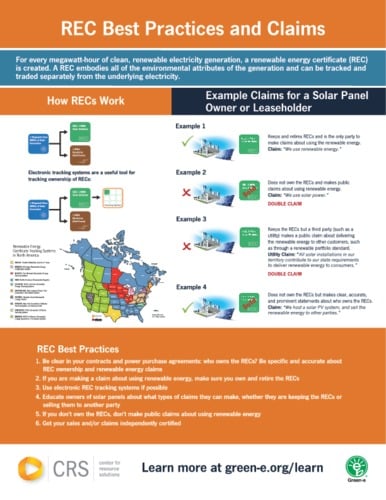
- REC Best Practices and Claims
- Author: Rachael Terada
- Published: October 17th, 2014| Other | 1 Pages
- Other
- 2014
An illustration of how renewable energy certificates (RECs) work to track ownership, best practices for using and claiming RECs, and a series of example claims for solar panel owners or leaseholders.
- View
- Protecting Carbon Markets From Boiler Room Activities: Overview and Recommendations for Market Participants
- Author: Todd Jones
- Published: September 2nd, 2014| Report | 10 Pages
- Report
- 2014
In 2010, reports of boiler rooms operating in carbon markets and selling emissions reduction credits (carbon offsets) as investments began to emerge out of the U.K. In 2013, CRS began work examining what investor protections are needed in carbon markets, particularly in voluntary OTC markets, and what practices market participants could adopt to regulate carbon …
- View
- Tracking Renewable Energy for the U.S. EPA’s Clean Power Plan: Guidelines for States to Use Existing REC Tracking Systems to Comply with 111(d)
- Author: Robin Quarrier, David Farnsworth
- Published: June 25th, 2014| Report | 12 Pages
- Report
- 2014
Existing renewable energy certificate (REC) tracking systems hold promise as an enabler of 111(d) compliance with renewable resources such as solar and wind generation. REC tracking systems, together with state policies designed to increase the production and use of renewable electricity, will provide one key to helping states reduce the carbon intensity of their power …
- View
- Explanation of Green-e Energy Double-Claims Policy
- Author: Green-e Energy Staff
- Published: June 23rd, 2014| Report | 9 Pages
- Report
- 2014
This document is intended to articulate Green-e Energy’s standard approach to resolving questions and disputes regarding the eligibility of RECs for use in Green-e Energy certified transactions or products, when multiple parties have made statements related to the environmental attributes of the REC or underlying electricity.
- View
- Comments From CRS to the Arizona Corporation Commission’s Proposed Rulemaking to Modify Arizona’s Renewable Energy Standard
- Author: Robin Quarrier, Jennifer Martin
- Published: April 21st, 2014| Comment | 6 Pages
- Comment
- 2014
CRS suggests changes to the proposed revision that will reduce the potential for double counting, including rejecting Track and Monitor and Track and Record, purchasing least cost RECs or kWh, creation of a maximum conventional energy requirement, the option of mandatory upfront incentives, and others
- View
- Defining the Intangible: Renewable Energy Certificate Claims and Ownership in the Green Guide Era
- Author: Robin Quarrier and John P. Rose
- Published: February 21st, 2014| Article | 18 Pages
- Article
- 2014
As environmental commodities, renewable energy certificates (RECs) may expose their owners and traders to potentially conflicting obligations and regulations from state and federal agencies. This article in the February, 2014 issue of the ABA’s Renewable, Alternative, and Distributed Energy Resources Committee Newsletter looks at claims and marketing issues with RECs after the revised FTC Green …
- View
- E999/CI-13-720 In the Matter of a Commission Inquiry into Ownership of Renewable Energy Credits Used to Meet Minnesota Requirements
- Author: Robin Quarrier and Jennifer Martin
- Published: February 7th, 2014| Comment | 6 Pages
- Comment
- 2014
CRS provides comments to the Minnesota PUC on the “Notice of Comment Period on Commission Inquiry…In the Matter of Commission Inquiry Into Ownership of RECs Used to Meet Minnesota Requirements” These comments also provided a brief summary of the value of RECs in the voluntary market for renewable energy in Minnesota.
- View
- Comments on Sustainability Accounting Standards Board (SASB) Proposed Revisions to Technology & Communications Sector Sustainability Accounting Standards TC0101, TC0102, TC0103, TC0201, TC0301, and TC0401
- Author: Michael Leschke
- Published: January 2nd, 2014| Comment | 3 Pages
- Comment
- 2014
CRS submitted comments on the Draft Standards for the Technology & Communication Sector that recommended that renewable energy certificates be retained for all claims to the use of renewable energy. CRS also supports the inclusion of emissions from purchased electricity use (scope 2 emissions) to the proposed disclosure language and guidance in all applicable SASB …
- View
- Comments on Washington State’s Chapter 194-37 (Energy Independence Act
- Author: Robin Quarrier
- Published: January 2nd, 2014| Report | 2 Pages
- Report
- 2014
CRS comments in support of the Washington Department of Commerce’s proposed addition to the Energy Independence Act (WAC 194-37-120) requiring the retirement of RECs in WREGIS, especially when they are used to comply with the Washington State renewable energy standard.
- View
- 2013: Advances in Sustainable Energy
- Author: CRS Staff
- Published: December 20th, 2013| Report | 8 Pages
- Report
- 2013
A look back at the year’s accomplishments for Center for Resource Solutions and its programs.
- View
- Summary of Changes to the Green-e Energy National Standard, Provisions on Biomass: April 9, 2012 Update
- Author: CRS Staff
- Published: November 19th, 2013| Other | 4 Pages
- Other
- 2013
On April 9, 2012 the Green-e Governance Board approved changes to the Green-e Energy National Standard that modified the then-existing language defining the eligibility of biomass as a renewable fuel source under the Standard. The new language clarified the circumstances under which organic matter can be used for electricity generation and considered eligible for inclusion …
- View
- 2012 Green-e Verification Report
- Author: CRS Staff
- Published: November 6th, 2013| Report | 12 Pages
- Report
- 2013
In 2012 Green-e showed another year of impressive growth, with a remarkable 29% increase in Green-e Energy certified sales in 2012, reaching almost 36 million MWh. This is enough to power nearly a third of U.S. households for a month. Green‐e now certifies over 1% of the total U.S. electricity mix and approximately three‐quarters of …
- View
- Comments on July 2013 Proposed Amendments to the California Cap-and-Trade Regulation
- Author: Todd Jones
- Published: August 2nd, 2013| Comment | 2 Pages
- Comment
- 2013
CRS submitted comments to the California Air Resources Board (CARB) regarding proposed changes to the California cap-and-trade program, as contained in a July 2013 Discussion Draft and presented at the July 18, 2012 Public Workshop.
- View
- Letter to the Arizona Corporation Commission on Options Proposed for Utility Renewable Energy Standard and Tariff (REST) Compliance
- Author: Robin Quarrier, Jennifer Martin
- Published: May 31st, 2013| Letter | 7 Pages
- Letter
- 2013
This letter urges the Commission to reject Staff’s proposal of “Track and Monitor” because of the impact on Arizona renewable energy generators and customers, and because it violates the requirements of the REST while raising issues with double counting.
- View
- Comments on ACCO Core Competencies for Climate Change Officers and Professionals
- Author: Todd Jones
- Published: May 16th, 2013| Comment | 3 Pages
- Comment
- 2013
CRS submitted comments to the Association of Climate Change Officers (ACCO) in response to their call for input on their Core Competencies for Climate Change Officers and Professionals.
- View
- Comments to the U.S. EIA Regarding “Electricity and Renewable (Photovoltaic) Survey Form Changes Proposed for 2014”
- Author: Alex Pennock
- Published: May 6th, 2013| Comment | 2 Pages
- Comment
- 2013
CRS commented on the proposed revisions to the Energy Information Administration’s (EIA) data collection practices, reiterating the need for continued data collection and the continued relevance of the data, as the EIA data collected on utility green electricity programs and renewable electricity is one of the few sources of hard information that can be used …
- View
- Tracking Emissions Associated with Energy Serving Load in the Regional Greenhouse Gas Initiative (RGGI) States: a Feasibility Study
- Author: David Farnsworth, Rachael Terada
- Published: April 1st, 2013| Report | 64 Pages
- Report
- 2013
In this paper the Regulatory Assistance Project (RAP) and CRS assess the suitability for tracking CO2 emissions associated with electricity imported into the RGGI region of two energy attribute tracking systems currently in use in the RGGI region.
- View
- Center for Resource Solutions’ (CRS’s) comments on California Energy Commission (CEC) Staff Concept Paper for the Implementation of Assembly Bill 2196 for the Renewables Portfolio Standard
- Author: Jennifer Martin, Todd Jones
- Published: February 8th, 2013| Comment | 4 Pages
- Comment
- 2013
Comments on a California Energy Commission (CEC) paper for the implementation of Assembly Bill 2196 for the California Renewable Portfolio Standard
- View
- 2011 Green-e Verification Report
- Author: CRS Staff
- Published: January 31st, 2013| Report | 12 Pages
- Report
- 2013
The report highlights Green-e Certified renewable energy and carbon offset sales in 2011, as well as organizations that participated in Green-e Marketplace to demonstrate their commitment to renewable energy.
- View
- Comments of Environmental Defense Fund, The Nature Conservancy, and the Center for Resource Solutions on the proposal to link California’s cap-and-trade program with Quebec’s program
- Author: Erica Morehouse (EDF), Jennifer Martin (CRS), Michelle Passero (TNC)
- Published: January 23rd, 2013| Comment | 3 Pages
- Comment
- 2013
Comments of Environmental Defense Fund, The Nature Conservancy, and the Center for Resource Solutions on the proposal to link California’s cap-and-trade program with Quebec’s program
- View
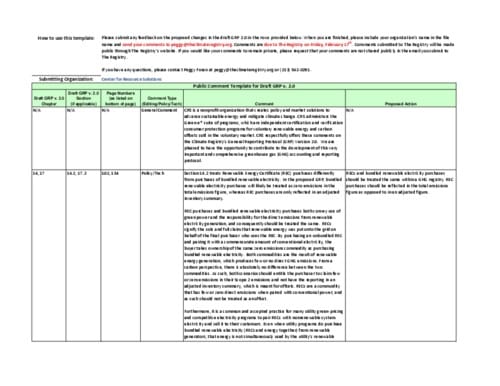
- CRS Comments on The Climate Registry’s Draft General Reporting Protocol 2.0
- Author: Jennifer Martin, Todd Jones
- Published: January 18th, 2013| Comment | 4 Pages
- Comment
- 2013
CRS submitted comments on the proposed changes to the GRP 2.0.
- View
- CRS Letter to Arizona Corporation Commission
- Author: Robin Quarrier
- Published: November 15th, 2012| Letter | 3 Pages
- Letter
- 2012
CRS submitted a comment letter to the Arizona Corporation Commission regarding the proposed Track and Record option for utilities to use kilowatt-hours (kWh) from interconnected distributed generation (DG) for compliance with Arizona’s Renewable Energy Standard and Tariff (REST), instead of using Renewable Energy Certificates (RECs).
- View
- Fact Sheet: Green-e Energy Certification Program
- Author: CRS Staff
- Published: November 8th, 2012| Report | 3 Pages
- Report
- 2012
A brief description of the requirements and benefits of Green-e Energy.
- View
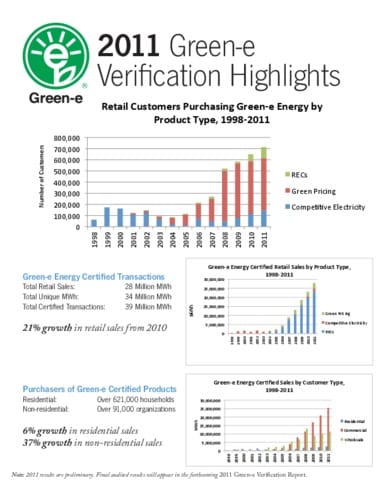
- 2011 Green-e Verification Highlights
- Author: CRS Staff
- Published: September 24th, 2012| Report | 2 Pages
- Report
- 2012
A review of the highlights of the Green-e program in 2011. The brief shows 21% growth from the previous year, including 39 Million MWh in total certified transactions; 50 organizations and over 500 products participating in Green-e Marketplace; and certified sales growth by nearly 9% in Green-e Climate
- View
- Joint Comment Letter to the Federal Housing Finance Agency on Property Assessed Clean Energy programs.
- Author: CRS with 62 partner organizations
- Published: September 13th, 2012| Comment | 39 Pages
- Comment
- 2012
CRS, along with 62 other partner organizations, submitted this joint comment letter to the Federal Housing and Finance Agency (FHFA) in support of local government Property Assessed Clean Energy (PACE) programs.
- View
- CRS Annual Report 2011
- Author: Center for Resource Solutions
- Published: September 7th, 2012| Report | 17 Pages
- Report
- 2012
A review of CRS activities and programs through 2011.
- View
- Comments to ICLEI-Local Governments for Sustainability
- Author: Todd Jones
- Published: July 30th, 2012| Comment | 3 Pages
- Comment
- 2012
CRS submitted comments to ICLEI-Local Governments for Sustainability on revisions to its Community Protocol, the national standard for community-scale reporting of greenhouse gas emissions.
- View
- Comments Regarding Proposed Amendments to the Cap-and-Trade Regulation to Allow for the Use of Compliance Instruments Issued by Linked Jurisdictions
- Author: Alex Jackson, Jennifer Martin, Erica Morehouse, Michelle Passero
- Published: June 27th, 2012| Comment | 2 Pages
- Comment
- 2012
CRS, along with its partners Environmental Defense Fund, Natural Resources Defense Council, and The Nature Conservancy, submitted comments to the California Air Resources Board (CARB) regarding proposed amendments to California’s Cap-and-Trade Regulation to allow for the use of compliance instruments issued by linked jurisdictions.
- View
- Comments on Discussion Draft Potential Amendments to the Regulation for the Mandatory Reporting of Greenhouse Gas Emissions
- Author: Jennifer Martin, Todd Jones
- Published: June 25th, 2012| Comment | 1 Pages
- Comment
- 2012
CRS submitted comments to the California Air Resources Board (CARB) regarding potential regulatory changes to the Regulation for the Mandatory Reporting of Greenhouse Gas Emissions, or Mandatory Reporting Regulation (MRR) (title 17, California Code of Regulations, sections 95100-95157).
- View
- Comments on Council on Environmental Quality (CEQ) Revision to Guidance Federal Greenhouse Gas Accounting and Reporting
- Author: Jennifer Martin, Todd Jones, Jane Valentino, CRS Staff
- Published: April 11th, 2012| Comment | 8 Pages
- Comment
- 2012
CRS submitted comments to the Council on Environmental Quality regarding the DRAFT Federal Greenhouse Gas Accounting and Reporting Guidance. All CRS comments pertain to Section 4.0 of the DRAFT Federal Greenhouse Gas Accounting and Reporting Guidance, “Renewable Energy and Carbon Offsets” (pg. 24-31).
- View
- CRS Comments on LEED 2012 Rating System Drafts
- Author: Todd Jones, Jennifer Martin
- Published: March 19th, 2012| Comment | 5 Pages
- Comment
- 2012
CRS submitted comments to the USGBC on the proposed LEED 2012 Rating System Drafts regarding carbon offsets and RECs.
- View
- CRS Comments on the Climate Registry’s Draft General Reporting Protocol 2.0
- Author: Jennifer Martin and Jane Valentino
- Published: February 14th, 2012| Comment | 5 Pages
- Comment
- 2012
CRS submitted comments on the proposed changes to the GRP 2.0.
- View
- 2010 Green-e Verification Report
- Author: Center for Resource Solutions
- Published: November 23rd, 2011| Report | 12 Pages
- Report
- 2011
The report highlights Green-e Certified renewable energy and carbon offset sales in 2010, as well as organizations that participated in Green-e Marketplace to demonstrate their commitment to renewable energy. The report shows a 23% increase in total Green-e Energy retail sales volume over the previous year, equivalent to over 23 million MWh of renewable energy …
- View
- CRS Annual Report 2010
- Author: Center for Resource Solutions
- Published: November 11th, 2011| Report | 16 Pages
- Report
- 2011
2010 Annual Report
- View
- Report to the Oregon Department of Energy Regarding Retroactive RECs and Stranded Generation
- Author: CRS Staff
- Published: November 1st, 2011| Report | 3 Pages
- Report
- 2011
The Oregon Department of Energy arranged for WREGIS to create RECs retroactively for stranded electricity. Under this arrangement, all RECs created through this process must be exclusively used for Oregon RPS compliance. The Center for Resource Solutions was contracted to complete a review of the stranded generation RECs against voluntary market transactions. This report summarizes …
- View
- CRS Comments on the Verified Carbon Standard (VCS)
- Author: Todd Jones
- Published: October 28th, 2011| Comment | 8 Pages
- Comment
- 2011
The Verified Carbon Standard (VCS) Program is a standard and framework for GHG emission reductions and removals. It is also a Green-e Climate Endorsed Program. On 1 September 2011, VCS released for public consultation draft requirements for standardized approaches for baselines and additionality. CRS submitted comments in general support of the VCSA’s decision to move …
- View
- Opening Comments Filed by the Center for Resource Solutions on Decision Implementing Portfolio Content Catagories for the Renewables Portfolio Standard Program
- Author: Robin Quarrier
- Published: October 27th, 2011| Comment | 11 Pages
- Comment
- 2011
In these comments, CRS recommends removal or clarification of the tenets proposed on page 14 of the Administrative Law Judge’s Proposed Decision Implementing Portfolio Content Categories (“Proposed Decision”) for the Renewables Portfolio Standard Program (“RPS”) pursuant to Pub. Util. Code §399.16 (2011), “What you buy is what you have.” and “What you have is what …
- View
- Petition for a declaratory order regarding the extra credits for apprentice labor provision of RCW 19.285.0404(2)(h), Docket U-111663; Washington Utilities and Transportation Commission.
- Author: Jennifer Martin and Jane Valentino
- Published: October 19th, 2011| Comment | 3 Pages
- Comment
- 2011
CRS submitted comments to the Washington Utilities and Transportation Commmission with regard to Puget Sound Energy’s (PSE) petition to bifurcate the apprentice labor multiplier from the Renewable Energy Credit (REC). CRS believes this bifurcation would directly result in the double counting of renewable energy attributes if the REC were sold into the voluntary market, or …
- View
- CRS Comments to CARB on Second 15-Day Amendments
- Author: Jennifer Martin and Jane Valentino
- Published: September 27th, 2011| Comment | 2 Pages
- Comment
- 2011
Comments on the second 15-day amendments to the California Cap on Greenhouse Gas (GHG) Emissions and Market-Based Compliance Mechanisms proposed regulations.
- View
- Comments on Second 15-Day Amendments – Voluntary Renewable Electricity Set Aside
- Author: Andy Katz, Jennifer Martin, Peter Miller, Susan Stephenson and Laura Wisland
- Published: September 27th, 2011| Comment | 3 Pages
- Comment
- 2011
A coalition letter supporting the California Air Resource Board’s (CARB) inclusion of a set aside for the voluntary renewable electricity (VRE) market. Comments regarding the following issues: eligibility of renewable energy generators by online date, clarification regarding the use of tracking systems, and how to “true up” allowances to account for oversubscription.
- View
- Comments on LEED 2012 Rating System Drafts, Neighborhood Development (ND) Rating System
- Author: Todd Jones, Jennifer Martin
- Published: September 14th, 2011| Comment | 3 Pages
- Comment
- 2011
Suggestions for changes to be made to language under GIB Credit: On-site Renewable Energy Sources and the subheading “ND Plan, ND”
- View
- Comments on LEED 2012 Rating System Drafts
- Author: Todd Jones, Jennifer Martin
- Published: September 14th, 2011| Comment | 9 Pages
- Comment
- 2011
General Comments in support of the LEED 2012 Rating System Drafts, including the inclusion of criteria and points for green power and carbon offset purchasing in the LEED Standards, and LEED’s citation and reference to the Green-e Standards for renewable energy (Green-e Energy) and carbon offsets (Green-e Climate). Also suggested changes to help bolster and …
- View
- Comments Regarding Quebec’s Cap and Trade Draft Regulation
- Author: Jane Valentino, Jennifer Martin
- Published: September 3rd, 2011| Comment | 2 Pages
- Comment
- 2011
CRS applauds Quebec for proposing such a comprehensive system for reducing greenhouse gas emissions, and urges you to adopt a Voluntary Renewable Energy (VRE) set aside as enabled under Western Climate Initiative rules.
- View
- CRS Comments to Draft WindMade Standard
- Author: Orrin Cook
- Published: August 12th, 2011| Comment | -4 Pages
- Comment
- 2011
Comments to the draft standard as part of the WindMade public consultation process. We support the inclusion of a definition of “green credentials” and requiring a unique ID number; and we suggest adding additional information regarding the allowable claims and condoned uses of the label, keeping a clear distinction between renewable energy and carbon offsets …
- View
- Comments Filed by the Center for Resource Solutions on Implementation of New Portfolio Content Categories for the Renewable Portfolio Standard Program
- Author: Robin Quarrier
- Published: August 5th, 2011| Comment | 6 Pages
- Comment
- 2011
CRS respectfully offers these comments on issues nine and ten of the Administrative Law Judge’s Ruling Requesting Comments on the Implementation of the New Portfolio Content Categories for the RPS Program. In these comments, CRS seeks to augment the record by bringing to the Commission’s attention language in the RPS statute that requires renewable energy …
- View
- Comments on Proposed 15-Day Modifications to the CA Cap-and-Trade Mechanisms
- Author: Jennifer Martin, Jane Valentino
- Published: August 4th, 2011| Comment | 7 Pages
- Comment
- 2011
Center for Resource Solutions (CRS) submitted comments to the California Air Resources Board (ARB) on the proposed 15-day modifications to the California Cap on Greenhouse Gas (GHG) Emissions and Market-Based Compliance Mechanisms. The comments focused on the following topics: Accounting for Null Power Imports and Voluntary Renewable Electricity.
- View
- Comments of the Center for Resource Solutions (“CRS”) to the Commodity Futures Trading Commission (“CFTC”) and Securities and Exchange Commission (“SEC”) on Notice of Proposed Rulemaking; Request for Comments on Further Definition of “Swap,” “Security-Based Swap,” e.t.c., (17 CFR Part 23, RIN 3038 AC96 Pursuant to Section 750 of the Dodd-Frank Wall Street Reform and Consumer Protection Act (“Dodd-Frank Act”)
- Author: Robin Quarrier, JP Rose, Jennifer Martin
- Published: July 22nd, 2011| Comment | 13 Pages
- Comment
- 2011
The intent of these comments is to introduce CRS as an interested party, to describe the services that we provide for the voluntary over-the-counter (“OTC”) market for environmental commodities through our Green-e Energy and Green-e Climate certification and consumer-protection programs, and to provide comments on the Joint Notice of Proposed Rulemaking Request (“JNOPR”) for comments …
- View
- Comments on the U.S. Senate Committee on Energy and Natural Resources Clean Energy Standard (CES)White Paper
- Author: Jane Valentino
- Published: April 11th, 2011| Comment | 6 Pages
- Comment
- 2011
Comments from the Center for Resource Solutions on the U.S. Senate Committee on Energy and Natural Resources Clean Energy Standard (CES) White Paper.
- View
- Letter to Washington State Senate Environment, Water and Energy Committee on HB 1712
- Author: Jennifer Martin
- Published: March 2nd, 2011| Letter | 3 Pages
- Letter
- 2011
CRS believes Washington State’s HB 1712 could negatively impact the clean energy industry because as currently written the inclusion of null power in the definition of renewable resource and the ambiguous nature of the definition of null power constitutes a potential double claim of renewable energy attributes. Generation owners in Washington whose null power was …
- View
- Letter to Washington State Senate Environment, Water and Energy Committee on S.1506.1
- Author: Jennifer Martin
- Published: February 16th, 2011| Letter | 2 Pages
- Letter
- 2011
CRS believes Washington State’s S.1506.1 could negatively impact the clean energy industry because if RECs are no longer used as a declared resource for electric utility fuel mix disclosures, generation owners in Washington whose null power is represented as renewable for utility fuel mix disclosures would become ineligible to sell their RECs into a Green-e …
- View
- Comments of Center for Resource Solutions (CRS) to the Commodity Futures Trading Commission (CFTC) Request for Information (RFI) for Public Input for the Study Regarding the Oversight of Existing and Prospective Carbon Markets pursuant to Section 750 of the Dodd‐Frank Wall Street Reform and Consumer Protection Act (Dodd‐Frank Act)
- Author: Todd Jones, Jennifer Martin
- Published: December 17th, 2010| Comment | 5 Pages
- Comment
- 2010
The intent of these comments is to introduce CRS as an interested party; to describe the services that we provide for the voluntary over‐the‐counter (OTC) carbon offset market through our Green‐e Climate certification and consumer‐protection program; to briefly explain our position that the current structure and existing oversight mechanisms in the voluntary carbon offset market …
- View
- Letter to CARB Chairman Nichols and Board after passage of AB32, offering Support for the Voluntary Renewable Energy Set-Aside but concerns about the WCI recommendation that RECs have no role in cap-and-trade accounting
- Author: Chris Busch
- Published: December 14th, 2010| Letter | 3 Pages
- Letter
- 2010
CRS wrote a letter to California Air Resources Board (CARB) Chairwoman Nichols and the Board expressing support for the inclusion of a voluntary renewable energy set aside in AB 32, and our remaining concerns about the Western Climate Initiative recommendation that renewable energy certificates (RECs) have no role in mandatory GHG reporting and compliance protocols. …
- View
- Joint Letter in Support for Voluntary Renewable Energy Set-Aside in the Proposed California Cap-and-Trade Program
- Author: Ian McGowan (3Degrees), Sue Kateley (California Solar Energy Industries Association), Nancy Rader (California Wind Energy Association), Nick Lapis (Californians Against Waste), Elvira Ramirez (Catholic Charities, Diocese of Stockton), Danielle Osborn Mills (Center for Energy Efficiency and Renewable Technologies), Jennifer Martin (Center for Resource Solutions), Jamie Fine(Environmental Defense Fund), Varner Seaman (Horizon Wind Energy), Kristen Eberhard (Natural Resources Defense Council), Kyle Boudreaux (NextEra Energy), Jay Carlis (Renewable Energy Markets Association, Community Energy, Inc.), Bill Magavern (Sierra Club California), Rachel McMahon (Solar Millennium), Kari Smith (Sunpower), Polly Shaw (Suntech America), Sara Birmingham (The Solar Alliance), and Erin Rogers (Union of Concerned Scientists).
- Published: December 13th, 2010| Letter | 2 Pages
- Letter
- 2010
A joint letter from CRS, clean energy businesses, organizations, and environmental groups write to you in support of including a provision in the Cap and Trade Regulation to establish a Voluntary Renewable Energy Set-Aside.
- View
- CRS Comments on Proposed Revisions to the FTC Green Guides
- Author: Robin Quarrier
- Published: December 10th, 2010| Comment | 18 Pages
- Comment
- 2010
Comments submitted on the Federal Trade Commission (FTC)’s proposed update to its Guides for the Use of Environmental Marketing Claims (“Green Guides”). Overall, we are very supportive of the proposed update and find that it reinforces many of the consumer-protection practices required by Green-e certification, but there are a few areas where we suggest further …
- View
- Summary of CRS Comments on Proposed Revisions to the FTC Green Guides
- Author: Robin Quarrier
- Published: December 3rd, 2010| Comment | 3 Pages
- Comment
- 2010
Summary of comments on the Federal Trade Commission (FTC)’s recently released proposed update to its Guides for the Use of Environmental Marketing Claims (“Green Guides”). CRS will be submitting comments, and we have developed a summary of the key points we will be making to the Commission. Overall, we are very supportive of the proposed …
- View
- 2009 Green-e Verification Report
- Author: Center for Resource Solutions
- Published: October 28th, 2010| Report | 12 Pages
- Report
- 2010
The report highlights Green-e Certified renewable energy and carbon offset sales in 2009, as well as organizations that participated in Green-e Marketplace to demonstrate their commitment to renewable energy. The report shows a 43% increase in total Green-e Energy sales volume over the previous year, with over 18 Million MWh purchased by over 545,000 residential …
- View
- Best Practices in Public Claims for Green Power Purchases and Sales
- Author: Center for Resource Solutions
- Published: October 7th, 2010| Report | 17 Pages
- Report
- 2010
Growth in the largely unregulated voluntary renewable energy market has highlighted the need for clear guidelines on what constitutes legitimate environmental claims. In order to evaluate green electricity claims, one must first determine what constitutes a claim. Some claims are explicit and easy to identify. Others, however, can be simply implied or even unintentional. This …
- View
- Letter to the New Mexico Environmental Improvement Board urging the adoption of a VRE set aside
- Author: Chris Busch
- Published: September 24th, 2010| Letter | 6 Pages
- Letter
- 2010
CRS submitted a comment letter to New Mexico’s Environmental Improvement Board urging the adoption of a set aside to ensure that voluntary renewable energy purchases continue to reduce carbon dioxide emissions after their cap-and-trade program goes into effect.
- View
- Shockproofing Society: How California’s Global Warming Solutions Act (AB 32) Reduces the Economic Pain of Energy Price Shocks
- Author: James Fine, Chris Busch, Remy Garderet
- Published: September 13th, 2010| Report | 60 Pages
- Report
- 2010
The price of gasoline is a telling economic weathervane. When gas is cheap, it is not given much attention. When gas prices hit record highs, however, as in 2008, the downside of America’s dependence on imported energy is made painfully obvious. This report analyzes how Assembly Bill (AB) 32, California’s Global Warming Solutions Act, will …
- View
- CRS Annual Report 2009
- Author: Center for Resource Solutions
- Published: August 17th, 2010| Report | 16 Pages
- Report
- 2010
This report contains the activities and financial reporting documents for 2009.
- View
- CRS Comments on CARB’s Proposed Regulation for the 33% Renewable Energy Standard
- Author: Matt McDonnell, Robin Quarrier
- Published: July 16th, 2010| Comment | 8 Pages
- Comment
- 2010
This letter, addressed to Gary Collard at the California Air Resources Board in reference to the draft 33% RPS, details CRS’s position that a REC is a property right, that CARB’s recognition of these property rights inherent in RECs would not increase CARB’s risk of a regulatory taking under the Fifth Amendment, and that declaring …
- View
- Coalition letter to Kevin Kennedy, CARB Office of Climate Change on the issue of off-the-top treatment of voluntary renewable energy purchases
- Author: Chris Busch, various
- Published: June 7th, 2010| Letter | 8 Pages
- Letter
- 2010
CRS authored a letter to the California Air Resources Board on the issue of off-the-top treatment of voluntary renewable energy purchases and marshaled another coalition of nonprofit organizations and clean energy industry stakeholders to support the concept.
- View
- Letter from CRS to Kevin Kennedy, CARB Office of Climate Change on how to distribute allowances under a CA C&T program
- Author: Chris Busch
- Published: June 7th, 2010| Letter | 6 Pages
- Letter
- 2010
This letter expresses CRS’s view on off-the top as well as other allocation issues. We express our view that CARB’s proposed approach to allowance distribution would be an unfortunate overreaction to emission leakage concerns, and resulting overcompensation of carbon emitters would represent a lost opportunity to bolster the emerging clean energy economy that can contribute …
- View
- Letter to WCI Electricity and Markets Committees on the role of RECs in mandatory GHG reporting and compliance protocols
- Author: Center for Resource Solutions
- Published: May 27th, 2010| Letter | 3 Pages
- Letter
- 2010
The Center for Resource Solutions urges the WCI Partners, the Electricity Committee and Markets Committee to reconsider and rescind the recently released recommendation that renewable energy certificates (RECs) have no role in mandatory GHG reporting and compliance protocols. If implemented, this recommendation would strip the zero-emission attribute from renewable energy certificates (RECs) and destabilize the …
- View
- Green-e Marketplace Case Study: Codero Inc.
- Author: Center for Resource Solutions
- Published: May 14th, 2010| Report | 1 Pages
- Report
- 2010
This Green-e Marketplace Case Study on Codero, a webhost in Overland Park, KS, examines the company’s environmental initiatives, including purchasing certified renewable energy for 100 percent of its electricity use.
- View
- WeCAN Comments on the 4/14/10 WCI Auction Design White Paper
- Author: Chris Busch, WeCAN Markets Committee Members, WeCAN Cap Setting and Allowance Distribution Committee
- Published: May 7th, 2010| Comment | 2 Pages
- Comment
- 2010
Comments and recommendations submitted on the WCI’s Market Design Committee’s whitepaper by the WeCAN Markets and Cap Setting and Allowance Distribution Committees, pertaining to the disposition of unsold allowances and general auction design.
- View
- Climate Policy and Economic Growth in California: New Studies Agree California’s Economy Will Grow Strongly With AB 32 Implementation
- Author: Chris Busch
- Published: April 30th, 2010| Report | 2 Pages
- Report
- 2010
A policy brief that offers some discussion and comparison of three updated forecasts of the economic impact of California’s global warming law, AB 32. The three studies are from the California Air Resources Board, Charles River Associates, and the University of California’s Professor David Roland-Holst.
- View
- Letter to Gary Collard, CARB, RE: Comments on RES Draft Regulation
- Author: Arthur O'Donnell
- Published: April 8th, 2010| Comment | 3 Pages
- Comment
- 2010
Comments focusing on several broad market issues in the development of an RES as described by the March 11, 2010, Preliminary Draft Regulation, and the presentations made during the March 18, 2010 workshop.
- View
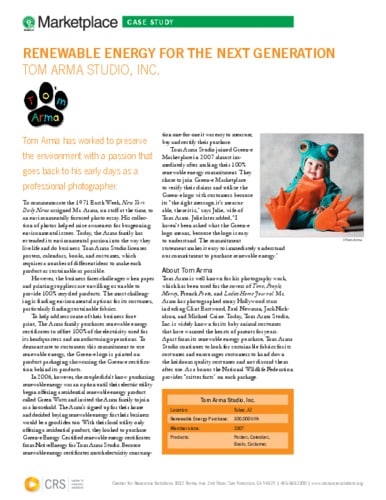
- Renewable Energy for the Next Generation: Tom Arma Studio, Inc.
- Author: Center for Resource Solutions
- Published: March 11th, 2010| Other | 1 Pages
- Other
- 2010
This Green-e Marketplace Case Study on Tom Arma Studios examines the studio’s environmental actions, including how its purchase of renewable energy fits with its overall sustainability goals.
- View
- Comments on WCI Paper “Voluntary Renewable Energy Market: Issues and Draft Recommendations” to WCI’s Electricity Committee
- Author: Chris Busch
- Published: February 19th, 2010| Comment | 12 Pages
- Comment
- 2010
Comments on WCI paper “Voluntary Renewable Energy Market: Issues and Draft Recommendations,” express agreement with and support of the comments of the Western Climate Advocates Network and the Renewable Energy Markets Association, which are supportive of a VRE Set Aside. Three main comments: 1) We urge the Partners to adopt a uniform VRE Set Aside …
- View
- Comments on VCS Methodology for Weatherization of Single and Multi-Family Buildings , Maine State Housing Authority
- Author: Jane Valentino
- Published: February 17th, 2010| Comment | 0 Pages
- Comment
- 2010
CRS comments on VCS’s proposed Maine State Housing Authority Methodology for Weatherization of Single and Multi-Family Buildings. CRS recognizes the value of energy efficiency measures as a vital means to reduce GHGs and mitigate the effects of climate change, and applauds the Maine State Housing Authority for taking the initiative to introduce such an important …
- View
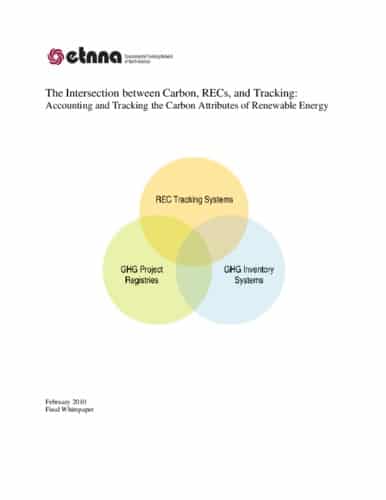
- The Intersection between Carbon, RECs, and Tracking
- Author: ETNNA
- Published: February 1st, 2010| Report | 26 Pages
- Report
- 2010
Both carbon offsets and renewable energy certificates (RECs) are used as ways to reduce greenhouse gas (GHG) emissions. As these marketplaces grow, it is important to examine how they overlap and avoid any double counting of carbon benefits or claims. The paper, which CRS assisted in drafting, examines REC tracking systems, GHG project registries, and …
- View
- About Green-e Energy
- Author: Center for Resource Solutions
- Published: January 26th, 2010| Other | 1 Pages
- Other
- 2010
This is a one-page description of Green-e Energy.
- View
- WeCAN Comments on WCI Electricity Subcommittee’s paper “Voluntary Renewable Energy Market: Issues and Draft Recommendations.”
- Author: Chris Busch, Jennifer Martin, Jane Valentino, others
- Published: January 14th, 2010| Comment | 5 Pages
- Comment
- 2010
WeCAN comment letter submitted to the WCI’s Electricity Committee on its paper “Voluntary Renewable Energy Market: Issues and Draft Recommendations.”
- View
- Best Practices in Public Claims for Solar Photovoltaic Systems
- Author: Alex Pennock
- Published: January 7th, 2010| Report | 9 Pages
- Report
- 2010
As markets for renewable energy grow, there is increasing interest in securing and selling Renewable Energy Certificates and renewable electricity. Some renewable electricity generation technologies, like solar photovoltaics, are slow to be widely adapted to market transactions because of the administrative costs of aggregating output into products that can be readily sold into compliance and …
- View
- Advanced Technology to Meet California’s Climate Goals: Opportunities, Barriers & Policy Solutions
- Author: Alan Lloyd, Dan Adler, Chris Busch, Jim Hawley, Dorothy Rothrock, Hank Ryan, Jan Smutny Jones, Fong Wan, Jonathan Weisgall, Rick Zalesky
- Published: December 14th, 2009| Report | 109 Pages
- Report
- 2009
A report of the California Economic and Technology Advancement Advisory Committee (ETAAC) Advanced Technology Sub-Group focusing on clean transportation, energy efficiency and renewable energy and updating selected sections of the February 2008 ETAAC report.
- View
- Climate Policy and Economic Growth in California: A Comparative Analysis of Different Economic Impact Projections
- Author: Chris Busch
- Published: December 3rd, 2009| Report | 22 Pages
- Report
- 2009
As California policymakers move to implement the state’s Global Warming Solutions Act, Assembly Bill 32 (AB 32), there has been considerable controversy over the economic impacts of this landmark law to reduce global warming emissions. Multiple macroeconomic analyses have been conducted by a variety of economic modeling teams. But, to date, there has been no …
- View
- About Green-e Marketplace
- Author: Center for Resource Solutions
- Published: November 23rd, 2009| Other | 2 Pages
- Other
- 2009
This is a one-page description of Green-e Marketplace.
- View
- CRS Annual Report 2008
- Author: CRS Staff
- Published: November 6th, 2009| Report | 16 Pages
- Report
- 2009
This report contains the activities and financial reporting documents for 2008.
- View
- Letter to AB 32 Economic and Allocation Advisory Committee on on Economic Modeling
- Author: Bonnie Holmes-Gen, Andy Katz, Shankar Prasad, Chris Busch, Jamie Fine, Audrey Chang, Kristin Grenfell, Jasmin Ansar
- Published: September 25th, 2009| Letter | 3 Pages
- Letter
- 2009
This CRS-led joint letter to the EAAC on economic analysis of the impacts of AB 32 recommended that EAAC issue a statement on economic modeling that communicates that: CARB results are consistent with other studies; CARB’s analysis to date has met reasonable expectations given time constraints, limited resources, and the state of modeling science; peer …
- View
- 2008 Green-e Verification Report
- Author: Green-e Staff
- Published: September 16th, 2009| Report | 16 Pages
- Report
- 2009
The report highlights Green-e Certified renewable energy and carbon offset sales in 2008, as well as organizations that participated in Green-e Marketplace to demonstrate their commitment to renewable energy. The report shows a 45 percent increase in total Green-e Energy sales volume over the previous year, equivalent to over 13 million MWh of renewable energy …
- View
- Insights into the Renewable Energy Market: A Brief Overview of Procurement Trends, Drivers, and Impacts of Voluntary Commercial Purchasers
- Author: Orrin Cook and Andreas Karelas
- Published: September 14th, 2009| Report | 20 Pages
- Report
- 2009
Commercial entities and organizations are increasingly looking to reduce the environmental impacts they are responsible for. The potential of renewable energy as a practical and effective market solution to a number of societal issues has garnered support from social, political, and business communities. Commercial demand significantly influences the overall renewable energy market, as commercial purchasers …
- View
- Comments submitted by WeCAN’s Cap Setting and Allowance Distribution Committee in response to the WCI’s “Draft Statement of Principles and Review of Proposed Options for Addressing Industrial Competitiveness Impacts”
- Author: Chris Busch, Eric de Place, Jamie Fine, Jessica Finn Coven, Dan Galpern, Kristin Grenfell, Kelly Knutsen, Jennifer Martin, Jane Valentino, Erin Rogers
- Published: August 28th, 2009| Comment | 3 Pages
- Comment
- 2009
WeCAN’s Cap Setting and Allowance Distribution Committee is recommending the addition of a fourth set of principles to WCI’s “Draft Statement of Principles,” one that recommends against overcompensating parties that have perceived concerns with maintaining competitiveness by granting unjustified or free allocations. This practice could lead to windfall profits, opportunity costs in the form of …
- View

- Inter-Registry REC Transfers
- Author: ETNNA
- Published: August 25th, 2009| Document | 12 Pages
- Document
- 2009
ETNNA was asked by the WREGIS working group on inter-registry transfers to draft a white paper summarizing the status of the working group activities and identifying potential next steps (including the pros and cons of each), as well as preliminary recommendations. At the same time it has become apparent that Congress may pass a federal …
- View
- Green-e Marketplace 2009 Survey Results
- Author: Green-e Marketplace
- Published: August 11th, 2009| Report | 2 Pages
- Report
- 2009
In 2009, Green‑e Marketplace conducted its second annual survey of program participants, to gain understanding of how certification and renewable energy fit into their overall corporate sustainability efforts.
- View
- Letter to Senator Boxer on Recommended Changes to Cap-and-Trade Design Under ACESA to Support the Voluntary Renewable Energy Market
- Author: Chris Busch, others
- Published: July 23rd, 2009| Letter | 3 Pages
- Letter
- 2009
The historic House passage of H.R. 2454, the American Clean Energy and Security Act (ACESA), was an important step toward a long-term clean energy policy, but we have concerns that the design of a cap-and-trade program proposed under the ACESA bill could undercut the thriving voluntary renewable energy market. As the Senate Environment and Public …
- View
- Letter to Senator Bingaman on Recommended Changes to a Pending Federal RES
- Author: Chris Busch, others
- Published: July 23rd, 2009| Letter | 3 Pages
- Letter
- 2009
The historic House passage of H.R. 2454, the American Clean Energy and Security Act (ACESA), was an important step toward a long-term clean energy policy, but unless certain modifications are made to the renewable electricity standard (RES) and cap-and-trade provisions of these bills, it could inadvertently undercut the thriving voluntary renewable energy market which serves …
- View
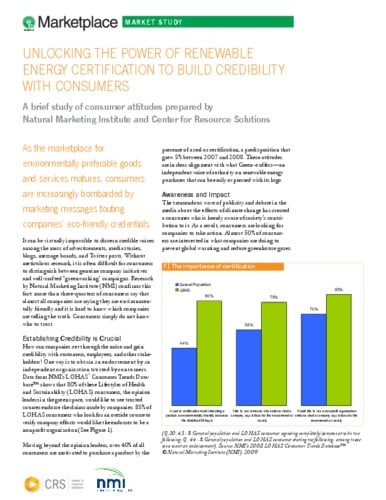
- Unlocking the Power of Renewable Energy Certification to Build Credibility with Consumers
- Author: Natural Marketing Institute, Green-e Marketplace
- Published: June 23rd, 2009| Report | 2 Pages
- Report
- 2009
A brief study of consumer attitudes prepared by Natural Marketing Institute and Center for Resource Solutions.
- View
- Tracking System Changes to Serve a Federal Renewable Electricity Standard (RES)
- Author: CRS and ETNNA
- Published: June 21st, 2009| Document | 16 Pages
- Document
- 2009
This paper from ETNNA anticipates what would be needed to adapt the existing and emerging state/regional tracking systems to serve a federal renewable electricity standard (RES), also known as a renewable portfolio standard (RPS), should such a policy be approved by Congress.
- View
- Comments submitted by the WeCAN Cap Setting and Allowance Distribution Committee in Response to the WCI White Paper on Early Reduction Allowances (ERAs)
- Author: WeCAN Cap Setting and Allowance Distribution Committee
- Published: June 19th, 2009| Comment | 7 Pages
- Comment
- 2009
Comments of the Western Climate Advocates Network on the WCI’s white paper on rewarding early action, the White Paper on Early Reduction Allowances (ERAs)
- View
- Comments submitted by WeCAN’s Cap Setting and Allowance Distribution Committee in response to the WCI’s “Stakeholder Discussion Questions on Competitiveness”
- Author: WeCAN Cap Setting and Allowance Distribution Committee
- Published: June 19th, 2009| Comment | 7 Pages
- Comment
- 2009
Western Climate Advocates Network response to WCI stakeholder discussion questions pertaining to addressing competitiveness concerns.
- View
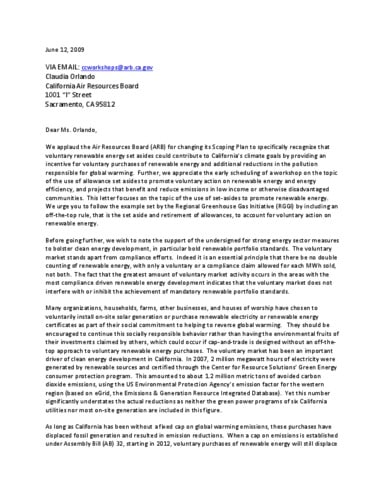
- Letter to Claudia Orlando, California Air Resources Board, in support of Scoping Plan Changes to support voluntary renewable energy purchases
- Author: Chris Busch, others
- Published: June 12th, 2009| Letter | 3 Pages
- Letter
- 2009
We applaud the Air Resources Board (ARB) for changing its Scoping Plan to specifically recognize that voluntary renewable energy set-asides could contribute to California’s climate goals by providing an incentive for voluntary purchases of renewable energy and additional reductions in the pollution responsible for global warming. This letter focuses on the topic of the use …
- View
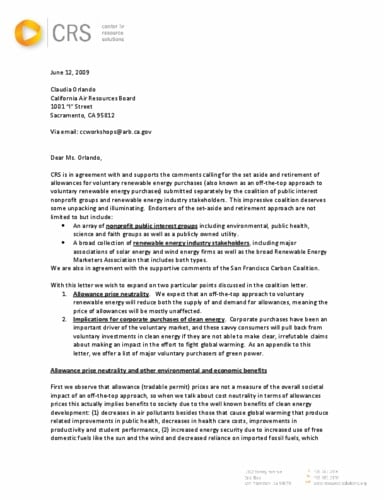
- Letter to Claudia Orlando, California Air Resources Board supporting off-the-top approach to voluntary renewable energy purchases in a California cap-and-trade program
- Author: Chris Busch
- Published: June 12th, 2009| Letter | 6 Pages
- Letter
- 2009
CRS is in agreement with and supports the comments calling for the set aside and retirement of allowances for voluntary renewable energy purchases (also known as an off-the-top approach to voluntary renewable energy purchases) submitted separately by the coalition of public interest nonprofit groups and renewable energy industry stakeholders.
- View
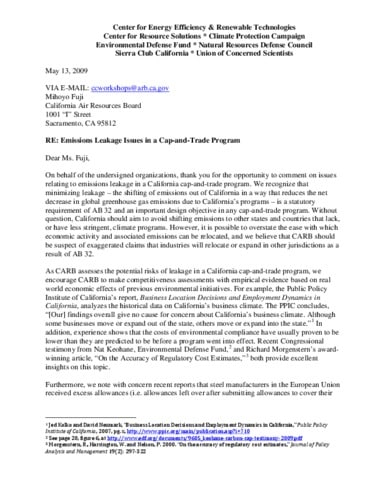
- Letter to CARB on setting the cap in California’s cap-and-trade program
- Author: Chris Busch, Bernadette Del Chiaro, James Fine, Kristin Grenfell, Bill Magavern, Erin Rogers
- Published: May 29th, 2009| Other | 3 Pages
- Other
- 2009
Comments relating to the establishment of the cap in California’s cap-and-trade program. We are troubled by CARB’s proposal to set the cap in 2012 at the level of expected actual emissions, i.e. a level that achieves no reductions. The implication of setting the cap at expected actual emissions is that the price of allowances will …
- View
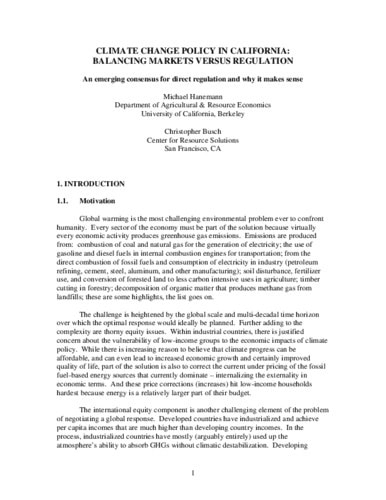
- Climate Change Policy In California: Balancing Markets Versus Regulation
- Author: Michael Hanemann, Christopher Busch
- Published: May 27th, 2009| Report | 26 Pages
- Report
- 2009
Climate policy in California has been at the forefront in the North American effort to fight global warming. California has been a leader in energy policy for decades. The paper explores the state’s energy policy over the past few decades, as well as the economic, psychological, and institutional factors that support the emerging best practice. …
- View
- Support Voluntary Purchases of Clean, Safe, 21st Century Energy With an Off-the-Top Rule Under Cap and Trade
- Author: Chris Busch
- Published: May 18th, 2009| Report | 2 Pages
- Report
- 2009
Without careful design, cap and trade could hinder the voluntary market for renewable energy. The voluntary market has played an important role in advancing clean energy development in large part because socially responsible organizations and individuals want to help fight global warming. Cap and trade should include an off-the-top rule to account for voluntary renewable …
- View
- Letter to CARB On Emissions Leakage Issues in a Cap-and-Trade Program
- Author: Chris Busch, James Fine, Kristin Grenfell, Ann Hancock, Bill Magavern, Danielle Osborn Mills, Erin Rogers
- Published: May 13th, 2009| Other | 2 Pages
- Other
- 2009
Letter commenting on issues relating to emissions leakage in a California cap-and-trade program. Minimizing the shifting of emissions out of California in a way that reduces the net decrease in global greenhouse gas emissions due to California’s programs is a statutory requirement of AB 32 and an important design objective in any cap-and-trade program. And …
- View
- REC Questions and Answers
- Author: CRS and ETNNA
- Published: May 5th, 2009| Report | 5 Pages
- Report
- 2009
An overview of common questions about renewable energy certificates (RECs).
- View
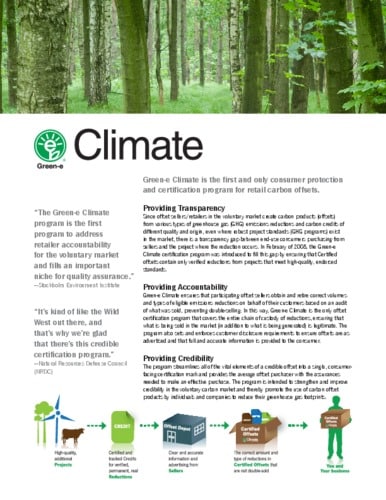
- About Green-e Climate
- Author: Center for Resource Solutions
- Published: April 21st, 2009| Other | 3 Pages
- Other
- 2009
This is a one-page description of Green-e Climate
- View
- Letter from the WeCAN Cap Setting and Allowance Distribution (CSAD) Committee on behalf of WeCAN
- Author: Chris Busch, Jessica Finn Coven, Barbara Haya, Chris Henschel, Erin Rogers, Derek Walker, Katy Yan
- Published: April 15th, 2009| Other | 3 Pages
- Other
- 2009
Comments, Questions, and Recommendations for the WCI CSAD committee on Data review and collection, Competitiveness Analysis, Offsets compliance limit, and Early Reduction Allowances.
- View
- CRS Comments to California Energy Commission (CEC) Regarding RPS Procurement. Docket 02-REN-1038 and 03-RPS-1078
- Author: Alex Pennock, Robin Quarrier
- Published: April 3rd, 2009| Other | 12 Pages
- Other
- 2009
California Energy Commission Staff Workshop on 2006 RPS Procurement Verification Data Review, Comments of CRS Regarding RPS Procurement; Attachment B: Questions Regarding Outstanding RPS Procurement Claims
- View
- Letter on Recognizing Voluntary Early Actions in Cap-and-Trade
- Author: Chris Busch, Bill Magavern, Bernadette Del Chiaro, Michelle Passero, James Fine, Shankar Prasad, Kristin Grenfell, Erin Rogers, Bonnie Holmes-Gen, Mike Sandler, Andy Katz, Scott Smithline
- Published: March 31st, 2009| Other | 2 Pages
- Other
- 2009
Commenting on issues relating to voluntary early emissions reductions in a California cap-and-trade program and CARB’s efforts in designing an effective cap-and-trade program as part of AB32. Recommending auction allowances to incentivize early action, carving out early action allowances from within the cap, maintaining distinction between capped sources and uncapped sources, ensuring reductions occur before …
- View
- Community Aggregation: Innovative Ways Communities Can Secure Their Energy Future
- Author: Andreas Karelas
- Published: March 27th, 2009| Other | 1 Pages
- Other
- 2009
Poster presentation for AWEA Windpower 2009 Conference by Andreas Karelas on community choice aggregation programs in Berkeley and Marin County
- View
- Letter to the House Energy and Commerce Committee
- Author: Arthur O'Donnell, Chris Busch
- Published: February 27th, 2009| Other | 2 Pages
- Other
- 2009
Urging the House Energy and Commerce Committee to include specific language that recognizes the ability of voluntary renewable energy purchases to produce reductions in addition to those directly required by a cap-and-trade program, such as an off-the-top provision.
- View
- Letter to the House Energy and Commerce Committee
- Author: Arthur O'Donnell, Chris Busch
- Published: February 27th, 2009| Other | 2 Pages
- Other
- 2009
Urging the House Energy and Commerce Committee to include specific language that recognizes the ability of voluntary renewable energy purchases to produce reductions in addition to those directly required by a cap-and-trade program, such as an off-the-top provision.
- View
- Letter to Senate Environment and Public Works Committee
- Author: Arthur O'Donnell, Chris Busch
- Published: February 27th, 2009| Other | 2 Pages
- Other
- 2009
Urging the Senate Environment and Public Works Committee to include specific language that recognizes the ability of voluntary renewable energy purchases to produce reductions in addition to those directly required by a cap-and-trade program (an off-the-top provision).
- View
- The Climate Registry: Electrical Power Sector Protocol Public Comment Draft
- Author: Jane Valentino
- Published: February 23rd, 2009| Other | 4 Pages
- Other
- 2009
Comments on the Climate Registry’s Electric Power Sector Protocol
- View
- Comments of the Center for Energy Efficiency and Renewable Technologies and the Center for Resource Solutions Regarding the Treatment of Renewable Energy within the Western Climate Initiative
- Author: Center for Energy Efficiency and Renewable Technologies and the Center for Resource Solutions
- Published: February 6th, 2009| Comment | 6 Pages
- Comment
- 2009
These are the submitted comments from the Center for Energy Efficiency and Renewable Technologies (CEERT) and the Center for Resource Solutions (CRS)on the treatment of RECs and null power (power generated at a renewable source that is no longer bundled with its RECs) within the Western Climate Initiative. The comments detail our organizations’ several key …
- View
- Utility Procurement Study: Solar Electricity in the Utility Market
- Author: Mike Taylor, Frederick Morse, Cynthia Hunt Jaehne, Mark McGree, Bud Beebe, Arthur O'Donnell, Ray Dracker, Andreas Karelas, Andrew Nourafshan
- Published: December 1st, 2008| Report | 17 Pages
- Report
- 2008
SEPA’s new report addresses utilities’ acquisition of large-scale solar, which currently occurs primarily through requests for proposals (RFPs) and subsequent power purchase agreement (PPA) contracts. This report draws best practices from both the utility and solar industries, and provides education and insights for both parties that can lower costs, improve expectations, and streamline efficiency. Additionally, …
- View
- Treatment of Environmental Attributes Across Tracking Systems
- Author: CRS and ETNNA
- Published: November 25th, 2008| Report | 14 Pages
- Report
- 2008
This paper is intended to provide guidance for tracking systems that would like to create uniformity in the treatment of environmental attributes associated with RECs in a manner that meets the needs of all state RPS programs and other compliance markets as well as the needs of the voluntary REC market. There are several opportunities …
- View
- Comments of Center for Resource Solutions on Commissioner Peevey’s Proposed Decision on Greenhouse Gas Regulatory Matters
- Author: Arthur O'Donnell
- Published: October 2nd, 2008| Other | 15 Pages
- Other
- 2008
Order Instituting Rulemaking to Implement the Commission’s Procurement Incentive Framework and to Examine the Integration of Greenhouse Gas Emissions Standards into Procurement Policies
- View
- CRS Comments on Climate Change Draft Scoping Plan
- Author: Arthur O'Donnell
- Published: August 1st, 2008| Comment | 3 Pages
- Comment
- 2008
These comments detail and explain several issues concerning the unintended impacts an emissions cap could have on the voluntary renewable energy market, as well as disincentives it could impose on energy efficiency efforts voluntarily undertaken by citizens and business. The comments additionally presents ideas on how some of these issues can be effectively addressed in …
- View
- Tracking Environmental Attributes: A Discussion Paper
- Author: CRS and ETNNA
- Published: April 14th, 2008| Document | 10 Pages
- Document
- 2008
The differences in renewable energy certificate (REC) definitions, information, and tracking capability are problematic for a liquid market, can create confusion, or possibly create opportunities for fraud. This paper focuses on the question of how RECs are defined by different tracking systems, and examines options for harmonizing RECs among tracking systems.
- View
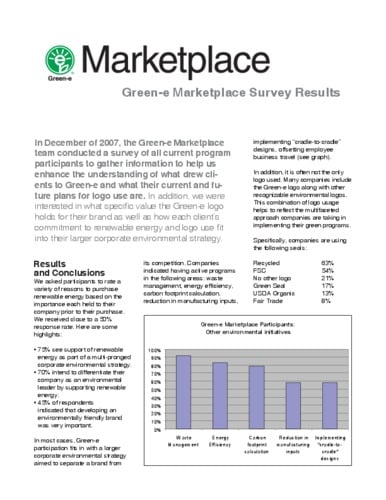
- Green-e Marketplace 2007 Survey Results
- Author: Green-e Marketplace
- Published: January 1st, 2008| Report | 6 Pages
- Report
- 2008
In December of 2007, the Green-e Marketplace team conducted a survey of all current program participants to gather information to help us enhance the understanding of what drew clients to Green-e and what their current and future plans for logo use are.
- View
- CRS Annual Report 2007
- Author: CRS Staff
- Published: December 31st, 2007| Document | 17 Pages
- Document
- 2007
The 2007 Annual Report for CRS highlights the organization’s efforts in advancing renewable energy and climate solutions. Key achievements include the development of the Green-e Climate program, state and federal policy advocacy, engagement in community initiatives, and public engagements.
- View
- A Review of the Potential International Trade Implications of Key Wind Power Industry Policies in China
- Author: Joanna I. Lewis
- Published: October 1st, 2007| Report | 13 Pages
- Report
- 2007
This paper reviews wind power industry policies in China, investigates how similar regulations in other industries have been treated under the policies of the WTO, and assesses the likely international trade implications of the aforementioned policies in the wind sector. It concludes with a brief discussion of whether ongoing and proposed Chinese government policies to …
- View
- A Comparison of Wind Power Industry Development Strategies in Spain, India and China
- Author: Joanna I. Lewis
- Published: July 19th, 2007| Report | 25 Pages
- Report
- 2007
Reviews the respective policy environments for wind energy in India, China, and Spain and how these policies have influenced the rise of a major domestic wind turbine manufacturer in each national context. Examines and compares the manner in which Suzlon, Goldwind and Gamesa became domestic leaders in their respective countries’ wind industries, with a focus …
- View
- Renewable Energy as a Hedge Against Fuel Price Fluctuation: How to Capture the Benefits
- Author: Dan Lieberman, Siobhan Doherty
- Published: June 1st, 2007| Report | 47 Pages
- Report
- 2007
This paper demonstrates the benefits of renewable energy as a hedge against electricity market fuel price fluctuation. It considers how regulators and electricity customers may address this opportunity either as a socialized cost/benefit scenario (by including renewable energy in the rate base), on an individual customer basis (through green pricing options that convey price stability …
- View
- Review of the Role of Renewable Energy in Global Energy Scenarios
- Author: Jan Hamrin, Holmes Hummel, Rachael Canapa
- Published: June 1st, 2007| Report | 91 Pages
- Report
- 2007
2007 report to the IEA, aiming to (1) explain why certain global energy scenarios contain larger shares of renewable energy than others; (2) identify key assumptions; and (3) recommend appropriate settings for assumptions critical to the role of renewable energy that might be used in future global energy scenarios.
- View
- Promoting Renewable Energy Sources in Portugal: Possible Implications for China
- Author: Katrin-Dorothee Heer, Ole Langniss
- Published: June 1st, 2007| Report | 25 Pages
- Report
- 2007
High-level overview of the implementation costs for four renewable energy policy tools: feed-in law, public benefits fund, renewable portfolio standard, and competitive tendering process. Provides an idea of the range of administrative costs that can be expected to implement each of these policies.
- View
- Executive Summary: The Potential for Energy Savings Certificates (ESC) as a Major Tool in Greenhouse Gas Reduction Programs
- Author: Jan Hamrin, Edward Vine, Amber Sharick
- Published: May 24th, 2007| Report | 8 Pages
- Report
- 2007
In existing cap-and-trade schemes, there is a need for effective energy efficiency measurement and verification programs, along with a credible tracking system that guards against double counting and identifies measures that meet “additionality” criteria. Energy savings certificates (ESCs), it is argued, may be the necessary tool to make this link. ESCs may be particularly useful …
- View
- The Potential for Energy Savings Certificates (ESC) as a Major Tool in Greenhouse Gas Reduction Programs
- Author: Dr. Jan Hamrin, Dr. Edward Vine, Amber Sharick
- Published: May 24th, 2007| Report | 109 Pages
- Report
- 2007
James Hansen, Director of the Goddard Institute on Space Studies and one of the foremost experts on climate change, has said that man has just 10 years to reduce greenhouse gas (GHG) emissions before global warming reaches what he calls a tipping point and becomes unstoppable.3 Energy efficiency is a critical means to meeting a …
- View
- Fostering Renewable Electricity Markets in North America (Executive Summary)
- Author: Meredith Wingate, Jan Hamrin, Lars Kvale
- Published: April 1st, 2007| Report | 20 Pages
- Report
- 2007
The paper provides an overview of the key market demand and supply-side drivers for renewable electricity in each of the three North American countries. It then identifies regulatory mandates, voluntary purchases, self-supply and financial incentives as the most important drivers of a renewable electricity market in North America today. The paper also explores the opportunities …
- View
- CRS Annual Report 2006
- Author: CRS Staff
- Published: December 31st, 2006| Document | 18 Pages
- Document
- 2006
The 2006 Annual Report for CRS highlights the implementation of renewable energy policy, consumer protection mechanisms, publications, and community initiatives.
- View
- The German 250-MW-Wind-Program
- Author: Ole Langniss
- Published: September 6th, 2006| Report | 5 Pages
- Report
- 2006
Historical overview of the German 250 MW Wind Program, perhaps the most significant effort of any country to support the piloting and demonstration of new wind turbines and wind turbine designs. The paper also details the criteria used in the grant application process and in the quota system meant to benefit domestic manufacturers. Emphasis is …
- View
- Best Practices for Transferring Certificates Across Tracking System Boundaries
- Author: CRS Staff
- Published: August 24th, 2006| Document | 23 Pages
- Document
- 2006
This document contains recommendations to enable, when and where desired, seamless certificate transfers between certificate tracking systems in North America. These recommendations were developed by the Center for Resource Solutions (CRS), in consultation with North American Association of Issuing Bodies (NAAIB) Working Group.
- View
- Recommended Common Practices for Treatment of Behind-the-Meter Generators in Certificate Tracking Systems
- Author: ETNNA Staff
- Published: August 16th, 2006| Document | 6 Pages
- Document
- 2006
This final consensus document was developed by the NAAIB Working Group of certificate-based tracking system operators and regulators under the auspices of NAAIB.
- View
- Double Counting Best Practices
- Author: CRS and ETNNA
- Published: May 5th, 2006| Document | 7 Pages
- Document
- 2006
This document contains recommendations for best practices for avoiding double counting of RECs. The final consensus document was developed by the North American Association of Issuing Bodies (NAAIB) Working Group. (Note: NAAIB became ETNNA)
- View
- Regulator’s Handbook on Renewable Energy Programs & Tariffs
- Author: Jan Hamrin, Dan Lieberman, Meredith Wingate
- Published: March 1st, 2006| Report | 76 Pages
- Report
- 2006
The Regulator’s Handbook on Renewable Energy Programs & Tariffs is a reference guide for regulators involved in the design of renewable energy programs. Written with a specific focus on tariff setting, it suggests best practices for designing renewable energy programs and highlights success stories in a series of case studies. This Handbook is divided into …
- View
- CRS Annual Report 2005
- Author: CRS Staff
- Published: December 31st, 2005| Document | 10 Pages
- Document
- 2005
The 2005 Annual Report for CRS highlights the organization’s public interest and technical assistance projects including the China Sustainable Energy Program, the creation of the National Green-e Standards, and policy assistance for implementing the California Renewable Portfolio Standard.
- View
- Achieving a 33% Renewable Energy Target
- Author: Jan Hamrin, Ray Dracker, Jennifer Martin, Ryan Wiser, Kevin Porter, David Clement, Mark Bolinger
- Published: November 1st, 2005| Report | 181 Pages
- Report
- 2005
The purpose of the report is to assess how to accelerate and expand the current CPUC Renewable Portfolio Standard (RPS) and related programs to achieve the Governor’s goal of meeting 33 percent of statewide electric power supply with renewable energy by 2020. This report identifies what the CPUC can do within the scope of its …
- View
- Lessons Learned for Integrating Renewables into Greenhouse Gas Trading Programs
- Author: Center for Resource Solutions
- Published: October 1st, 2005| Report | 21 Pages
- Report
- 2005
Reviews the Regional Greenhouse Gas Initiative (RGGI) process and outlines lessons learned for incorporating renewable energy and specifically the voluntary renewable energy market into greenhouse cap-and-trade regimes. Draws conclusions about greenhouse gas reduction efforts in general and key elements in their success or failure.
- View

- CRS Annual Report 2004
- Author: CRS Staff
- Published: August 17th, 2005| Report | 26 Pages
- Report
- 2005
This report contains the activities and financial reporting documents for 2004.
- View
- International Tax Incentives for Renewable Energy: Lessons for Public Policy
- Author: David Clement, Matthew Lehman, Jan Hamrin, Ryan Wiser
- Published: June 17th, 2005| Report | 27 Pages
- Report
- 2005
Discusses a variety of tax incentives introduced as policy tools in 29 countries and 35 US states, offering lessons based on international experience with these tax incentive programs. Prepared for the Energy Foundation China Sustainable Energy Program.
- View
- A Review of International Experience with Policies to Promote Wind Power Industry Development
- Author: Joanna Lewis, Ryan Wiser
- Published: March 10th, 2005| Report | 70 Pages
- Report
- 2005
Explores the motivations behind establishing a local wind power industry, and the paths that different countries have taken to develop indigenous large wind turbine manufacturing industries within their borders. Includes a series of detailed country case studies showing how 12 different countries have sought successfully or unsuccessfully to encourage local wind turbine manufacturing. Identifies lessons …
- View
- Renewable Energy Law The People’s Republic of China
- Author: Standing Committee of the 10th National People's Congress
- Published: February 28th, 2005| Other | 10 Pages
- Other
- 2005
Text of a 2005 Chinese act proposing “to promote the development and utilization of renewable energy, increase energy supply, improve the energy structure, safeguard energy security, protect the environment, and realize the sustainable development of the economy and society.”
- View
- Tradable Renewable Certificates and Emissions Values: The CRS Perspective on Best Practices in Marketing
- Author: Dan Lieberman
- Published: March 1st, 2004| Report | 6 Pages
- Report
- 2004
Brief on the issue of “disaggregated” Trade Renewable Certificates (TRCs) [also known as Renewable Energy Credits (RECs)]. Because there is both a TRC market and an emissions credit market, there emerges the possibility for confusion in the accounting of ultimate environmental benefit. TRCs that have had their discrete emisssions values separated and sold individually, the …
- View
- The Need For Green-e Certification And Verification In An Era Of Renewable Energy Tracking Systems
- Author: Dan Lieberman
- Published: March 1st, 2004| Report | 11 Pages
- Report
- 2004
The question has been raised about the need for Green-e certification and verification in regions where tracking systems are in place. Is Green-e still relevant in an era when each unit of renewable energy is identified and tracked from generation to retirement? This document provides a discussion of the comparative functions of tracking systems and …
- View
- CRS Annual Report 2002-2003
- Author: CRS Staff
- Published: December 31st, 2003| Document | 14 Pages
- Document
- 2003
The 2002–2003 Annual Report for CRS showcased the organization’s efforts in expanding the China Sustainable Energy Program, the Public Renewables Partnership/PIER project, and the Green-e certification program.
- View
- The Current Status of Renewable Energy Certificate Tracking Systems in North America
- Author: Meredith Wingate, Matthew Lehman
- Published: December 1st, 2003| Report | 17 Pages
- Report
- 2003
Discusses and compares the existing or proposed Renewable Energy Credits (REC) tracking systems in North America and introduces the North American Association of Issuing Bodies (NAAIB), an institution that will help network renewable certificate tracking bodies in North America.
- View
- Best Practices in Marketing Green Pricing Programs: A Resource Guide for Renewable Energy Marketers
- Author: Keri Bolding
- Published: November 1st, 2003| Other | 154 Pages
- Other
- 2003
A resource guide targeted to municipal utilities, to improve marketing decisionmaking, to educate staff as well as consumers on effective methods of communicating renewable energy messages visually and verbally, and to leverage municipal efforts to increase participation in green power programs.
- View
- International Experience with Public Benefits Funds: A Focus on Renewable Energy and Energy Efficiency
- Author: Ryan Wiser, Catherine Murray, Jan Hamrin, Rick Weston
- Published: October 16th, 2003| Report | 100 Pages
- Report
- 2003
Summarizes international experience with Public Benefit Fund (PBF) policies that target renewable energy (RE) and energy efficiency (EE) investments, and identifies lessons learned from these experiences that are applicable to the Chinese context.
- View
- North American Association of Issuing Bodies Conceptual Model
- Author: Center for Resource Solutions
- Published: September 1st, 2003| Report | 3 Pages
- Report
- 2003
Proposes the formation of an organization for the central tracking of renewables certificates in North America, and makes recommendations for the structure and responsibilities of such a body. The overarching goal of such an organization will be to facilitate the creation of the minimum standards and protocols that ensure compatibility between systems issuing and tracking …
- View
- The Potential for Using a Renewable Certificate System to Encourage Renewable Energy Development in Mexico
- Author: Jan Hamrin, Meredith Wingate, Laura Campbell
- Published: June 15th, 2003| Report | 78 Pages
- Report
- 2003
Report to the North American Fund for Environmental Cooperation, examining the technical, legal and economic issues involved in developing a North American market for tradable renewable energy certificates (TRCs) from Mexico. Assesses both the feasibility of using TRCs to encourage the development of renewable energy in Mexico, and the challenges and opportunities associated with building …
- View
- Regulator’s Handbook on Tradable Renewable Certificates
- Author: Jan Hamrin, Meredith Wingate
- Published: June 1st, 2003| Report | 135 Pages
- Report
- 2003
As markets for green power develop, regulators must ensure that these markets function in an effective manner. Consumers must have confidence in the integrity of the product claims. Developers and purchasers of renewable resources must have a platform for transparent and fluid transactions. This Handbook will facilitate the development of these markets. This Handbook provides …
- View
- Green Pricing at Public Utilities: A How-to Guide Based on Lessons Learned to Date
- Author: Dan Lieberman
- Published: October 1st, 2002| Report | 49 Pages
- Report
- 2002
Based on based on a survey of green pricing program managers at public utilities combined with advice from leading renewable energy experts on green pricing best practices, this Public Renewables Partnership (PRP) report offers a public utilities background on lessons learned from public utilities that have implemented green pricing programs and offers recommendations to consider …
- View
- Renewable Energy Policy Options for China: A Comparison of Renewable Portfolio Standards, Feed-in Tariffs, and Tendering Policies
- Author: Ryan Wiser, Jan Hamrin, Meredith Wingate
- Published: June 1st, 2002| Report | 16 Pages
- Report
- 2002
Reviews US and EU experiences with feed-in policies, tendering, and renewable portfolio standards, and compares the relative merits and disadvantages of each approach both generically and for application in China.
- View
- Project Development and Public Policies: Feed-in Tariffs, Green Pricing, PBF, RPS
- Author: Center for Resource Solutions
- Published: June 1st, 2002| Report | 11 Pages
- Report
- 2002
Identifies the most common elements of renewable energy (RE) project development and how they have been applied with various types of policy approaches, and points out the critical factors affecting their use. Discussion limited to larger (1 MW), grid-connected facilities.
- View
- Developing a Framework for Tradable Renewable Certificates
- Author: Jan Hamrin, Meredith Wingate
- Published: May 19th, 2002| Report | 70 Pages
- Report
- 2002
Investigates the potential for coordination between existing voluntary and mandatory tracking and verification regimes for tradable renewable certificates (TRCs) in the US. Provide recommendations for the development of a national network to track and verify certificates, with the underlying assumption that the development of a coordinated US network for tracking and verifying TRCs will build …
- View
- Recommendations for the Development of an American Certificate Tracking and Verification Network
- Author: Jan Hamrin, Meredith Wingate
- Published: May 13th, 2002| Report | 13 Pages
- Report
- 2002
This paper recommends establishing a similar association in the US that will facilitate coordination between existing issuing and tracking systems. It also includes recommendations for establishing issuing and tracking systems for generators that fall outside of existing tracking regime boundaries.
- View
- Certification Of Off-Grid Renewable Energy Systems
- Author: JP Ross
- Published: September 29th, 2001| Report | 8 Pages
- Report
- 2001
The rate of dissemination of off-grid renewable energy technologies is greatly dependent on the satisfaction of end-users and therefore the quality of past installations. Many systems currently installed are not functioning at the promised levels. One of the main causes of sub-optimal system performance is the use of poorly made components and a lack of …
- View
- Non-Grid Renewable Energy Policies: International Case Studies
- Author: JP Ross
- Published: August 16th, 2001| Report | 15 Pages
- Report
- 2001
Governmental support is one of the main drivers of renewable energy dissemination throughout the world. Subsidies, import tariffs, quality enforcement programs, and governmental provision of financial intermediaries can all play a role in expanding the market for off-grid renewable energy services. This memorandum outlines actions a government can take to stimulate the growth of renewable …
- View
- Financing Off-Grid PV
- Author: JP Ross
- Published: July 12th, 2001| Report | 6 Pages
- Report
- 2001
There are many barriers to the widespread diffusion of renewable energy technologies in the rural environment. One of the main barriers is financial, as many rural families have little expendable capital and lack access to credit. This memorandum outlines schemes that have been utilized to finance solar photovoltaic projects.
- View
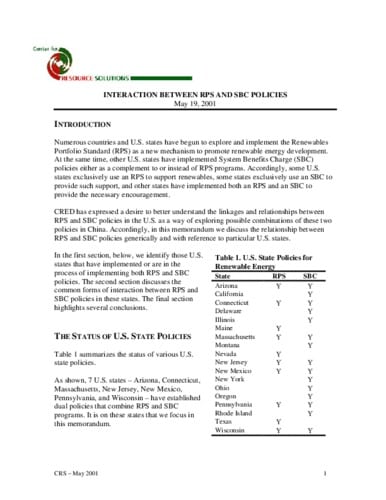
- Interaction Between RPS and SBC Policies
- Author: Center for Resource Solutions
- Published: May 19th, 2001| Report | 5 Pages
- Report
- 2001
Discusses the linkages and relationships between Renewables Portfolio Standard (RPS) and Systems Benefit Charge (SBC) policies in place in particular US states, to explore possible combinations of these two policies in China.
- View
- Capacity and Energy Based RPS Policies
- Author: Center for Resource Solutions
- Published: May 19th, 2001| Report | 4 Pages
- Report
- 2001
Reviews the relative merits and disadvantages of various ways to apply an RPS to affected electricity suppliers, with particular emphasis on the complexities of applying a capacity-based renewable energy purchase obligation. Includes a review of the Texas experience with this approach.
- View

- MonsterOptIn Test Document Popup
- Author: Slack
- Published: January 1st, 2001| Report | 22 Pages
- Report
- 2001
In a 4-minute video taped last week and posted to social media Monday, Cline, an actress, influencer and a native of Goose Creek, South Carolina, interviews Harris about the importance of the youth vote. It’s a sign the Biden campaign is working to find new strategies to reach the young Americans critical to its 2024 …
- View
- CRS Annual Report 2000
- Author: CRS Staff
- Published: December 31st, 2000| Document | 11 Pages
- Document
- 2000
The 2000 Annual Report for CRS showcases key achievements such as the implementation of regional criteria for the Green-e program, utility program accreditation by the Green Pricing Program, the launch of a stakeholder process for tradable renewable certificates, and technical assistance projects in China, Mexico, and Morocco.
- View
- RPS Case Study: Texas
- Author: Center for Resource Solutions
- Published: May 1st, 2000| Report | 34 Pages
- Report
- 2000
Detailed study of the motivation, design, implementation and progress of the 1999 Texas electricity restructuring legislation, a bill containing some of the most aggressive Renewables Portfolio Standard (RPS) policies yet implemented in the US.
- View
- Designing a Renewables Portfolio Standard: Principles, Design Options, and Implications for China
- Author: Jan Hamrin, Ryan Wiser, Seth Baruch
- Published: January 1st, 2000| Report | 21 Pages
- Report
- 2000
Details Renewables Portfolio Standard (RPS) design principles that ensure an effective and low-cost RPS, recounts lessons learned from specific case studies, and summarizes the advantages and disadvantages of taking certain paths, with recommendations for a proposed RPS approach in the Chinese context.
- View
- CRS Annual Report 1999
- Author: CRS Staff
- Published: December 31st, 1999| Document | 10 Pages
- Document
- 1999
The 1999 Annual Report for CRS summarizes the organization’s key achievements, such as the second full year of the Green-e program, the formation of the oversight board for the Green Pricing program, the launch of the Green-e Plus program, the Nature Conservancy Project, and policy initiatives in China.
- View
- CRS Annual Report 1998
- Author: CRS Staff
- Published: December 31st, 1998| Document | 10 Pages
- Document
- 1998
The 1998 Annual Report for CRS highlights the administration of domestic programs such as Green-e, Green Pricing, Demonstration Center, Low-Impact Hydro Institute, and international programs such as the Global Guardianship Initiative.
- View
- Hourly Clean Energy Utility Product Designs: Nine Product Model Examples
- Author: CRS Staff
- Published: June 11th, 2026| Document | 27 Pages
CRS’s Clean Energy Accounting Project (CEAP)’s Hourly Clean Energy Utility Product Designs: Nine Product Model Examples helps vertically integrated utilities in the United States design credible, customer-focused hourly clean electricity products. The guidance includes nine of the most practical Product Model options organized by complexity and risk to the utility, equipping utilities to offer a …
- View
- Rethinking the Impact of Renewable Energy Certificates
- Author: CRS Staff
- Published: May 12th, 2026| Report | 6 Pages
A summary of CRS’s recent webinar, Rethinking the Impact of RECs – Developer Perspectives. The webinar brought together new academic research and real-world developer perspectives to explore a key question in clean energy markets: Do voluntary RECs meaningfully drive new renewable energy development? The discussion challenged overly simplistic narratives about REC impact and highlighted the …
- View
- Best Practices for Power Source & Emissions Disclosure
- Author: CRS Staff
- Published: March 31st, 2026| Document | 27 Pages
Clear power source disclosure helps customers understand what electricity they are buying and the emissions associated with it. CEAP’s new Best Practices for Power Source and Emissions Disclosure offers a practical U.S. framework for more accurate, transparent, and comparable electricity disclosures. The guidance recommends product-specific disclosure; accounting based on delivered attributes rather than utility-wide averages; …
- View
- Preserving the Emissions Impact of Voluntary Renewable Electricity under the Cap-and-Invest Program
- Author: CRS Staff
- Published: March 9th, 2026| Comment | 1 Pages
This letter urges the California Air Resources Board (CARB) to amend proposed cap-and-trade rules. Without changes, voluntary renewable energy purchases will no longer reduce overall emissions. The signatories recommend a small, limited allowance set-aside (5.5 million credits through 2030) to preserve the environmental integrity and credibility of voluntary green power investments.
- View
- Comments of CRS on Proposed Amendments to the Regulation for the California Cap on Greenhouse Gas Emissions and Market Based Compliance Mechanisms
- Author: CRS Staff
- Published: March 9th, 2026| Comment | 5 Pages
Center for Resource Solutions (CRS) urges the California Air Resources Board (CARB) to restore the Voluntary Renewable Electricity Program (VREP) by setting aside 5.5 million allowances for 2025–2030. Without this, voluntary renewable energy purchases will no longer reduce overall emissions under the cap, undermining their integrity. This limited, cost-controlled set-aside preserves environmental impact without harming …
- View
- Developer Insights on Financial Modeling to Describe Renewable Energy Certificate Impacts
- Author: Eric O'Shaughnessy
- Published: February 5th, 2026| Report | 7 Pages
This report by Eric O’Shaughnessy, Ph.D. is the result of a series of interviews in 2023 of renewable energy market stakeholders and follow-up interviews in 2024 with four large renewable energy developers about the financial impact of renewable energy certificates (RECs) on project development. The interviews highlighted that common financial models underestimate how RECs influence …
- View
- CRS Responds to the Greenhouse Gas Protocol’s Electricity-Sector Consequential Methods Public Consultation
- Author: CRS Staff
- Published: January 20th, 2026| Comment | 8 Pages
This document reproduces Center for Resource Solutions’ (CRS’s) responses to the Greenhouse Gas Protocol’s Electricity-Sector Consequential Methods Public Consultation in January 2026. The survey sought feedback on consequential accounting methods for estimating avoided emissions from electricity-sector actions, which will feed into work in the Actions and Market Instruments (AMI) workstream. The responses presented here reflect …
- View
- CRS Responds to the Greenhouse Gas Protocol’s First Scope 2 Public Consultation Survey
- Author: CRS Staff
- Published: January 20th, 2026| Comment | 44 Pages
This document reproduces Center for Resource Solutions’ (CRS’s) responses to the Greenhouse Gas Protocol’s first Scope 2 Public Consultation Survey in January 2026. The survey sought stakeholder input on proposed updates and clarifications to the Scope 2 Guidance (2015), which addresses the accounting and reporting of greenhouse gas (GHG) emissions from purchased or acquired electricity, …
- View
- CRS Comments on the draft Advanced and Indirect Mitigation Platform Electricity Annex
- Author: CRS Staff
- Published: December 4th, 2025| Comment | 4 Pages
CRS welcomes the AIM Electricity Annex and supports its goal of providing electricity-specific guidance for Scope 3 interventions, while recommending targeted revisions to improve clarity, consistency, and guardrails. The comments ask AIM to strengthen electricity-sector direction on additionality; clearly define key regional terms such as “market boundary” and “electricity sourcing or use region” in line …
- View
- CRS Comments in Response to the Advanced and Indirect Mitigation (AIM) Platform, Intervention Quality, Accounting, and Reporting (QAR) Standard
- Author: CRS Staff
- Published: November 24th, 2025| Comment | 9 Pages
The Advanced and Indirect Mitigation (AIM) Platform, convened by C2ES, Green Market Activation (GMA), and Gold Standard, has put out its Intervention Quality, Accounting, and Reporting (QAR) Standard for public consultation. CRS’s comments center around four key factors: Some requirements do not align with how certain market-based instruments (e.g. EACs) operate in practice. Key terms …
- View